


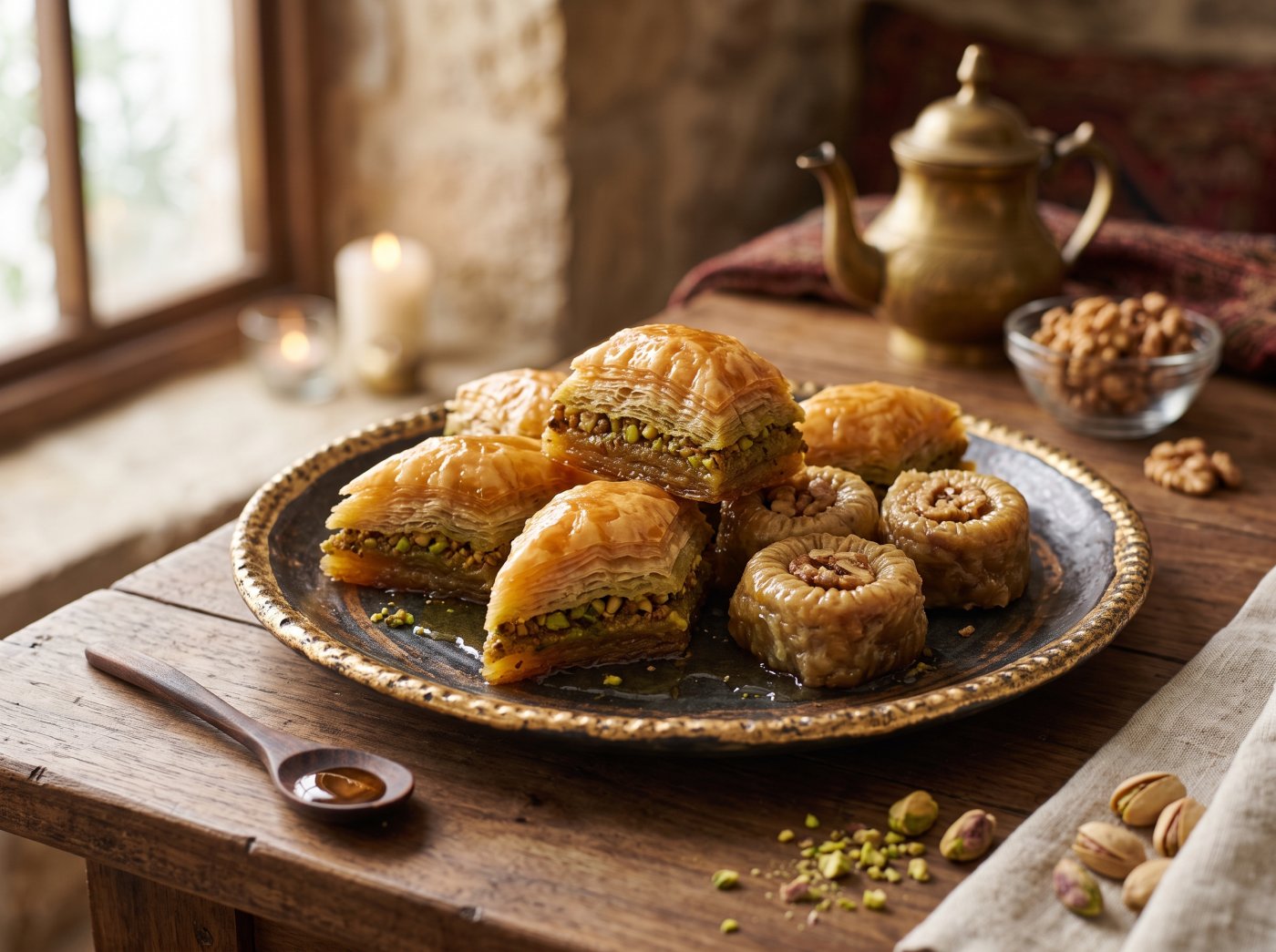
In baklava, the term "first class" is not an official grade; it is a distinction the trade drew for itself. Even so it is not arbitrary. Four variables decide which class a baklava belongs to, and every one of them can be checked by eye at the counter.
Why is filo thinness the first criterion?
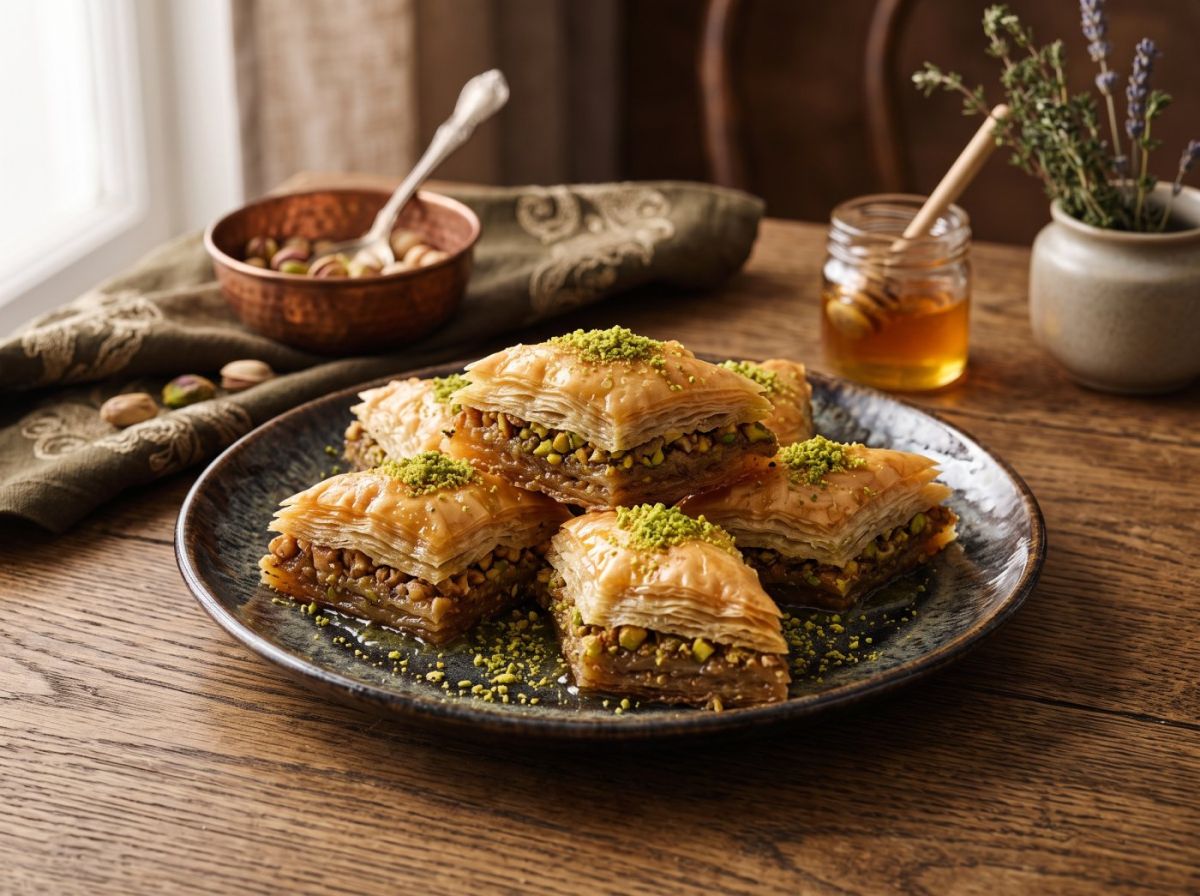
Baklava quality is measured first by how many layers of pastry it contains. Standard production gives between thirty and forty layers per tray; premium production exceeds forty-five. More layers means each sheet has been stretched thinner.
Thin filo has two consequences. The first concerns texture: thin layers dry separately in the oven and give a crispness that shatters like sand under the bite. Thick filo stays doughy and absorbs too much syrup.
The second concerns labour. Filo cannot be stretched this thin by machine; it is done by hand and takes time. Much of the price difference originates here.
Counting the layers in cross-section is the most direct way to read quality. If the layers separate and can be counted by eye, the workmanship is good. If they have fused into a single mass, either the filo was rolled thick or too much syrup was used.
What should the nut ratio be?
The second criterion is the filling's share by weight. In standard baklava the pistachio ratio sits around fifteen per cent; in the premium segment it rises to twenty-five, and in some special production to thirty.
The way to estimate this by eye is to look at the cross-section. If the layer of nuts approaches a third of the total height, the ratio is high. If it appears as a thin line, it is standard production.
The nut itself is a separate variable. Large, deep-green pistachios cost more than small, pale ones and give a more concentrated aroma. Artificial colour is easy to spot: in natural pistachio the shade of green varies from slice to slice, while a uniform bright green invites suspicion.
Which fat is being used?
Traditional baklava uses clarified butter. Because its water and milk protein have been removed, clarified butter has a high smoke point and stays between the layers without evaporating; this is what keeps the layers apart.
Baklava made with margarine or vegetable oil costs less to produce, but two differences emerge. The first is flavour: the background note clarified butter leaves cannot be reproduced with another fat. The second is the texture once cooled; vegetable fats solidify at room temperature and sit heavily on the palate, whereas clarified butter melts near body temperature and dissolves in the mouth.
The practical way to tell is to taste the baklava after it has cooled. If a film remains coating the palate, the fat was not clarified butter.
How is the syrup balanced?
The syrup's job is not to sweeten but to bind the layers together. Too much soaks the filo and destroys the crispness; too little leaves the baklava dry and loose.
The plate is the indicator of correct balance. If syrup pools on the plate when a piece is lifted, there is too much. If the piece leaves no trace at all, there is too little. Correctly made baklava leaves a thin, glossy mark.
Syrup temperature is part of the technique too. Cold syrup goes onto hot baklava, or hot syrup onto cold baklava; having both hot collapses the layers.
How does the difference look in a table?
| Criterion | Standard production | First-class production |
|---|---|---|
| Filo layers | 30-40 | 45 and above |
| Nut ratio | 12-16% | 22-30% |
| Fat | Blend or vegetable | Clarified butter |
| Nut size | Small, broken | Large, near whole |
| Layers in section | Partly fused | Individually countable |
| Shelf life | Longer | Shorter; eaten fresh |
The last row is often overlooked. Better baklava stales faster, because it contains no preservatives and clarified butter is more open to oxidation. A long shelf life is not always a positive sign.
Why are pistachio and walnut baklava priced differently?
The difference comes entirely from raw material cost. Pistachio costs many times more per unit weight than walnut; the tree's biennial bearing habit and a harvest that has to be sorted by hand keep that gap permanent.
Technically the two fillings also behave differently. Pistachio releases less oil and stays dry between the layers, which preserves crispness. Walnut is oilier and gradually passes its oil into the pastry, so walnut baklava takes on a slightly softer texture and stales sooner.
They differ in taste as well. Pistachio leaves a sweetish, gentle aroma; walnut gives a faintly bitter background note that balances the sweetness of the syrup. For this reason the syrup for walnut baklava is usually kept a little heavier.
Why is home-style baklava a separate category?
Home-style baklava deliberately keeps the layer count low. The sheets are rolled thicker, the number of layers drops, and the result is a doughier, more filling dessert.
This is not lower quality but a different intention. In home-style baklava the aim is density rather than crispness; it is usually made with walnut and carries a heavier syrup. Judging the two by the same criteria would be a mistake.
Does freezing cost baklava its quality?
Baklava frozen after baking suffers no marked loss when thawed correctly. In syrup-soaked desserts the water is largely bound within the sugar, and large ice crystals do not form during freezing; that is the mechanism which tears layers apart, and it does not come into play here.
Losses usually happen during thawing. Baklava thawed slowly in the refrigerator keeps its texture. Left directly at room temperature, condensation forms on the surface and softens the top layer.
To restore crispness, warm the baklava for five or six minutes at 150 °C. That is enough to drive off surface moisture; longer boils the syrup and collapses the layers.
What should you look for when buying?
- Cross-section: can the layers be counted, and how thick is the nut layer?
- Colour: the top should be golden; dark brown means overbaked, pale yellow underbaked.
- Sound: touched with tongs, it should give a faint crackle.
- Plate mark: pooled syrup is a sign of excess.
- Smell: the scent of clarified butter should be evident; a sour note means the fat has gone stale.
These five checks tell you most of what there is to know about a baklava before tasting it.
