


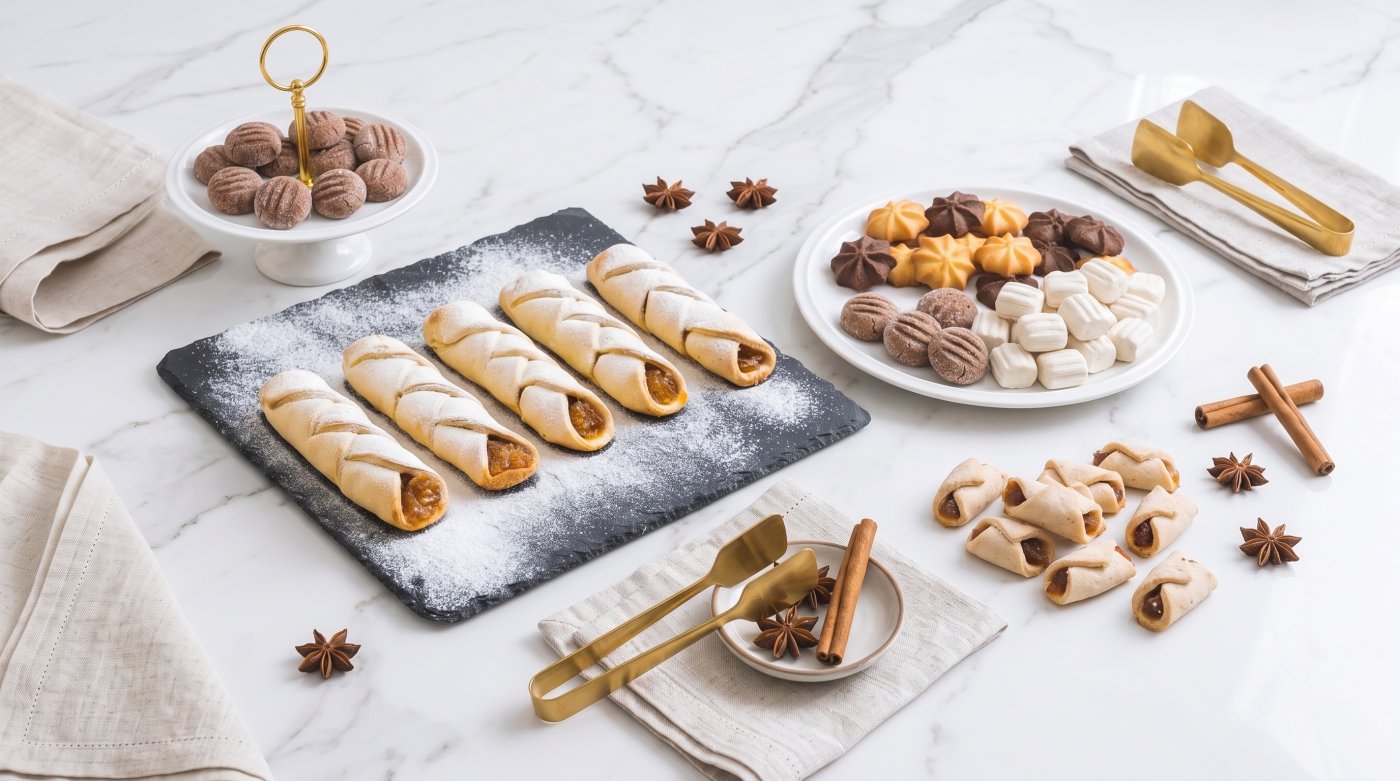
The first reflex on bringing baklava home is to put it in the fridge. That decision damages the product rather than protecting it, and it works through two separate mechanisms.
What does the fridge do to the butter?
What separates the layers in baklava and gives it its texture is butter.
The melting range of butter sits at 32 to 35 degrees Celsius.
A fridge runs at four degrees; at that temperature butter is entirely solid.
Solidified butter forms a hard layer between the pastry sheets.
The result is a texture that is hard to chew and does not break down.
Baklava taken out of the fridge partly recovers as it reaches room temperature, but it does not fully return to its previous state.
Because a second mechanism is also at work.
What happens to the syrup?
The sugar in the syrup exists as a saturated solution.
As the temperature falls, the capacity of water to hold sugar decreases.
Excess sugar leaves the solution and begins forming crystals.
Those crystals appear on the surface and between the layers.
The baklava takes on a gritty texture and the sweetness feels rough.
Crystallisation is not a reversible process; the crystals do not fully redissolve when the temperature rises.
In baklava left in a fridge both mechanisms work together and the product deteriorates markedly.
| Temperature | Butter | Syrup | Result |
|---|---|---|---|
| 4 °C | Fully solid | Crystallises | Hard, gritty |
| 12-16 °C | Semi-solid | Stable | Acceptable |
| 20-24 °C | Soft | Stable | Ideal |
| Above 28 °C | Runny | Stable | Fat runs |
How should it be stored at room temperature?
The correct condition is room temperature in a covered container.
The temperature range is 18 to 24 degrees.
In that range the butter stays soft and the syrup stable.
The container should be covered but need not be airtight; baklava should be able to breathe.
The tray can be covered, or the product moved to a wide container.
Choose a place out of direct sun; light and heat accelerate oxidation of the butter.
Near the hob in a kitchen is unsuitable; the temperature fluctuates there.
If summer temperatures rise above 28 degrees, a cool room or pantry should be used.
What does the container change?
The wrong container damages the product even at the right temperature.
An airtight plastic container traps moisture; the baklava softens and the layers merge.
Leaving it fully open is a problem too; the product dries and the surface hardens.
The best answer is covered but not sealed: a box whose lid does not close fully, or a tray lightly covered.
A cardboard box works well; it passes moisture while reducing the risk of dust and drying.
Cling film should not touch the product directly; syrup sticks to it and the surface tears when a piece is lifted.
The depth of the container matters too. Stacked pieces crush those beneath; a single layer is ideal.
Different desserts should not share a container; products with clotted cream release moisture and soften dry ones.
What are the storage times by product?
Shelf life varies markedly within the baklava family.
Dry baklava — with pistachio or walnut, no cream — keeps seven to ten days at room temperature.
Sarı burma and similar dry products fall in the same range.
Şöbiyet, containing clotted cream, drops to two or three days and refrigeration becomes mandatory.
Baklava with clotted cream belongs in the same group.
Milk-based and cold baklava require refrigeration; two to three days.
The distinguishing question is this: does the product contain dairy?
If it does, refrigeration is mandatory and the window short; if not, room temperature is correct and the window long.
Is freezing right?
For long storage freezing is the best method, with conditions.
Baklava without syrup can be frozen and gives a good result.
Baked but unsyruped baklava keeps three months.
On the day of use it is warmed in the oven and syruped; the result is very close to fresh.
Syruped baklava can be frozen too, but the result is weaker.
On thawing the syrup releases water and the layers go soggy.
If that method is used the product should be portioned before freezing and thawed slowly in a fridge.
Products with clotted cream are not suited to freezing; the cream separates on thawing.
After thawing the product should come to room temperature; baklava served cold feels hard.
Can stale baklava be refreshed?
It can be refreshed partly, and the method is simple.
Baklava is warmed at 150 degrees for five to eight minutes.
That melts the butter and separates the layers again.
The surface regains some crispness too.
But where the syrup has crystallised the method does not fully correct it; the gritty texture remains.
A microwave should not be used; the syrup boils locally and the product turns doughy.
After warming the product should rest a few minutes; hot baklava falls apart.
The method can be applied once; repeated warming dries the product out.
What to watch when transporting it
Baklava travels often as a gift, and transport conditions affect it.
The tray should be kept level; on a tilted tray the syrup runs to one side.
It should not sit anywhere warm in a car; in summer a boot reaches forty degrees and the butter runs.
In an air-conditioned car the front passenger footwell is the most suitable place.
Over long distances a cool bag can be used, but the ice pack should not touch the product; localised cooling causes crystallisation.
On arrival the product should come out of the box immediately; moisture building up in a closed box softens the layers.
For products with clotted cream the journey should be limited to an hour and a cool bag is mandatory.
How should it be displayed in a shop?
Displaying baklava in a business is an extension of the storage rules.
The display should be at room temperature; a refrigerated case is the wrong choice for dry baklava.
The tray belongs in an enclosed case; on an open counter the product dries and collects dust.
Pieces should sit in a single layer with space between them; stacked pieces are crushed.
Products with clotted cream or milk belong in a separate refrigerated section and should be labelled.
Syrup collecting at the edge of the tray should be removed regularly; it over-soaks the pieces at the edge.
Pieces unsold during the day should move into a separate container and go to the front the next day; first-in-first-out applies to desserts too.
