


In Türkiye the word börek describes not a single product but a family of methods. The common ground is pastry meeting filling; the distinctions emerge from how the two are brought together. When the shape changes, so does the baking time, the ratio of crust, and the way it is served.
Why does shape matter so much?
What determines the texture of a börek is the ratio of the pastry's total surface area to the filling. Thin dough folded many times has a large surface area; in the oven each of those surfaces dries separately and crispness increases. Thick dough with few folds has little surface, the interior stays moist and the texture softens.
The second factor is the distance heat has to travel to the centre. The centre of a thin roll sits close to the surface and cooks quickly. In a thick tray börek the centre is far away; cooking it through without over-browning the outside means lowering the temperature and extending the time.
These two variables explain why every type of börek calls for different baking instructions. Even working with the same filling and the same pastry, a change of shape forces a change of oven setting.
What is rolled börek?
Rolled börek is made by cutting the pastry into a long strip, lining the filling along one edge and rolling it up tightly. The result is a single-portion product shaped like a baton.
Its greatest strength is portion control. Because every piece weighs the same, costing is straightforward for businesses and the plate looks orderly. Baking time is short; its thin structure finishes in roughly twenty minutes.
Its weakness is the filling ratio. Because the roll is tight, only so much filling fits inside, which makes rolled börek a pastry-dominant product. If a high filling ratio is wanted, another shape suits better.
Why is rose börek coiled?
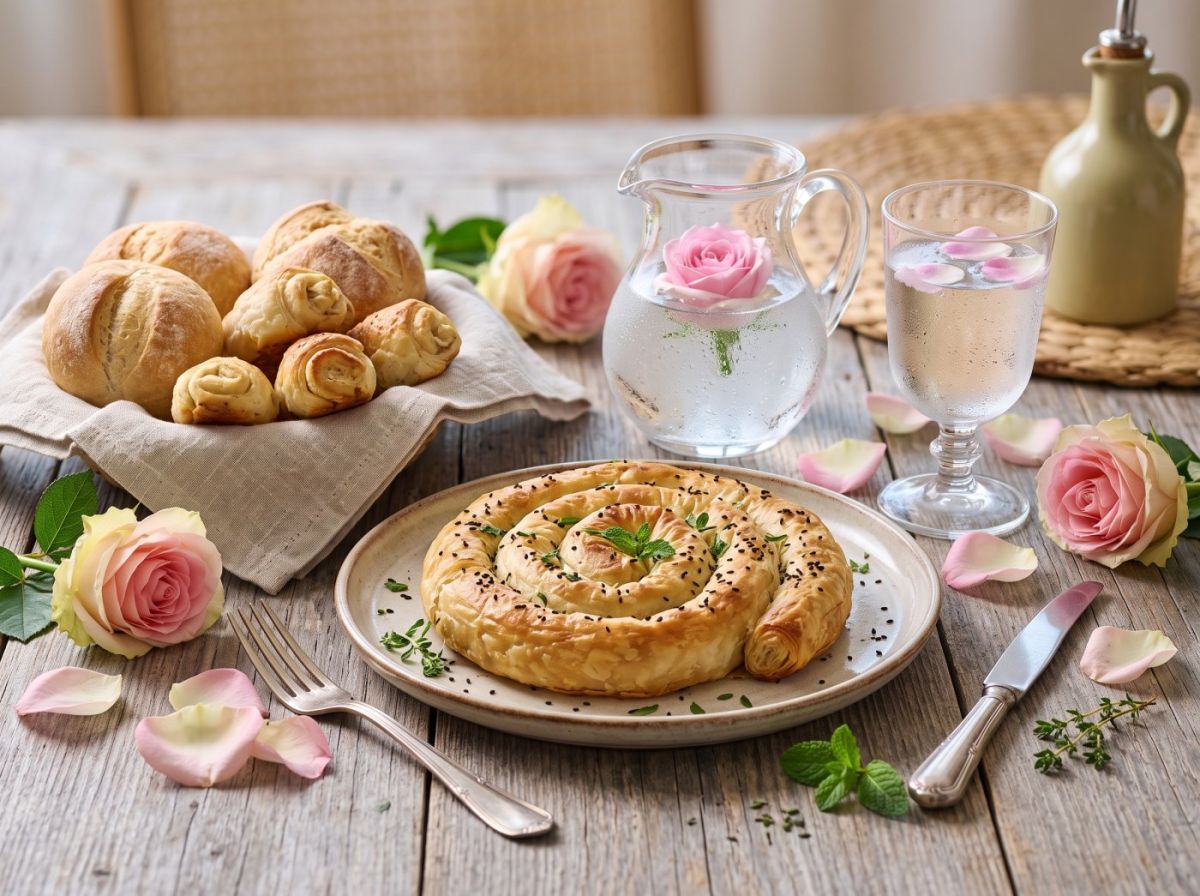
Rose börek also begins with pastry rolled into a strip, but that roll is not left straight; it is turned around itself into a spiral disc. The resulting shape resembles the flower it is named after.
The coil does two things. First, it packs more layers of pastry into the same volume; the layer count visible in cross-section exceeds that of a rolled börek, and that produces a crisper crust.
Second, it creates height on the plate. Rose börek has volume and looks fuller than a flat roll on a platter, which is why it is often chosen for receptions and meetings.
Why is water börek its own category?
Water börek takes its name from a step in its preparation: the sheets are boiled in water before being layered into the tray. No other börek type includes this step.
Boiling gelatinises the starch in the pastry and gives the dough its characteristic soft, faintly tacky texture. In the oven only the topmost layer dries and crisps; every layer beneath stays soft. This is why water börek feels entirely unlike the others.
It is also the most laborious. The sheets are boiled one by one, transferred to cold water and laid carefully into the tray; they tear very easily. For this reason water börek is rarely made at home but widely supplied as a par-baked frozen product.
What need does Bosnian börek meet?
Bosnian börek is made by laying a long roll into a tray as a spiral, and it is usually produced in large trays approaching two kilograms. It is not a single portion but something cut and shared.
That structure suits crowded tables, buffets and catering operations. The number of slices from one tray can be set to the requirement; the same product yields anything from small canapé pieces to full main-course portions.
In exchange, preparation and baking take longer. Heat needs time to reach the centre of a large tray, and cooking the base through requires deliberate shelf positioning.
How do the four compare?
| Property | Rolled | Rose | Water | Bosnian |
|---|---|---|---|---|
| Portion | Single | Single | Sliced | Sliced |
| Layers in section | Few | Medium | Many, soft | Many, crisp |
| Filling ratio | Low | Medium | High | High |
| Baking time | 20-25 min | 25-30 min | 35-45 min | 45-60 min |
| Texture | Crisp shell | Crisp, voluminous | Soft, moist | Crisp top, soft base |
| Best use | Breakfast, canteen | Receptions | Alongside mains | Shared tables |
The striking point in the table is that filling ratio and baking time rise together. More filling means more water to evaporate inside, and the time extends.
Which filling suits which shape?
Dry fillings work with every shape. Cheese and minced meat cause no trouble in any of the four. With fillings that release water, shape starts to matter.
Spinach filling risks soaking the pastry in the slender rolled and rose forms, so it has to be squeezed thoroughly. The same filling is more forgiving in a thick, many-layered Bosnian börek, because there are layers to absorb the excess moisture.
Potato filling behaves the opposite way. Being dry, it can leave thick böreks too dry inside, while giving a balanced result in thin rolls.
Raw frozen or par-baked frozen?
Raw frozen börek is shaped and blast-frozen without baking. It delivers the freshness of something just out of the oven and fills the premises with its own baking aroma. In return it requires oven capacity and baking time.
Par-baked frozen börek is baked at the factory and then frozen. Because it only needs reheating, service time drops sharply; for businesses with limited oven capacity it is the only workable solution.
The choice follows the operation's bottleneck. If the oven has a queue during the morning rush, par-baked works better; if demand is steady through the day, raw frozen gives the better result.
How is börek served and stored?
Börek should rest for ten minutes after leaving the oven; cut before the steam disperses, the filling runs and the layers stick together.
Leftovers keep for a day at room temperature and three days refrigerated. Reheating calls for an oven or air fryer. A microwave traps steam inside the pastry; the börek softens and never regains its crispness.
