


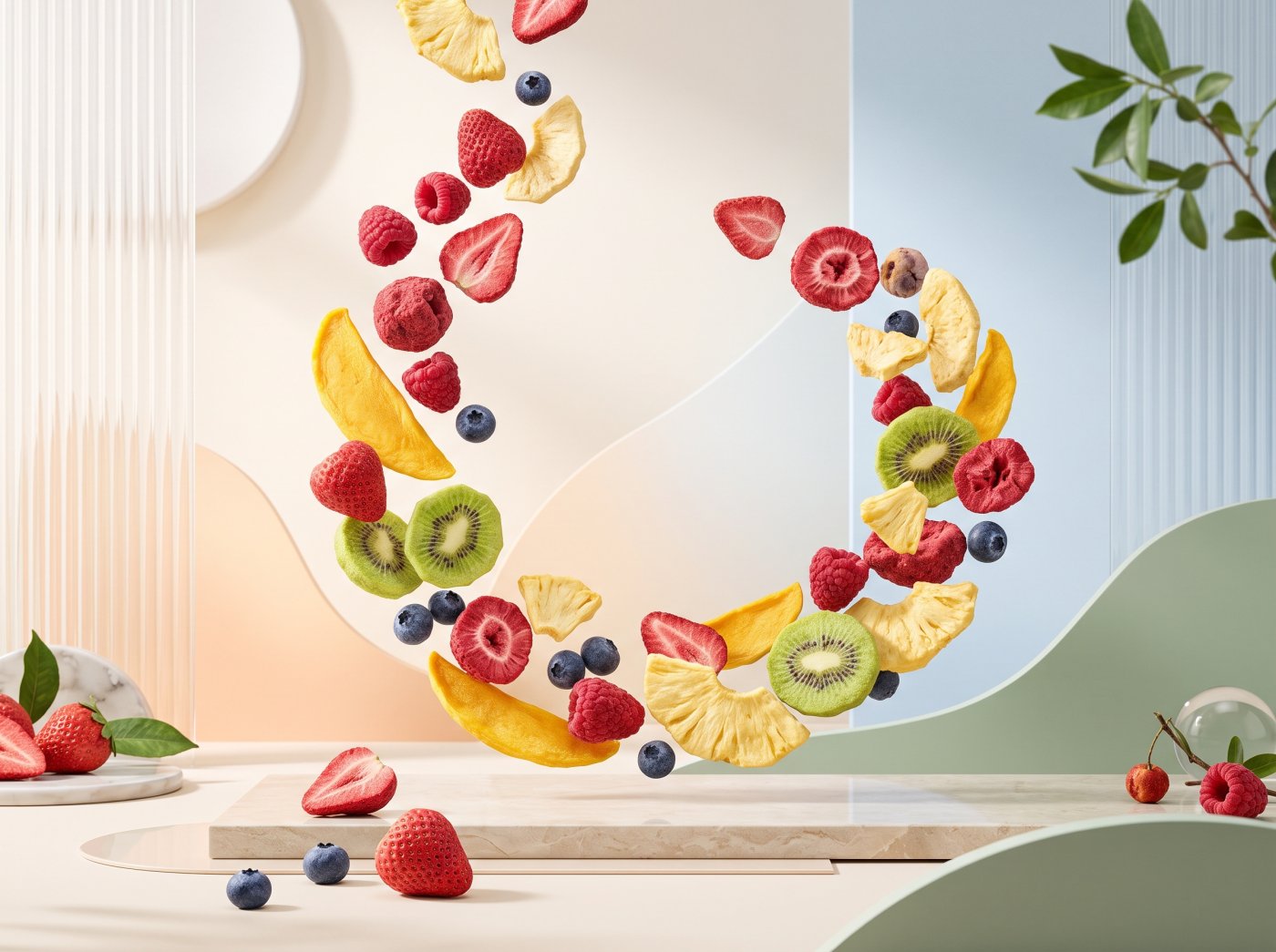
Dry a strawberry in the sun and it shrivels, darkens and hardens. Put the same strawberry through a freeze-drying plant and it keeps its shape, holds its colour and crumbles to powder under a fingertip. The difference comes from the route the water takes on its way out of the food.
What is sublimation?
Substances usually move from solid to liquid and from liquid to gas. But when pressure is lowered far enough, one step can be skipped: water in its solid state passes directly into vapour without ever becoming liquid. This transition is called sublimation, and the whole of freeze-drying rests on it.
Liquid water is a substance that moves inside food. As it evaporates it drags the cell walls along with it and the structure collapses. Ice, by contrast, stays put. When ice crystals sublime they leave behind cavities in their own shape, and the skeleton of the food remains intact. This is why freeze-dried products are porous and light.
How many stages does freeze-drying have?
1. Freezing. The product is brought down rapidly, usually to around -40 °C. Speed matters here: water that freezes slowly forms large ice crystals, and those crystals tear cell walls. Fast freezing keeps the crystals small and the tissue undamaged.
2. Primary drying. Pressure in the chamber is lowered under vacuum and very gentle heat is applied. That heat is not enough to melt the ice; it only supplies the energy sublimation requires. Most of the free water leaves at this stage, and the process takes hours.
3. Secondary drying. A small amount of water remains, bound to molecules. The temperature is raised gradually to remove it as well. Moisture content usually ends up below five per cent.
4. Packaging. The product is highly hygroscopic, meaning it pulls moisture from the air quickly. Vacuum or moisture-barrier packaging is therefore mandatory.
How does it differ from conventional drying?
| Property | Sun / hot air | Freeze-drying |
|---|---|---|
| Water removal | Evaporation | Sublimation |
| Temperature | 50-80 °C | Between -40 °C and +30 °C |
| Volume | Marked shrinkage | Almost unchanged |
| Texture | Leathery, pliable | Porous, crisp |
| Colour | Darkens | Largely preserved |
| Moisture content | 15-25% | 2-5% |
| Duration | 6-48 hours | 20-40 hours |
The decisive row in that table is temperature. Most heat-sensitive compounds begin to break down above 60 °C. In freeze-drying the product never reaches that threshold.
Is nutritional value preserved?
Largely, though it would be wrong to say nothing is lost. Vitamin C, the most heat-sensitive component, suffers some loss; even so, that loss is far below what hot air drying causes. Minerals and fibre are barely affected. Colour compounds also mostly stay in place — the visible vividness of the product is direct evidence of this.
On the other hand, because the water is gone the product becomes denser by weight. The sugar in a hundred grams of fresh strawberries ends up compressed into roughly ten grams of dried product. That does not mean the product "has become sugary"; it means the same quantity now occupies a smaller volume. This is worth accounting for when judging portions.
Why is it so crisp?
The cavities left behind by subliming ice crystals turn the product into a sponge full of air. Press on that structure and the walls fracture all at once, producing a sharp snap. When the same product meets saliva in the mouth the pores fill rapidly and the texture dissolves within seconds. That sudden softening after the crunch is a mouthfeel particular to freeze-dried food.
Why does moisture matter so much for freeze-dried food?
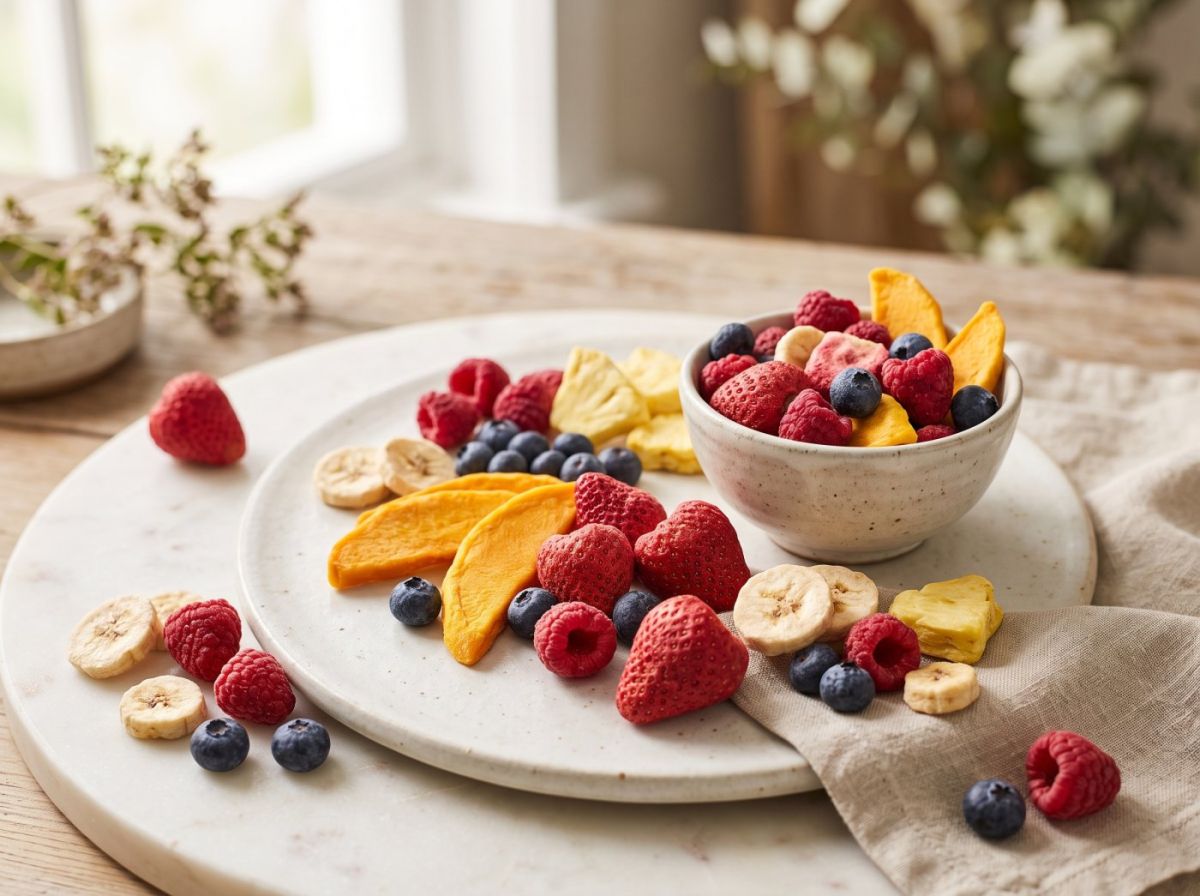
The porous structure offers a large surface for attracting moisture. A freeze-dried fruit left in an open pack loses its crispness within hours and turns soft. This is not spoilage, but the texture does not come back.
For this reason it is best to close an opened pack tightly, and ideally transfer the contents to a sealed container. Refrigerating has the opposite of the intended effect: moisture condensing on cold surfaces passes into the product. The right place is a cool, dry cupboard shelf.
Can the product take its water back?
It can, and this property is one of the most widely used aspects of the method. The porous structure absorbs liquid rapidly; a piece of freeze-dried fruit dropped into liquid regains much of its volume within minutes. This is called rehydration.
The restored product is not identical to fresh fruit. Because the cell walls lose some elasticity during drying, the texture stays a little softer. Taste and aroma, however, largely return. This is why freeze-dried fruit added to yoghurt, milk-based cereal or a hot drink behaves like fresh fruit within a short time.
There are also cases where rehydration is unwanted. In chocolate coatings, biscuit fillings and dry mixes the product is expected to stay crisp, and contact with moist ingredients has to be limited.
Why is the shelf life so long?
Microorganisms need water to multiply. What matters here is not total moisture but a measure called water activity, which describes how much of the water in a food is present in free form. In freeze-dried products this value is very low, leaving no habitable environment for bacteria, yeast or mould.
The second factor is oxygen. In low-fat products oxidation advances slowly; add a moisture-barrier pack and the product can stay sound for months, and under suitable conditions for years. This is why no preservatives are required: protection is achieved physically rather than chemically.
The only real threat to shelf life is moisture. Once packaging integrity is broken the product draws humidity from the air, water activity rises and the protection disappears.
Which foods suit this method?
Foods with high water content and a porous structure give the best results. Fruit, vegetables, herbs and cooked dishes all fall into this group. Foods high in fat perform poorly: fat does not sublime, it stays in the product and eventually turns rancid, shortening shelf life. The predominance of fruit in freeze-dried ranges is therefore no accident.
