


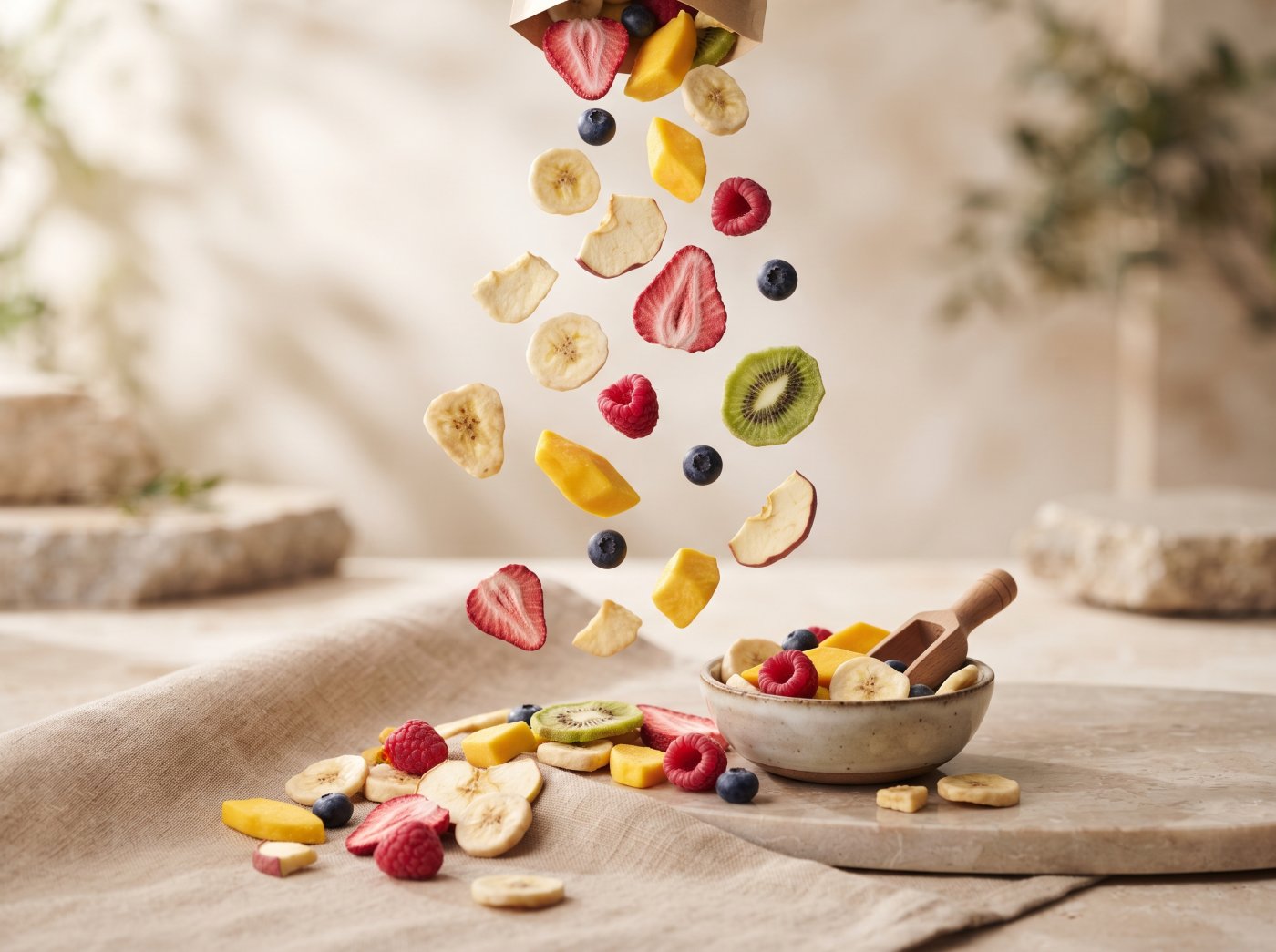
There is no single answer to whether dried fruit retains its vitamins, because "drying" is not a single method. Drying the same strawberry in the sun, in an oven or under vacuum produces three different outcomes in terms of the nutrients left behind.
What determines vitamin loss?
Vitamins are chemical compounds, each sensitive to different factors. There are three main threats: heat, oxygen and light. Drying methods expose the product to these three to differing degrees.
Heat is the most decisive. Most heat-sensitive compounds begin to break down around 60 °C, and loss accelerates as temperature rises. In hot air drying the product sits above that threshold for hours.
In freeze-drying the product remains frozen throughout the process, and the temperature only climbs to room level during secondary drying. That threshold is never crossed.
Duration is a factor too, though less than assumed. Freeze-drying takes longer than hot air drying; loss is nonetheless lower, because what matters is not the length of the exposure but the height of the temperature.
How much is each vitamin affected?
| Nutrient | Sensitivity | Hot air drying | Freeze-drying |
|---|---|---|---|
| Vitamin C | Very sensitive to heat and oxygen | 50-80% loss | 5-20% loss |
| Vitamin B1 | Heat sensitive | 30-50% loss | 5-10% loss |
| Vitamin A precursors | Moderately sensitive | 20-40% loss | 5-15% loss |
| Minerals | Insensitive | Negligible loss | Negligible loss |
| Fibre | Insensitive | Preserved | Preserved |
| Polyphenols | Moderately sensitive | 20-40% loss | 5-15% loss |
The values vary with the fruit and the processing conditions, which is why they are given as ranges. The ordering, however, holds under all conditions: freeze-drying gives lower losses in every category.
Why are minerals unaffected?
Minerals differ structurally from vitamins. Calcium, iron, potassium and magnesium exist as elements rather than compounds, and have no molecular structure for heat to break apart.
The only way minerals are lost is by passing into water. In wet methods such as boiling they dissolve into the water, and the loss occurs when that water is poured away. In drying, water leaves as vapour and leaves the minerals behind.
Dried fruit is therefore denser in minerals by weight than fresh fruit. The minerals in a hundred grams of fresh strawberries end up concentrated in roughly ten grams of dried product.
What does concentration change?
Removing water raises the proportion by weight of everything remaining. This produces a result that is both favourable and worth attention.
The favourable side is that a meaningful quantity of fibre and minerals can be taken in a small volume. A twenty-gram pack corresponds to roughly two hundred grams of fresh fruit.
The side needing attention is sugar. The fruit's natural sugar concentrates in the same proportion. That does not mean sugar has been added; but when judging a portion, what counts is not the volume but the quantity of fresh fruit it corresponds to.
Is fibre preserved?
Fibre consists of indigestible carbohydrate structures and is resistant to heat. Its structure is not broken down during drying.
Freeze-drying makes an additional contribution here. Because cell walls are largely preserved, the physical structure of the fibre also remains intact. In hot air drying some fragmentation occurs as the cell walls collapse.
In practice this difference creates a small but measurable advantage in the product's effect on digestion.
What happens to antioxidants?
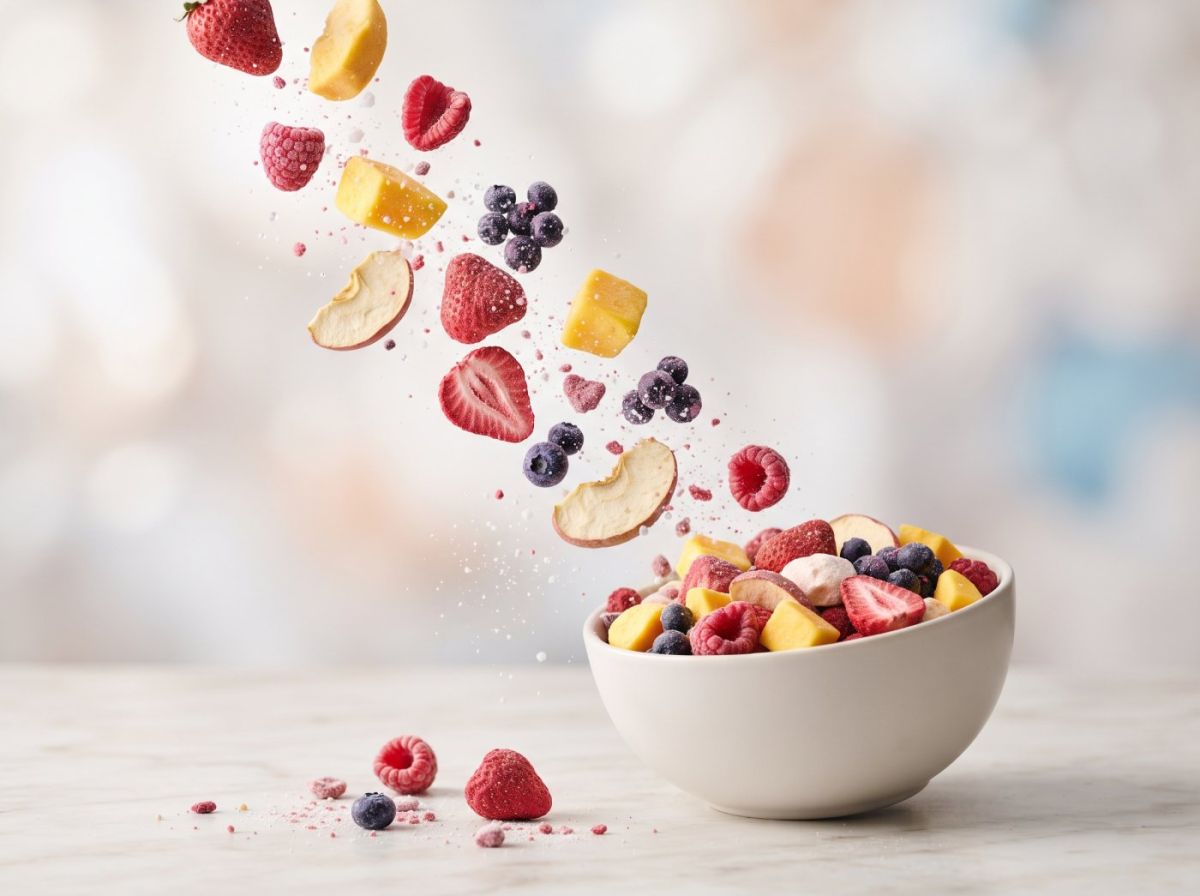
Most of the colour compounds in fruit also have antioxidant properties. Anthocyanins produce red and purple tones, carotenoids yellow and orange.
These compounds are moderately heat sensitive. In hot air drying they both degrade and oxidise; the darkening and fading of the product is the visible sign of this.
The vividness of colour retained in freeze-drying is no accident; if the colour is preserved, so largely is the compound producing it. The visual liveliness of the product is therefore an indirect but reliable indicator of its nutritional value.
Does it replace fresh fruit?
Not entirely, and it should not be expected to. Fresh fruit contains water, which both provides satiety and contributes to fluid intake. That component is absent from a dried product.
Some loss of vitamin C also occurs under any conditions. Planning to meet a daily vitamin C requirement from dried fruit is not a sound approach.
The right framing is this: freeze-dried fruit is not a substitute for fresh fruit but a good alternative where fresh fruit is unavailable or impractical. A school bag, an office drawer, a campsite and a journey are typical examples.
How should the sugar figure be read?
The high sugar value on a dried fruit label gives the initial impression that sugar has been added. In fact that value is the fruit's own fructose and glucose, concentrated by the departure of the water.
The way to verify this is the ingredients list. If it names only the fruit, no sugar has been added. If it carries a term such as "sugar", "glucose syrup" or "fructose syrup", it has.
The distinction matters in practice, because added sugar and a fruit's natural sugar are not assessed the same way nutritionally. Natural sugar arrives with fibre, and because the fibre structure is preserved in a freeze-dried product, that pairing persists.
How does it compare with other drying methods?
Vacuum drying gives the closest result to freeze-drying. Because pressure is reduced, water evaporates at a lower temperature and losses fall. But as the product is not frozen, its cell structure collapses somewhat; the texture is not as porous as freeze-dried.
Spray drying is used for liquid products and applies high temperature for a very short time. Because the exposure is brief, losses stay moderate, but the product becomes a powder and no piece form is retained.
Sun drying is the lowest-cost method and gives the highest losses; the product is exposed both to prolonged heat and to direct sunlight. Light further accelerates the breakdown of heat-sensitive compounds.
Does storage affect nutritional value?
It does. Oxidation continues slowly after packaging, and over time vitamin C and polyphenols in particular decline.
Two factors slow this process: isolation from oxygen and from light. This is why opaque, moisture-barrier packaging is preferred. Once opened, consuming the product promptly is better for both texture and nutritional value.
Temperature plays a part too. A product kept in a cool, dry cupboard holds its value noticeably longer than one sitting on a shelf exposed to light and warmth.
