


The dough in the poğaça in a bakery window was in all likelihood not kneaded in that bakery. Frozen dough technology split baked-goods production between two locations: the plant where the dough is made and the outlet where it is baked. That separation made it possible to scale up without giving up freshness.
How is frozen dough produced?
The process begins exactly as conventional dough preparation does: flour, water, yeast and other ingredients are mixed. The difference lies in when the dough is stopped.
After mixing, the dough is shaped and taken straight to a blast freezing tunnel. There the temperature is dropped rapidly, typically bringing the core to -18 °C within thirty to ninety minutes.
The purpose of that speed is to protect the yeast cells. Large ice crystals formed during slow freezing tear the cell walls and the yeast dies; the dough then fails to rise on thawing. In fast freezing the crystals stay small and most of the yeast survives.
The frozen product is packed and held at -18 °C. At that temperature yeast activity stops but the yeast does not die; it resumes where it left off once thawing begins.
What separates the three categories?
| Category | Baked in production | Work at the outlet | Time |
|---|---|---|---|
| Raw frozen | None | Thaw, prove, bake fully | 60-120 minutes |
| Par-baked frozen | 70-85% | Straight to oven, finish colour | 8-15 minutes |
| Fully baked frozen | 100% | Reheat only | 3-8 minutes |
Moving down the list, the workload at the outlet falls, but so does the perception of freshness. Raw frozen demands the most labour and delivers the just-out-of-the-oven impression best.
How is a raw frozen product prepared?
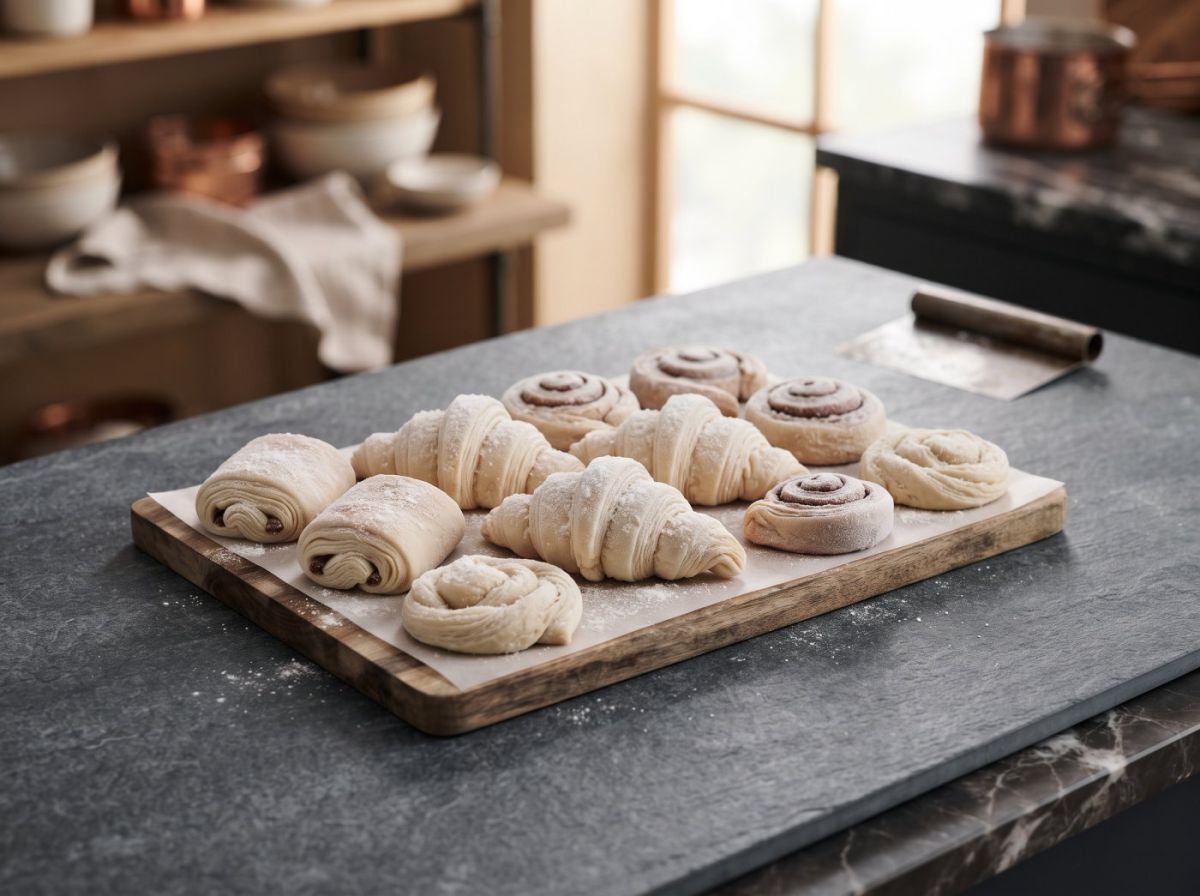
Raw frozen products go through three stages, none of which can be skipped.
Thawing. The product comes out of the freezer and thaws at refrigerator or room temperature. At this stage the yeast works only slowly.
Proving. The product is held in an environment kept at 28-32 °C and 75-85 per cent humidity. Under those conditions the yeast produces gas and roughly doubles the volume of the dough. The time ranges from forty-five minutes to two hours depending on the product.
Baking. The proved product goes into the oven, with temperature and time set to the product.
Proving is where mistakes are most often made. Under-proved, the product fails to rise in the oven and stays dense; over-proved, the gluten network tires and the product rises and then collapses.
Why does humidity matter so much when proving?
If the environment is dry during proving, the surface of the dough dries and forms a thin skin. That skin does not stretch; as the dough continues to expand from within, the surface cracks and the product takes on an irregular shape.
If the environment is too humid, water collects on the surface instead. A wet surface entering the oven generates steam, crust formation is delayed and the product stays pale.
A proving cabinet manages both variables together. For businesses without one, the practical solution is to cover the products with a damp cloth or to use the closed, warm interior of an oven.
Why is par-baked product not thawed?
In par-baked products the starch has already gelatinised and the structure is set; yeast activity has ended. These products need no thawing and should not be thawed.
During thawing the ice inside melts and the released water comes to the surface rather than being reabsorbed into the dough. A wet product entering the oven takes on a doughy texture.
Placed straight into the oven, the ice turns to steam as it heats, and that steam passes out through the product; the structure opens and crispness develops.
Why does freezing without blast equipment fail?
A domestic freezer takes between four and eight hours to freeze a tray of dough. Throughout that period the dough sits for a long time in the critical temperature band where water crystallises.
The coarse crystals formed in that band do two kinds of damage. They tear the yeast cells and reduce rising capacity, and they break up the gluten network; thawed dough turns sticky and resists shaping.
Industrial blast freezing brings the same tray down in thirty minutes. Because the time spent in the critical band is short, damage is minimised. This is the technical basis on which frozen dough became commercially possible.
What is the shelf life?
For raw frozen products, three to six months at -18 °C is a reasonable range. The limiting factor is the yeast; over time the number of viable cells falls and the product's rising power declines.
In par-baked and fully baked products the yeast is out of the equation, so shelf life is longer, between six and twelve months. Here the limiting factors are freezer burn and fat oxidation.
In both groups, temperature fluctuation shortens shelf life. Frequent opening of the freezer creates cycles of melting and refreezing at the product surface, and each cycle increases crystal size.
How does the oven setting change for frozen products?
Oven settings for frozen products differ from those for fresh dough, because the product goes in cold and its centre takes time to heat.
The general rule is to lower the temperature by ten degrees against fresh dough and extend the time. At high temperature the surface colours quickly while a cold core remains inside; cut open, that area looks doughy.
Fan ovens need a further correction. Air circulation speeds heat transfer at the surface, so they run fifteen degrees lower than static ovens. The fan also dries the surface; for products needing moisture, injecting steam at the start or placing a small dish of water in the oven corrects this.
Tray arrangement matters too. At least two fingers of space should be left between products; where they are packed closely the gaps fill with steam and those surfaces take no colour.
Which category should a business choose?
The decision follows the operation's bottleneck.
Where oven capacity is limited and the morning rush is sharp, par-baked or fully baked makes sense; baking time is short and the oven does not develop a queue.
Where oven capacity is sufficient and demand is steady through the day, raw frozen gives the better result. Product quality is highest and the premises fill with the smell of baking, which is a factor influencing purchase decisions directly.
Staff capability belongs in the calculation too. Raw frozen products require proving to be monitored; in businesses with inexperienced teams the result can vary from day to day. Par-baked product removes that variability.
