


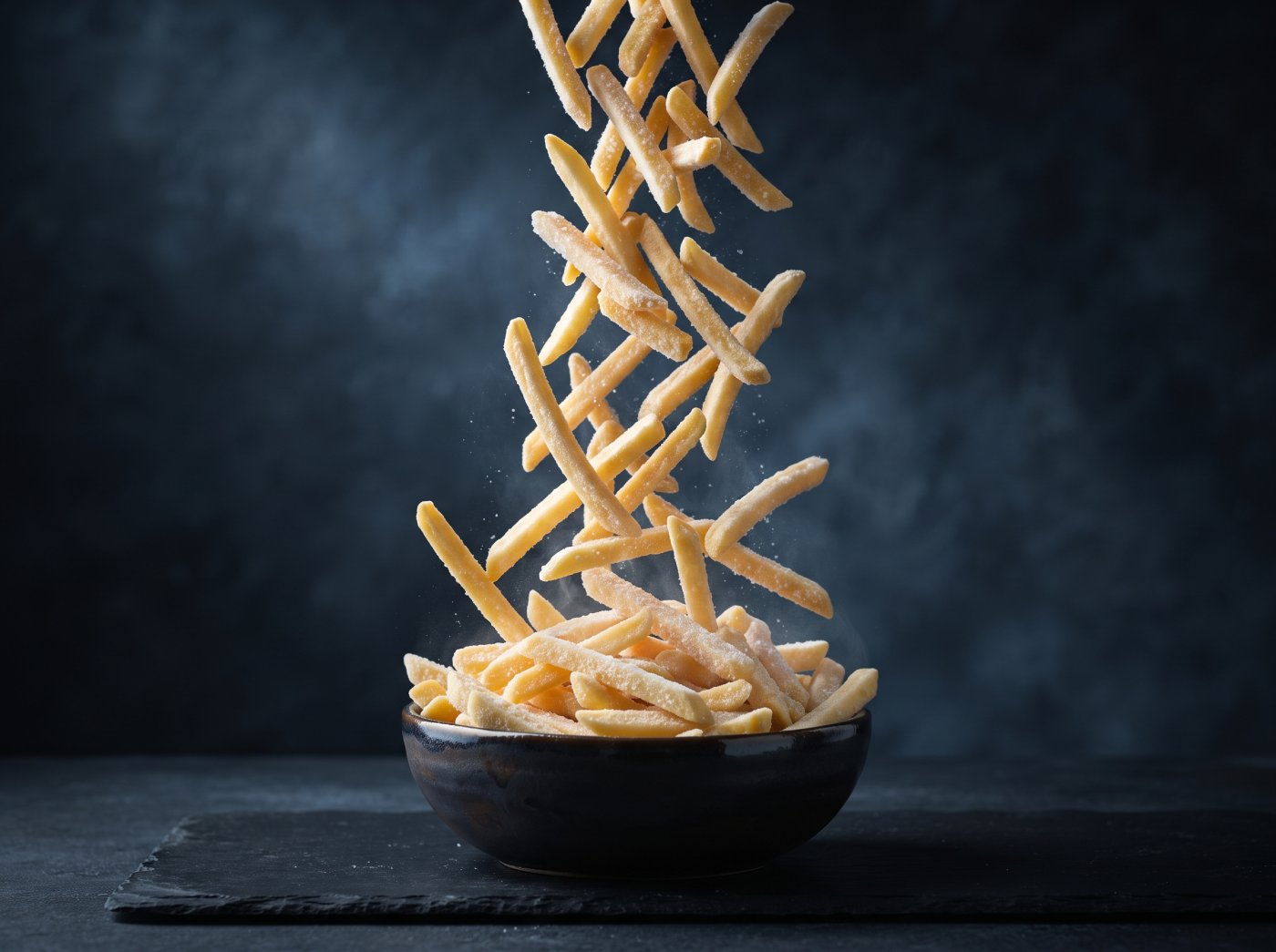
The frozen chips that go into a restaurant's fryer have passed through a process that can take months. Most of it happens in the field and in storage; the operations at the factory are only the last link in the chain.
Which potatoes count as frying potatoes?
A frying potato is determined by variety selection before production begins. Two properties are sought: high dry matter and an elongated tuber shape.
High dry matter means less oil absorbed during frying and a crisper result. The elongated form makes it possible to obtain even chips; round tubers yield short pieces and waste rises.
Agria, Russet Burbank and Innovator are common varieties carrying both properties. Under contract farming, the processing plant agrees with the grower in advance which variety will be planted.
What happens after harvest?
Potatoes are not processed straight after harvest. They first enter a resting period called curing.
During this period, roughly two weeks, they are held in a warm, humid environment. Surface wounds from harvesting close and the skin hardens. An uncured potato is far more prone to rotting in store.
The temperature is then brought down gradually to storage level. That descent must be slow; sudden cooling triggers the potato to convert starch into sugar.
Why is storage held at 7-10 °C?
That range is chosen because it is the narrow band between two risks.
Below 4 °C the potato undergoes cold sweetening: it converts starch to sugar. A high-sugar potato darkens rapidly when fried and takes on a bitter note.
Above 10 °C sprouting begins. A sprouting potato both loses weight and deteriorates in texture.
Commercial stores therefore operate between 7 and 10 °C at high humidity. Where humidity is low, the potato loses water and shrivels.
What operations does the potato go through at the plant?
| Order | Operation | Purpose |
|---|---|---|
| 1 | Washing | Removing soil and stones |
| 2 | Size grading | Classification for uniform cutting |
| 3 | Steam peeling | Skin removal |
| 4 | Optical sorting | Eliminating defective and greened pieces |
| 5 | Water-jet cutting | Cutting chips to specification |
| 6 | Short-piece screening | Separating out-of-spec pieces |
| 7 | Blanching | Halting enzymes, removing starch and sugar |
| 8 | Drying | Removing surface moisture |
| 9 | Par-frying | Forming a crust |
| 10 | Blast freezing | Rapid freezing |
| 11 | Weighing and packing | Portioning |
| 12 | Storage | -18 °C and below |
The two steps that raise most questions in that sequence are blanching and par-frying.
What does blanching achieve on the production line?
Cut potatoes are held in hot water for a few minutes. The operation solves three separate problems at once.
The first is enzymes. When a potato is cut, enzymes at the surface react with oxygen and browning begins. Heat deactivates them.
The second is free starch at the surface. Starch released during cutting causes the pieces to stick together during frying. The water removes it.
The third is sugar. Excess sugar formed in storage passes into the water, allowing colour to develop predictably during frying. This step is the basis of obtaining an even golden fry.
Blanching time is adjusted to the thickness of the cut. Held too long, the potato softens and breaks up in the following steps.
Why is par-frying necessary?
After blanching and drying, the potato is briefly immersed in hot oil. This step is not to cook the potato but to form a crust on its surface.
That crust does two jobs. It prevents ice crystals forming during freezing from damaging the surface, and it makes the final frying done by the customer much shorter.
Par-frying usually lasts under a minute at around 175-185 °C. The quantity of oil entering the potato at this step is limited; the product's oil content is largely determined at the final fry.
For coated products there is an additional step before this: immersion in a starch-based coating liquid. That coating creates a surface which stays crisp longer after the final fry.
How is blast freezing done?
Potatoes leaving the par-fryer must be frozen immediately; product left waiting loses moisture and its colour deteriorates.
In the blast tunnel, air between -35 °C and -40 °C is driven over the product at high velocity. The core reaches -18 °C in roughly fifteen minutes.
That speed keeps the ice crystals small. The coarse crystals formed in slow freezing tear cell walls; on thawing the potato weeps and stays soft.
Blast-frozen product remains free-flowing, meaning the pieces do not stick together. This allows any required quantity to be taken from the pack.
Why does packaging matter so much?
Frozen chips are vulnerable to moisture loss. Air remaining inside the pack draws moisture from the product and freezer burn develops over time.
Industrial packaging is therefore multi-layered with a moisture barrier. In large formats the strength of the packaging is a separate requirement; a pack punctured in transit spoils the product rapidly.
The cut information on the pack is technical data rather than marketing. Figures such as 7x7 or 9x9 give the cross-section in millimetres, and a business is expected to set its cooking time accordingly.
Where does the cold chain break?
Controlled as the production line is, the most fragile points in the chain are distribution and the point of sale.
Even a brief rise in temperature during transport creates melting at the product's surface; when it refreezes the ice crystals grow. This announces itself as clumps of ice inside the pack.
At the business, the most common problem is taking the product out of the freezer and leaving it to stand. A partially thawed potato refrozen loses its texture and fries soft.
Ice clumps in a pack are the most reliable sign that the product has thawed and refrozen at least once somewhere along the cold chain.
