


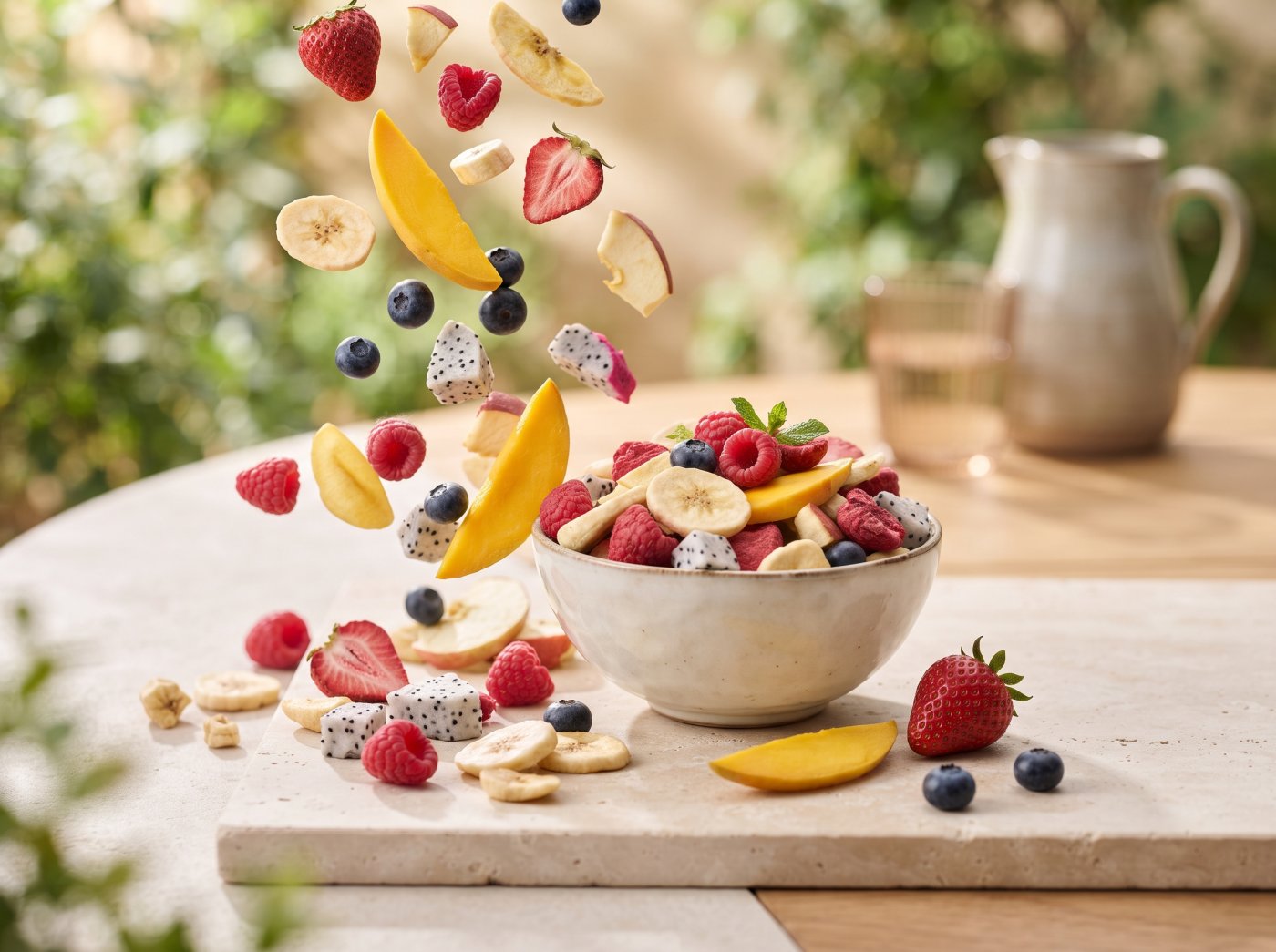
Crispness is not a single property in food science but a composite perception, formed where sound, resistance and the manner of fracture come together. Freeze-dried products generate all three at once, and in a distinctive way.
What is crispness actually a perception of?
When we bite into a food, the brain combines three separate signals.
The first is mechanical: the resistance the teeth meet and how abruptly that resistance breaks. The second is auditory; the sound released during fracture is perceived both through the ear and through bone conduction. The third is tactile: how the broken pieces disperse in the mouth.
In a crisp food all three signals are sharp and almost simultaneous. In a soft food the resistance breaks gradually, no sound is produced and dispersal is slow.
The abruptness of the fracture is the most decisive component of the perception. What matters is therefore not how hard a product is but how quickly it breaks.
How does porous structure produce that perception?
In freeze-drying, ice crystals leave the food by sublimation and leave behind cavities in their own shape. The result is a structure of countless air cells separated by thin walls.
Those walls are very thin and carry almost no elasticity. Under pressure they do not bend; at a particular force they all fracture at once.
A great many thin walls breaking simultaneously produce a short, sharp sound. A thick-walled structure breaks gradually and gives a duller note.
The lightness of the product comes from the same structure. Most of the volume is air; solid matter exists only in the walls.
What does glass transition mean?
In food science, a substance being in a "glassy" state means its molecules are locked in place in a disordered arrangement. It is brittle like glass: it does not bend, it cracks outright.
Because moisture content is very low in freeze-dried products, their sugars and other components sit in this glassy state. That is the physical basis of the crispness.
Raise the moisture and the situation changes. Water molecules work their way between the molecules of the solid structure and make it easier for them to move. The material passes from a glassy state to a rubbery one; it no longer fractures, it bends.
The point at which this happens is called the glass transition temperature, and it falls as moisture rises. In practice this means the product loses its crispness even after taking up a small amount of moisture.
How does it differ from a fried crisp?
Both are crisp, but by different mechanisms.
| Criterion | Freeze-dried | Fried crisp |
|---|---|---|
| What forms the cavities | Subliming ice | Evaporating water |
| Wall structure | Very thin, regular | Thick, irregular |
| Fat content | Negligible | 25-35% |
| Fracture sound | Short, sharp | Deeper, duller |
| Dispersal in the mouth | Dissolves in seconds | Broken down by chewing |
| Residual sensation | Clean | Oily film |
The most pronounced difference is the last row. In a fried product the fat leaves a thin film in the mouth and prolongs the perception of taste. A freeze-dried product leaves no such film; the taste starts sharply and ends quickly.
Why does it dissolve so fast in the mouth?
The porous structure offers a very large surface for absorbing liquid. As the product enters the mouth, saliva fills the cavities instantly by capillary action.
Once the cavities fill, the walls lose their support and the structure collapses. At the same moment sugars and acids dissolve and are released; the taste bursts simultaneously with the collapse of the texture.
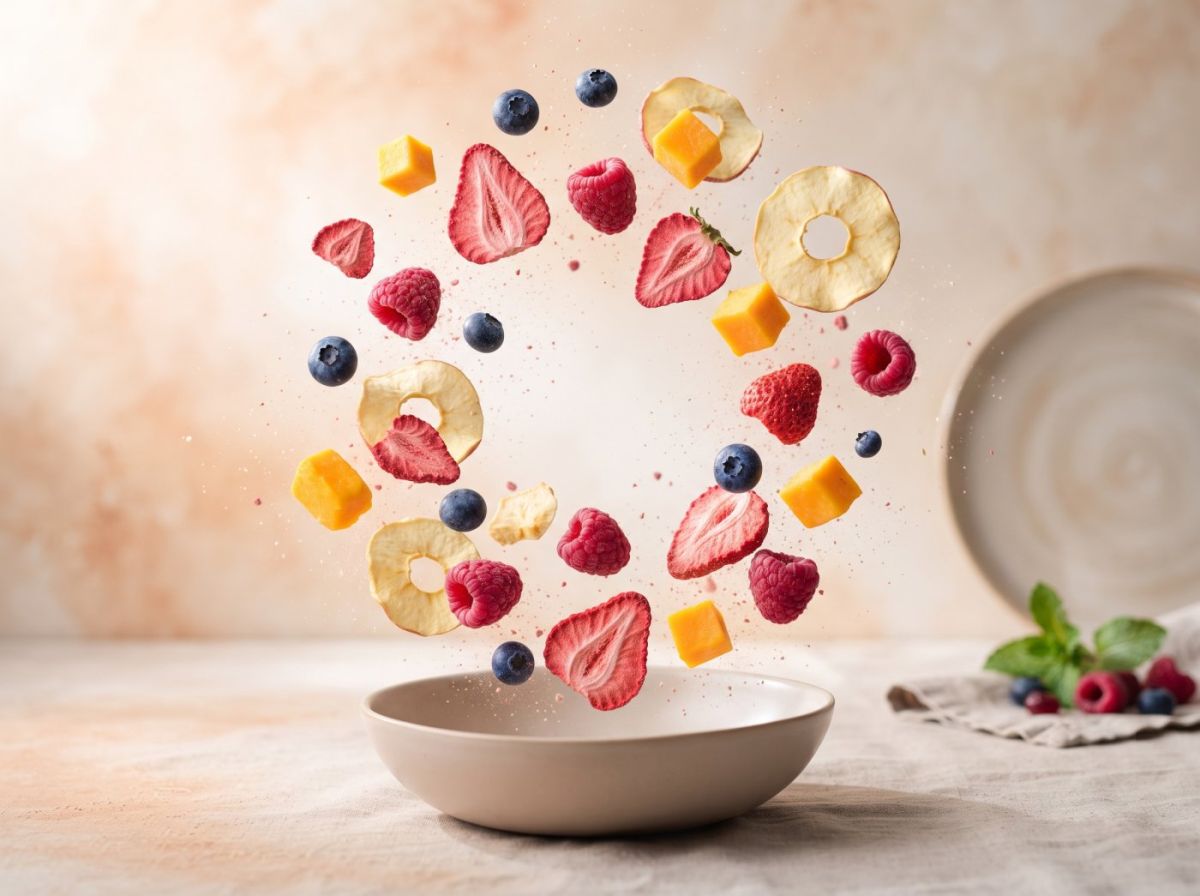
These two events happening together create a mouthfeel particular to freeze-dried products: first a sharp snap, then a dissolution requiring no chewing at all.
In products that are dried but not porous — conventional raisins, for example — these two stages do not occur; the product has to be chewed.
Why is moisture damage irreversible?
A freeze-dried product that takes up moisture softens. The problem is that this softening cannot be undone by drying.
The reason is structural. When water enters, the thin walls partly dissolve and stick to one another; the pores close. Dried again, the water leaves but the pores do not reopen. What remains is a denser, harder structure that is not crisp.
Trying to dry a softened freeze-dried product in an oven therefore does not work. The method that succeeds with biscuits fails here, because a biscuit's structure is dense to begin with and what it has lost is only surface moisture.
How is crispness preserved?
Preservation rests entirely on keeping moisture out.
Packaging should carry a moisture barrier and, if possible, block light. Once opened, the pack should be sealed tightly and the product ideally transferred to a lidded container.
The refrigerator is the most common mistake. Condensation forms on a cold product and the moisture passes directly into it. The right place is a cool, dry, dark cupboard shelf.
The desiccant sachets found in some packs should not be thrown away; leaving them inside when the pack is resealed extends the life of what remains.
Does piece size change the crispness?
It does, because the force required to fracture rises with the thickness of the piece.
A thinly sliced fruit — a slice of apple or kiwi — contains few layers of wall and breaks under very little force. The perception is a sharp but light snap.
In thicker pieces and whole fruits the number of walls to be broken increases. The force threshold rises and the sound comes out fuller. This is why fruits dried whole, such as strawberries, offer more pronounced resistance.
In a powdered product crispness disappears entirely; the walls have already been broken. What remains is simply a rapidly dissolving carrier of aroma.
This relationship is a deliberate tool in product development: different cut sizes are produced from the same fruit according to the mouthfeel wanted.
How is this texture used in patisserie?
The crispness of freeze-dried products is used deliberately as a textural tool in patisserie. Crisp fruit scattered over a soft cream creates a contrast of texture on the plate.
Timing is critical in this use, however. Freeze-dried product placed on a moist surface softens within minutes. It therefore has to be added immediately before serving.
A lasting solution is coating the product in chocolate or cocoa butter. The fat forms a moisture barrier and the crispness survives for hours even in a moist environment. The prevalence of chocolate-coated freeze-dried fruit rests on this technical reason.
When used as a powder, the aim is colour and aroma rather than texture; in that case moisture ceases to matter, because no crispness is being sought.
