


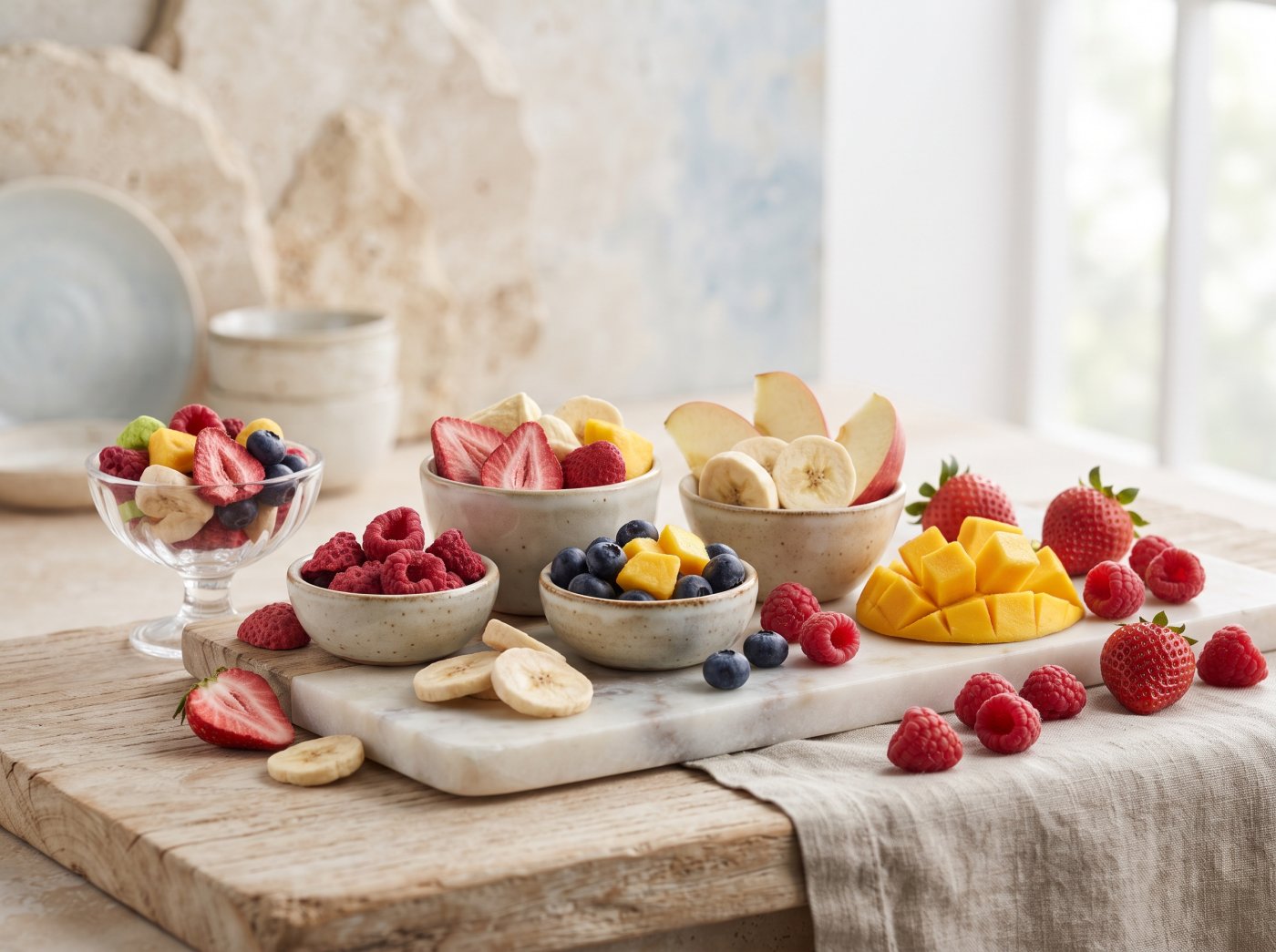
That a dried food keeps for a long time without spoiling raises the same question in most consumers: what was put into it? For freeze-dried products the answer is usually "nothing", and there is a technical reason for that.
Why are preservatives unnecessary?
Preservatives are used to prevent microorganisms multiplying in food. But microorganisms need water to multiply.
What decides this is not total moisture but a measure called water activity, showing how much of the water in a food is in free form. Bacteria need roughly 0.90, yeasts 0.80 and moulds 0.70.
In a freeze-dried product, water activity is generally below 0.20. At that value no microorganism can multiply.
Adding a preservative would mean guarding a second time against a risk already eliminated. Plain freeze-dried fruit products therefore contain none.
So what does the label say?
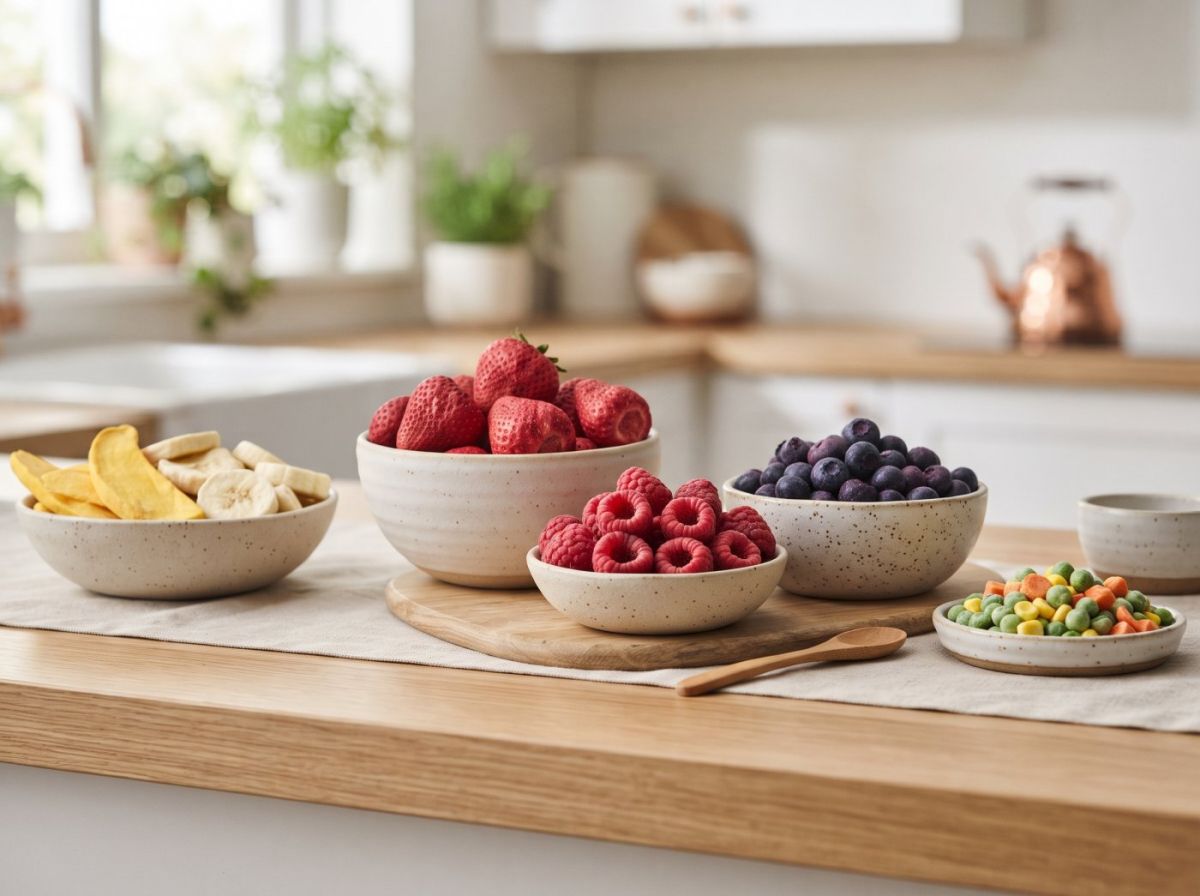
Only the name of the fruit. The ingredients list of a plain product is this short: "Strawberry." Or, in blends: "Apple, strawberry, banana."
This follows directly from food regulation. An ingredients list must name every component present in order of weight. In a single-ingredient product the list is one word.
If anything besides the fruit name appears, it is worth asking what that component does. This is not always negative; some additives have a technical justification.
Which additives are used and why?
| Component | Purpose | Assessment |
|---|---|---|
| Sugar, glucose syrup | Sweetening | Moves the product towards confectionery |
| Ascorbic acid (vitamin C) | Colour protection, antioxidant | Technically justified, harmless |
| Citric acid | Acidity regulation, colour protection | Common and accepted |
| Rice flour, starch | Anti-caking | Seen in powdered products |
| Vegetable oil | Coating, moisture barrier | In coated products |
| Natural flavouring | Boosting taste | Added where fruit flavour is weak |
| Colouring | Visual correction | Unnecessary in a quality product |
The first and last rows call for attention. Added sugar changes the position of the product; adding sugar on top of fruit sugar that is already concentrated makes a meaningful nutritional difference.
Colouring raises a different question. Freeze-drying is a method that preserves colour; needing to correct it says something about the quality of the raw material or the processing conditions.
Is ascorbic acid a bad sign?
It is not. Ascorbic acid is vitamin C itself, and it does two jobs in food.
The first is antioxidant; by reacting with oxygen itself it delays the oxidation of other components. The second is colour protection, used particularly in fruits such as apple and banana that brown when cut.
It appears on labels as "ascorbic acid" or "E300". Both are the same substance; an E number indicates approval in Europe rather than that something is synthetic.
That distinction matters generally: carrying an E number is not an indicator of concern. E300 is vitamin C, E440 is pectin and E330 is citric acid; all three are naturally derived.
How should the label be read?
Three lines settle most questions.
The length of the ingredients list. If it is one word, the product is plain. If it is long, each component invites the question of why it is there.
The order. Components are listed by weight. If sugar appears in the first three, there is a significant amount in the product.
The sugar line. In the nutrition table, "of which sugars" shows total sugar, and that figure includes the fruit's own. Only the ingredients list tells you whether any was added.
Are coated products different?
They are. Chocolate- or yoghurt-coated freeze-dried products are no longer single-ingredient.
The coating brings its own list: sugar, cocoa butter, milk powder, emulsifier. Total sugar and fat rise markedly in these products.
This is not a fault; the product belongs to a different category. But it should not be judged with the same nutritional expectations as plain fruit.
Soya lecithin is generally used as the emulsifier, and it must be declared as an allergen on the label.
Where is allergen information given?
Food regulation requires designated allergens to be emphasised within the ingredients list, usually in bold or capitals.
Freeze-dried fruit products contain no direct allergens. Two situations nonetheless call for attention.
The first is cross-contamination. If nuts or dairy are processed in the same facility, the label carries a "may contain" statement. That statement is not mandatory but manufacturers use it to declare risk.
The second is coated products, where milk, soya and nuts can be present as direct components.
What does "natural flavouring" mean?
Natural flavouring describes flavour substances of natural origin. They can be obtained from fruit, from plants or by fermentation.
A plain freeze-dried fruit needs no flavouring; the fruit's own aroma is already concentrated. If flavouring appears on the label, either the raw material's aroma is weak or the product is a blend.
This is not a safety issue; these are approved components. But it tells you about the product's position: a flavoured product belongs to a different category from pure fruit.
What do the certifications tell you?
Organic certification shows the raw material was grown under defined agricultural conditions. It is independent of the processing method; organic fruit passes through the same freeze-drying line.
Gluten-free certification shows the product has been measured and verified. Fruit is naturally free of gluten, but if grain is processed in the same facility a contamination risk exists; the certificate closes that risk.
Halal and kosher certifications become meaningful for coated products; there is no issue with plain fruit in any case.
None of these certifications indicates quality directly; each verifies that a particular condition has been met. How good the product actually is, is still told by the ingredients list and the texture.
