


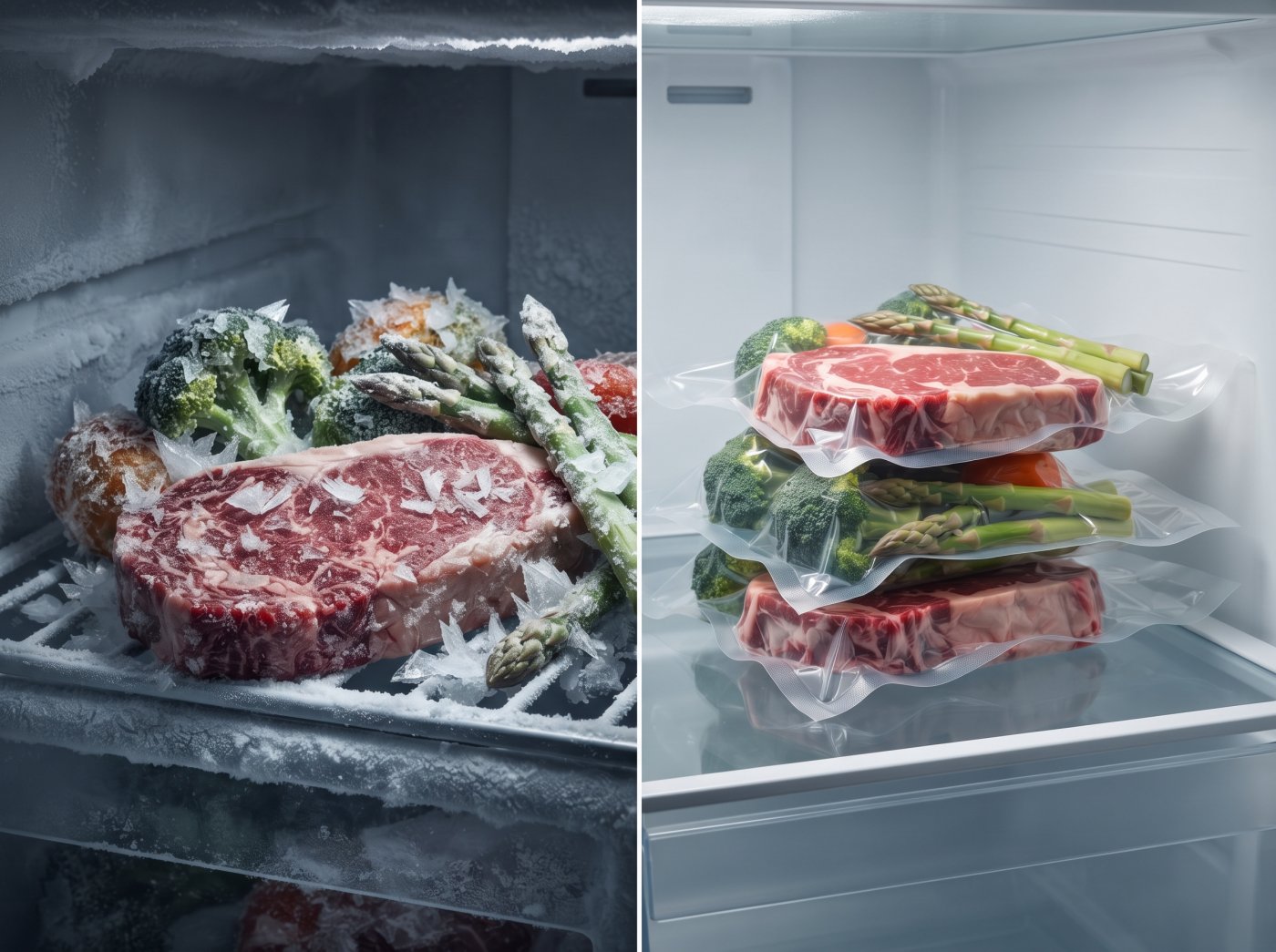
If a cut of meat taken from the freezer shows whitish, dry, matte patches on its surface, that is freezer burn. The name misleads: nothing has burned and nothing has spoiled. What has happened is far quieter; the food has been drying out slowly inside the freezer.
How does freezer burn form?
The water inside frozen food is in the form of ice. Ice can pass directly into vapour without becoming liquid; that transition is called sublimation, and it occurs at low temperatures too, just very slowly.
Ice crystals at the surface of the product sublime over time and pass as water vapour into the space inside the packaging. That vapour refreezes on the colder surfaces of the freezer or on the inner wall of the packaging; it does not return to the food.
The area left behind becomes a dry, porous texture. Those dry pores fill with air and oxygen comes into direct contact with the food. The colour change and loss of flavour are the result of that contact.
Why does it develop faster in some products?
Three factors determine the rate of sublimation.
The first is surface area. Products with large surface areas — mince, sliced meat, grated cheese — are affected far faster than whole pieces.
The second is fat content. In fatty products, oxidation accompanies moisture loss and the two together spoil the taste more quickly. This is why oily fish and fatty meat burn before lean ones.
The third is packaging. If there is an air gap between the food and the wrapping, the subliming vapour collects there. The larger the gap, the faster the loss.
Why does temperature fluctuation accelerate it?
Every time the freezer door opens, warm, humid air enters. The temperature rises briefly and part of the surface ice melts; when the door closes, that water refreezes.
With every repetition of this cycle the ice crystals grow. Larger crystals tear more cell walls and release more free water. And free water is what sublimes most readily.
A product in a frequently opened freezer therefore burns much faster than one in a rarely opened freezer at the same temperature. Stable temperature matters as much as low temperature.
Is freezer-burned food safe to eat?
Yes, there is no safety concern. Freezer burn is not microbiological spoilage; because bacteria do not grow at low temperature, the food remains safe.
The problem is entirely one of quality. The burned area is dry, stringy and tasteless, and does not soften when cooked. In fatty products, oxidation produces a bitter note.
The practical solution is to cut away the affected area and use the rest. Once a few millimetres are removed from the surface, the tissue beneath is usually sound.
How much does each type of packaging protect?
| Packaging | Air permeability | Protection period | Note |
|---|---|---|---|
| Vacuum pouch | Very low | 8-12 months | The most effective method |
| Zip bag, air pressed out | Low | 4-6 months | Most practical at home |
| Cling film plus bag | Medium | 3-5 months | Two layers are needed |
| Aluminium foil | Medium | 3-4 months | Prone to tearing |
| Original retail packaging | High | 1-2 months | Inadequate for long storage |
| Open container, uncovered | Very high | Weeks | Should be avoided |
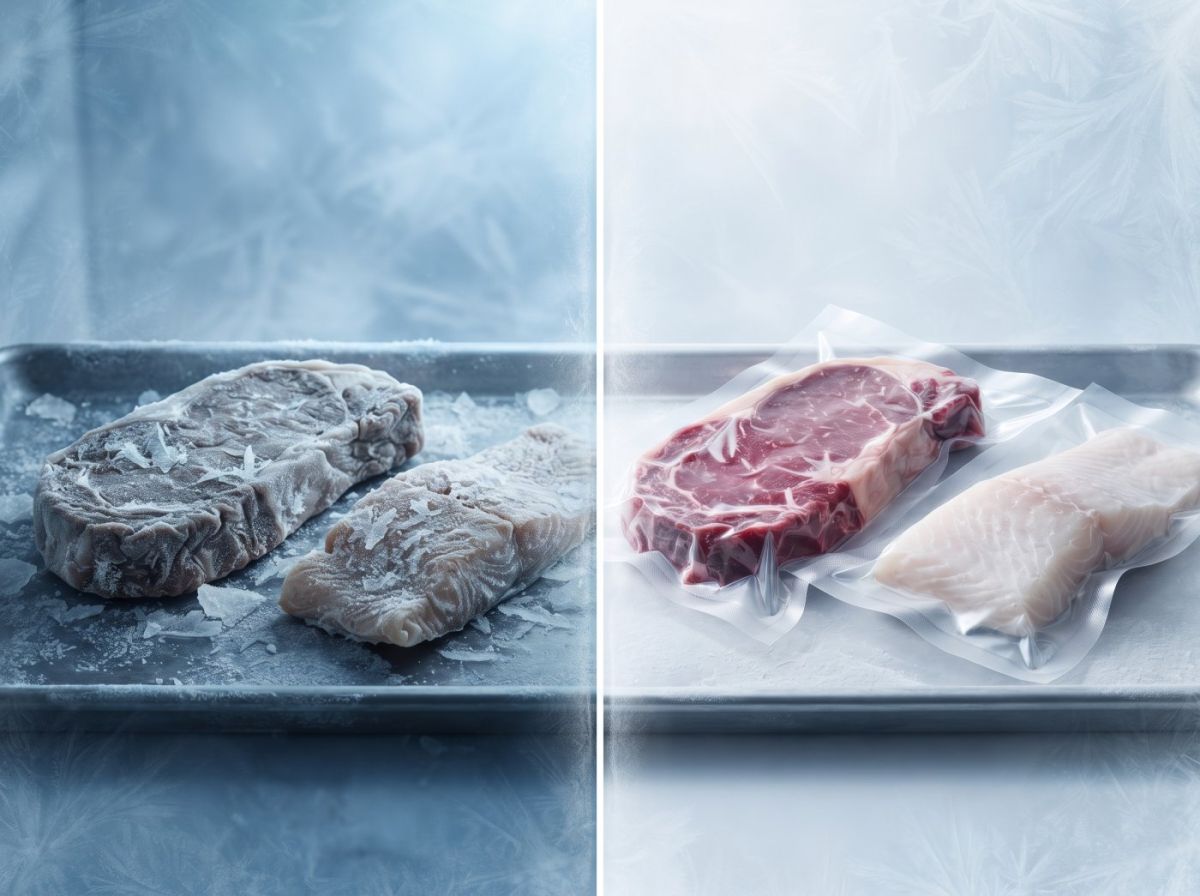
The differences in the table rest on a single principle: the smaller the distance between the food and the air, the better the protection. The superiority of vacuum packing comes from reducing that distance to zero.
What can be done at home?
In kitchens without a vacuum sealer, a few simple practices make a marked difference.
Wrapping the product tightly in cling film first, then placing it in a zip bag, creates a two-layer barrier. To remove air from the bag, lower it slowly into a container of water; water pressure pushes the air out, and the bag is then sealed.
Liquid products should not be filled to the brim, because water expands as it freezes. Pressing cling film onto the remaining space, however, reduces contact with air.
Freezing in small portions also helps. Only what is needed is taken out each time, and the remaining product is not exposed to repeated opening.
What temperature should a freezer be?
The standard target is -18 °C. At that temperature microbiological activity stops and sublimation slows.
Lower temperatures slow sublimation further; industrial stores operate between -24 °C and -30 °C, which is why the shelf life of commercial frozen products is longer.
In domestic freezers the real problem is not how low the temperature is but how stable. In a freezer with a failing door seal, or one that is overfilled, the temperature fluctuates constantly. A simple freezer thermometer is the cheapest tool for making the problem visible.
Is it related to ice build-up?
It is, directly. The frost accumulating on freezer walls is condensed moisture from the products and from the air entering. A thick layer of frost is therefore visible evidence that the products have been losing moisture.
Regular defrosting is not only a matter of efficiency; it protects product quality too. No-frost systems remove frost automatically, but they do so by running brief heating cycles, and those cycles can accelerate freezer burn in poorly packaged products.
Packaging quality matters even more in a no-frost freezer than in a conventional one.
How long can food be kept in the freezer?
Times vary with fat content and packaging. In vacuum packaging, red meat holds its quality for up to a year, poultry up to nine months, and cooked dishes for three or four.
These periods are not safety limits; food held at -18 °C is theoretically safe indefinitely. The figures given are the periods over which quality stays acceptable.
Labelling is the habit that helps most here. Writing the freezing date on the package removes the question of "how long has this been in there" and prevents unnecessary waste.
