


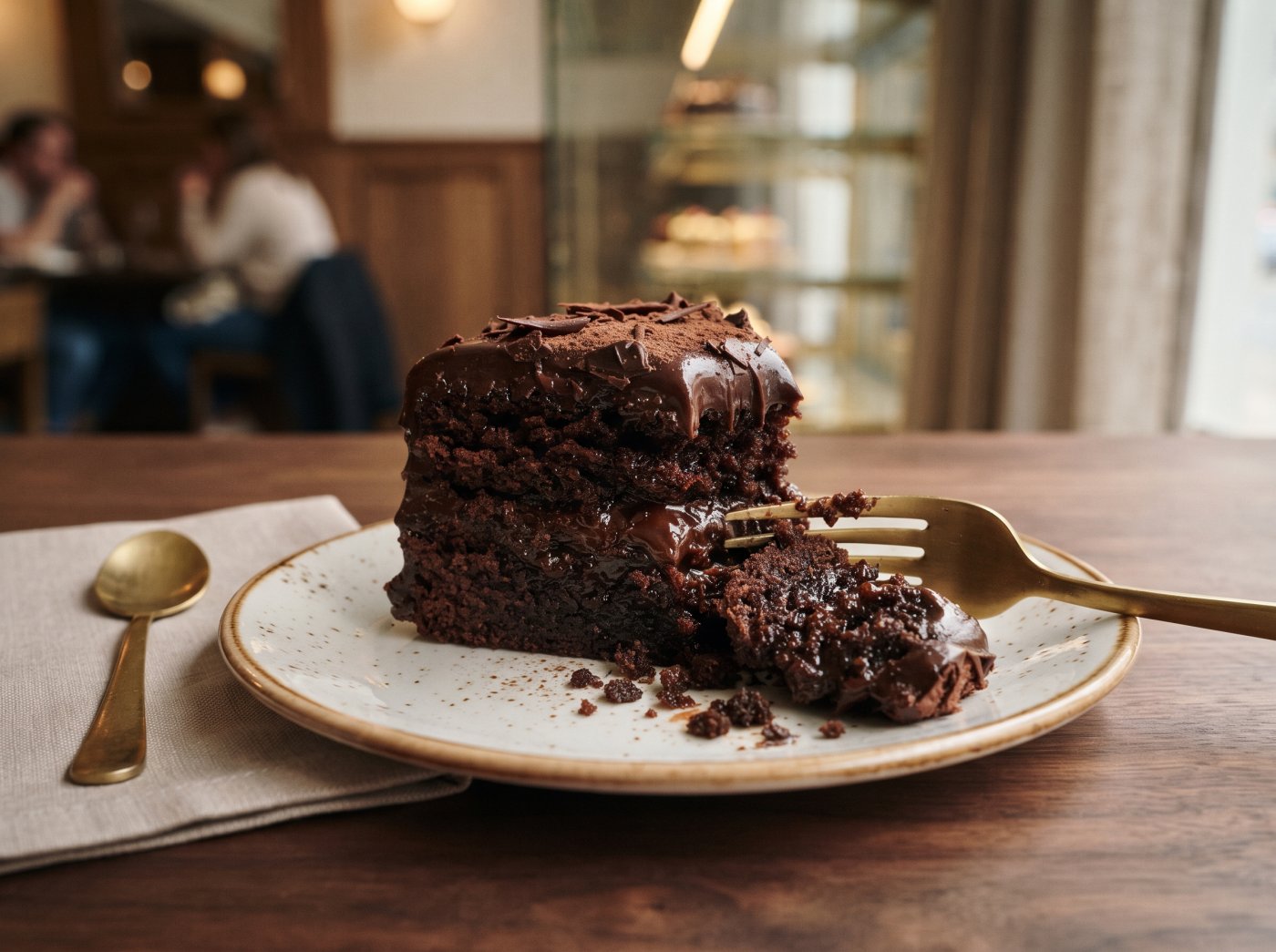
Chocolate drenched cake — ıslak kek — is one of the fastest-selling items in Turkish patisserie windows, and it takes its name directly from its texture. Two kitchens following the same recipe can produce one moist result and one soggy one. The difference lies not in the ingredients but in the timing.
How does the cake absorb the sauce?
The inside of a cake leaving the oven has a spongy structure: countless small air pockets sit between a network of starch and protein. Those pockets form the space the sauce will enter.
Absorption advances by two mechanisms. The first is capillarity; liquid is drawn spontaneously upward and inward through narrow spaces. The second is the starch itself; a gelatinised starch structure can bind water molecules.
Both mechanisms work efficiently only while the cake is hot. As it cools, starch begins to recrystallise and its capacity to bind water falls, while the pockets contract. This is why the same sauce, poured onto a cold cake, does not go in and collects in the tin instead.
When should the sauce be poured?
The right moment is within the first fifteen minutes after the cake leaves the oven. In that window the cake is still hot and the pores are open.
The second rule concerns temperature difference: warm or cool sauce goes onto a hot cake. Having both hot loosens the structure of the cake and makes it fall apart when sliced.
The sauce should be poured in two or three stages rather than all at once, waiting for the liquid to absorb between each. Poured in one go, it pools on the surface, over-soaking the top layer while never reaching the bottom.
Piercing the surface with a fork or skewer speeds absorption; but if the holes are too dense the cake falls apart when cut.
Why does the composition of the sauce matter?
A classic sauce consists of milk, sugar, cocoa and butter. Each component has a distinct function.
Milk is the carrier liquid, supplying the volume to be absorbed. Sugar prevents the sauce seeping back out of the cake; a sugared liquid is more viscous and holds better within the starch structure. Cocoa gives both taste and colour, and the starch it contains thickens the sauce slightly. Butter provides body in the mouth and, solidifying slightly on cooling, sets the texture.
When sugar is reduced the sauce becomes more fluid and seeps back out. Making a "low-sugar drenched cake" therefore cannot be achieved by reducing sugar alone; the viscosity of the sauce has to be raised another way.
Which cake batter absorbs best?
| Batter type | Crumb structure | Absorption | Result |
|---|---|---|---|
| Genoise sponge | Large, open | Very high | Absorbs fast, may collapse |
| Butter cake | Medium, tight | Medium | Balanced; the usual choice |
| Dense cocoa cake | Small, tight | Low | Absorbs slowly, sauce stays on top |
| Biscuit base | No pores | Very low | Unsuitable |
The table explains why drenched cake is generally made with a medium-density butter batter. Genoise absorbs a great deal but is structurally weak; a dense cake is robust but will not absorb.
Why does it need to rest overnight?
In a cake cut immediately after the sauce is poured, moisture is unevenly distributed; the top layer is wet and the bottom dry.
Over several hours in the refrigerator the liquid spreads through the whole cake by capillary action. In the same period the starch structure binds part of the water and the texture sets.
Drenched cake is therefore at its best the day after it is made rather than the day it is made. Display timing should be planned accordingly.
Why does it stale more slowly?
Cake staling occurs as starch recrystallises and water separates from the structure. In dry cakes the process advances quickly.
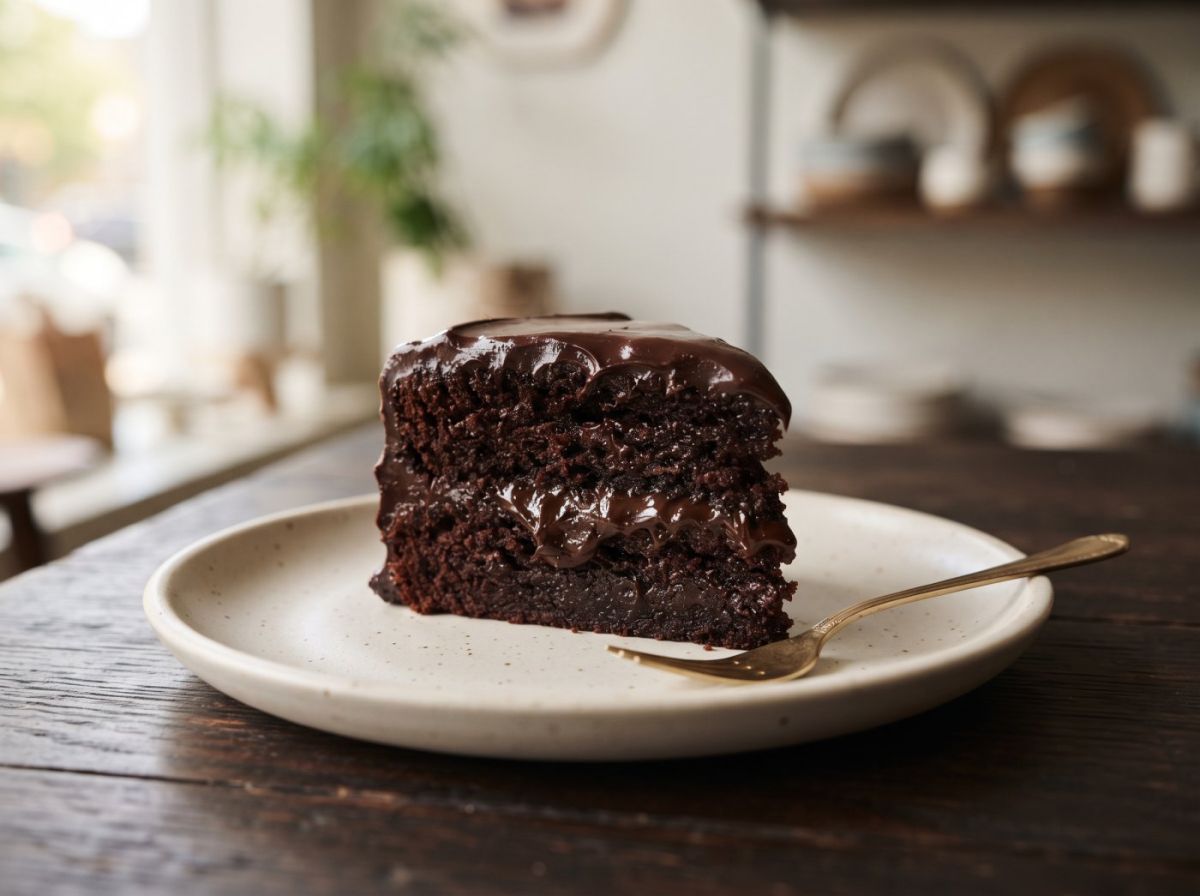
Two factors slow it in a drenched cake. The first is the high moisture content; with plenty of water present, starch is less inclined to crystallise.
The second is sugar. Sugar molecules bind water molecules to themselves and delay their return to the starch structure. This is a typical illustration that sugar is not merely a sweetener in patisserie.
The result is that drenched cake stays soft two or three days longer than a plain one.
How is frozen drenched cake thawed?
Drenched cake prepared frozen should be thawed slowly at refrigerator temperature. Depending on slice size, this takes between three and six hours.
Thawed quickly at room temperature, condensation forms on the surface and over-wets the top layer; the cake will not hold its shape when sliced.
Microwave thawing is unsuitable. A microwave heats water directly; the moisture inside the cake evaporates and the product comes out dry rather than moist.
What temperature should it be served at?
Drenched cake is served cold; at refrigerator temperature the texture stays firm and it slices cleanly.
But in a slice taken straight from the refrigerator the cocoa aroma is suppressed. Brought out ten minutes before serving, a slice holds its shape and shows its aroma.
A hot element alongside — warm chocolate sauce or a spoonful of hot espresso — creates a contrast in temperature and raises the perceived intensity. This adds value on the plate without changing cost.
Does the tin affect the result?
It does, because absorption starts at the surface and the geometry of the tin sets the ratio of surface to volume.
A cake baked in a wide, shallow tin has a large top surface; the sauce enters over a broad area and travels a short distance to the centre. Absorption is fast and even.
In a narrow, deep tin the sauce has a long distance to travel to reach the centre. The top layer saturates and stops conducting the excess liquid; the bottom stays dry.
This is why drenched cake is traditionally baked in wide trays and cut into squares. If a deep tin is used, the sauce should be divided into more stages with longer waits between them.
What mistakes are commonly made?
- Pouring sauce onto a cold cake: the most common error; it is not absorbed and pools in the tin.
- Pouring all the sauce at once: the top over-soaks while the bottom stays dry.
- Making too many holes: the cake falls apart when sliced.
- Reducing the sugar: the sauce thins and seeps back out.
- Serving the same day: the moisture has not finished distributing.
- Unmoulding too early: the sauce has not been absorbed and the cake loses its shape.
What these six have in common is that all of them concern timing. Drenched cake demands patience more than it demands ingredients.
