


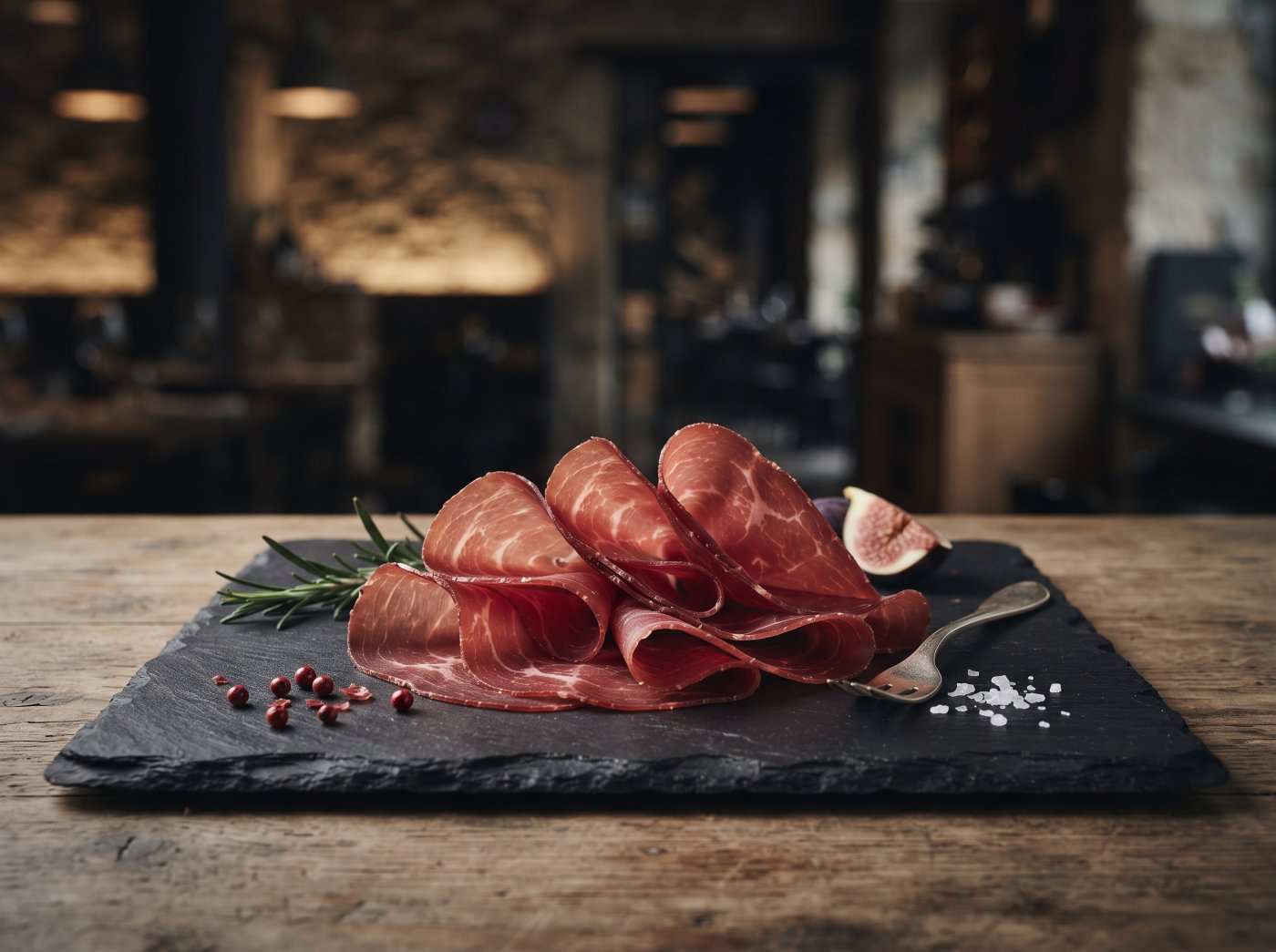
The word ham comes from an old root meaning the bend of the knee, and that origin gives the product its classic definition worldwide: a salted and cured meat product prepared from the leg of the animal.
What does ham mean in Türkiye?
In Türkiye, ham has come to denote a style of production rather than a specific anatomical region. Beef ham is produced by brining meat generally taken from the leg or shoulder, moulding it and putting it through heat treatment.
That shift also determined the character of the product. In classic hams the meat stays whole and its fibres are pronounced; in the type common in Türkiye, pieces of meat are brought together and moulded, so the cut face looks more uniform.
The second difference is heat treatment. Air-dried, cured hams are widespread internationally and are not cooked. Beef ham in Türkiye is a cooked product, ready to eat when it reaches the consumer.
How is it produced?
Production has five stages, and each affects the final texture.
Preparation. The meat is trimmed of fat and connective tissue. How much is removed at this stage determines the quality of the final product directly.
Brining. A solution of salt, sugar, spices and curing salts is introduced into the meat. In small production the meat is immersed; in industrial production it is injected through needles. Injection lets the salt reach the centre of thick pieces.
Tumbling. The meat is turned slowly with the brine in a rotating drum. This mechanical action draws muscle proteins to the surface, and those proteins later act as a natural adhesive binding the pieces together.
Moulding. The meat is placed in a mould according to the cross-section wanted. A square baton covers a slice of sandwich bread completely; a round baton gives the classic slice appearance.
Heat treatment. The product is cooked until its core reaches a specified temperature. This stage both delivers safety and binds the proteins into a structure that can be sliced.
What does the injection rate mean?
The ratio of brine to meat is the most concrete criterion of a product's quality class, and it appears on the label as meat content.
| Meat content | Brine share | Texture | Use |
|---|---|---|---|
| Above 90% | Low | Fibrous, firm | Premium, thin slicing |
| 80-90% | Medium | Balanced | General use |
| 70-80% | High | Soft, moist | Economy segment |
| Below 70% | Very high | Loose | Weeps when heated |
A high brine ratio makes the product cheaper but has two consequences: it releases noticeable water when heated in a pan or oven, and it falls apart more readily when sliced.
Reading the meat content on the label is the single most informative check when buying ham.
Why do some hams show visible pieces of meat?
Products showing distinct pieces in cross-section are described as containing whole muscle, and they are made by bringing larger pieces of meat together.
In products with a uniform cross-section the meat is ground more finely and a structure close to an emulsion forms. This gives a softer texture but a more uniform appearance.
There is no quality hierarchy between the two; they serve different uses. Whole-muscle product looks better on a cold plate and in thin slices; uniform product gives more even coverage in toasted sandwiches.
How should ham be sliced?
Slice thickness affects perceived quality directly. A thin slice feels tender; a thick one feels heavy and becomes harder to chew.
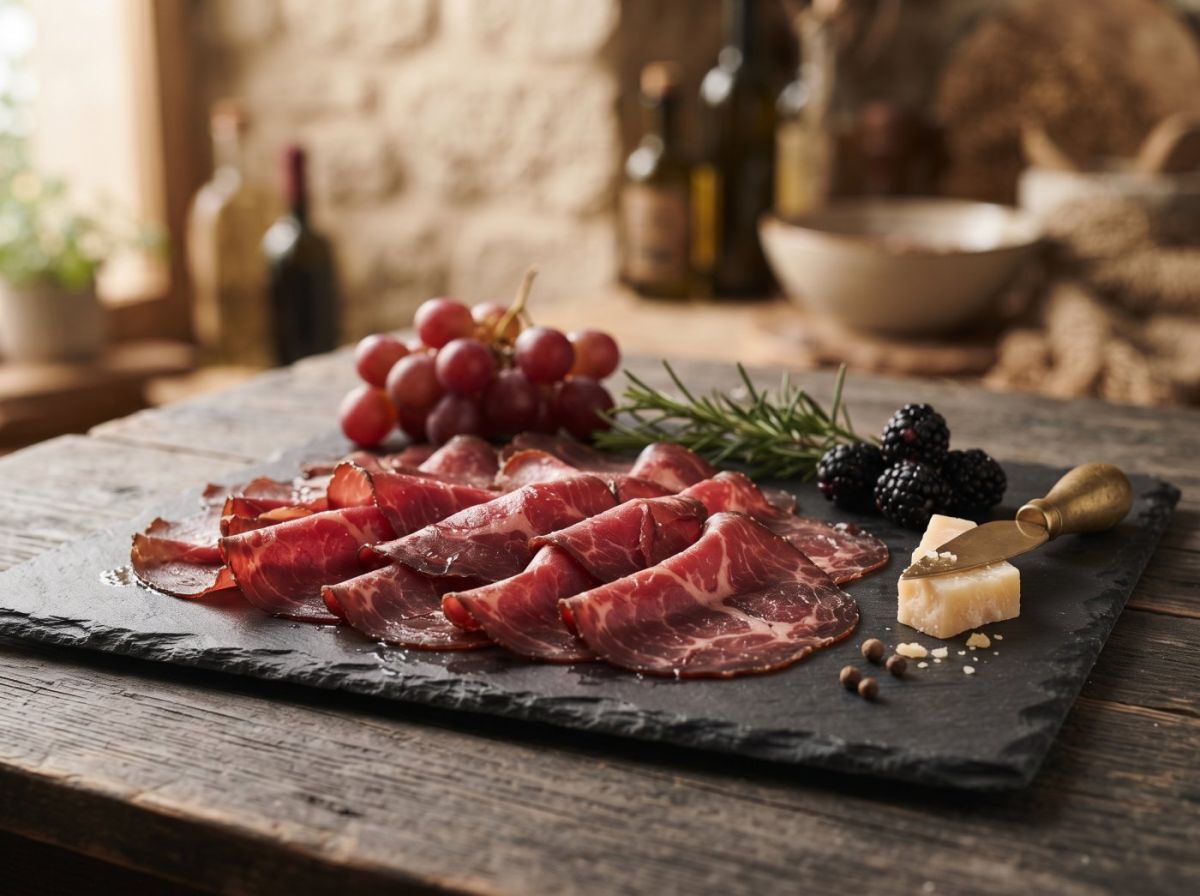
For cold plates and breakfast, 1-2 millimetres suits. In a sandwich 2-3 millimetres holds up better; anything thinner disappears inside the bread. For toasted sandwiches and pizza, 2 millimetres is enough.
Slicing should be done with product straight from the refrigerator. Ham that has come to room temperature softens, sticks to the blade and tears.
Buying a baton and slicing as needed has two advantages over pre-sliced: less of the cut surface oxidises, and the unit cost is lower.
Where is it used in the kitchen?
The most common use is cold service: breakfast plates, sandwiches, cold buffets. In these the product is not heated and is judged on its own texture.
Hot use calls for care. Ham is already cooked; heating it for long periods drives out its moisture and toughens it. Adding it last on a toasted sandwich or pizza protects both texture and colour.
When used within a dish — pasta sauce, omelette, pastry filling — the salt content has to be taken into account. The product is already salted, and adding more salt to the recipe upsets the balance.
How does it differ from other charcuterie?
Ham is often confused with salami and sausage, but their production logic diverges.
Salami is made by blending finely ground meat with spices and filling it into casing; no pieces of meat are visible and the texture is an emulsion. Sausage follows similar logic with different spicing and casing.
In ham, by contrast, the meat is kept as whole as possible. The aim is to preserve the meat's own fibre structure. This is why ham feels more like meat than salami does.
Roast is the product closest to ham; the difference is that a roast is generally made from a single piece and cooked without moulding.
What does curing salt do?
The brine used in ham production contains a small quantity of nitrite alongside table salt. That substance determines both the safety and the appearance of the product.
Its primary function is microbiological: nitrite prevents the growth of the bacterium that develops in oxygen-free conditions and causes botulism. For a product sold in vacuum packaging that protection is essential.
Its second function is colour. Nitrite combines with the myoglobin in the meat to form a heat-stable compound; this is why ham stays pink despite being cooked. Products made without nitrite come out a greyish brown.
The third is taste. The characteristic flavour of cured meat is a by-product of these reactions and cannot be obtained any other way.
The quantity used is limited by regulation, and production runs well below that limit; nitrite is added in measured amounts to the brine rather than to the meat directly.
How should ham be stored?
A vacuum-packed baton keeps in the refrigerator for the period on its label while sealed. Once opened, the cut surface is exposed to air and deterioration accelerates.
An opened baton should be stored with the cut face wrapped tightly in cling film. That single practice extends its life by several days.
Sliced product should be eaten within three or four days. Freezing is possible but the texture loosens somewhat; if it is to be frozen, greaseproof paper between the slices prevents them sticking together during thawing.
