


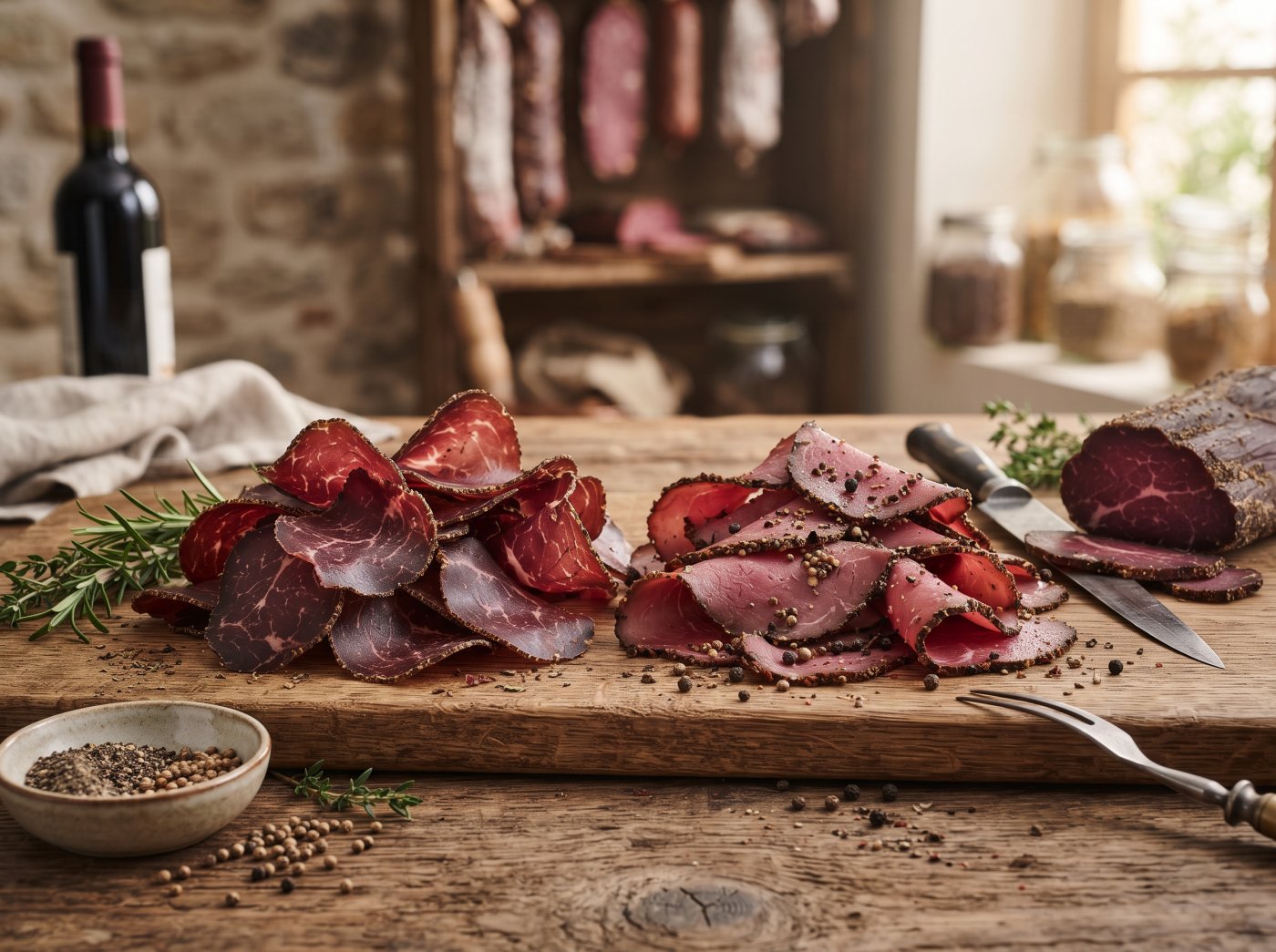
Air-dried beef is a more complex product than its name suggests. Drying meat is not simply driving off its water; unless time, temperature and humidity are managed together, the result is either underdone or hard as stone.
How is air-dried beef produced?
Production has three stages, all serving the controlled removal of water.
Salting. The meat is rubbed with dry salt or placed in brine. Salt draws water from the surface by osmosis. This is both the beginning of drying and the first step of microbiological safety; as water activity falls, bacterial growth slows.
Pressing. The salted meat is held under weight. Pressure forces out the water remaining inside and compacts the fibres into a dense structure. This step also gives the product its characteristic flat shape.
Drying. The meat is hung in a cool, ventilated space. Depending on thickness this can take weeks. The humidity of the environment is critical: air that is too dry hardens the surface rapidly and traps the moisture inside.
What does the weight loss ratio determine?
The decisive measure in drying is how much of its starting weight the meat has lost. That ratio writes the product's texture and shelf life directly.
| Weight loss | Texture | Shelf life | Use |
|---|---|---|---|
| 20-30% | Soft, moist | Short | Immediate consumption |
| 35-45% | Firm, sliceable | Medium | The common standard |
| Above 50% | Hard, dense | Long | Grated |
Below thirty-five per cent the water activity does not fall far enough and the product is not safe outside refrigeration. Above fifty per cent the meat becomes hard to chew even when sliced thinly.
Common commercial production targets around forty per cent; that ratio gives a balanced result for both sliceability and durability.
Where exactly does it differ from pastırma?
The two products pass through the first two stages — salting and pressing — almost identically. The divergence begins at the third step.
In pastırma, at a certain point during drying, the meat is coated in a paste called çemen, made from fenugreek, garlic, red pepper and water. This coating envelops the meat, which continues drying in that state.
Air-dried beef has no such coating. The meat dries bare and only its own colour remains on the surface.
The consequences of that single difference are large. Çemen creates a moisture barrier; pastırma dries more slowly and retains some moisture inside. The paste also transfers its own aroma to the meat. In air-dried beef the taste is entirely that of the meat and the salt.
| Criterion | Air-dried beef | Pastırma |
|---|---|---|
| Surface coating | None | Çemen paste |
| Dominant aroma | The meat itself | Fenugreek, garlic, pepper |
| Drying speed | Faster | Slower |
| Colour | Deep red-brown | Reddish-brown çemen |
| Slice thickness | 1-2 mm | 1-2 mm |
| Use | Cold plates, in dishes | Eggs, breakfast |
What is smoked air-dried beef?
Some production adds smoking to the drying stage. This changes the product in both aroma and preservation.
Smoke deposits antimicrobial compounds at the surface and delays the oxidation of fat. The drying period can shorten somewhat because protection now comes from two mechanisms.
In taste, a smoky background note is added. These products are usually sold as smoked air-dried beef and are distinctly different from the plain version.
The smoking is done cold; the meat does not cook, it only takes on aroma and continues to dry.
Which cut is used?
The sections best suited to drying are lean muscles that can be removed in a single piece.
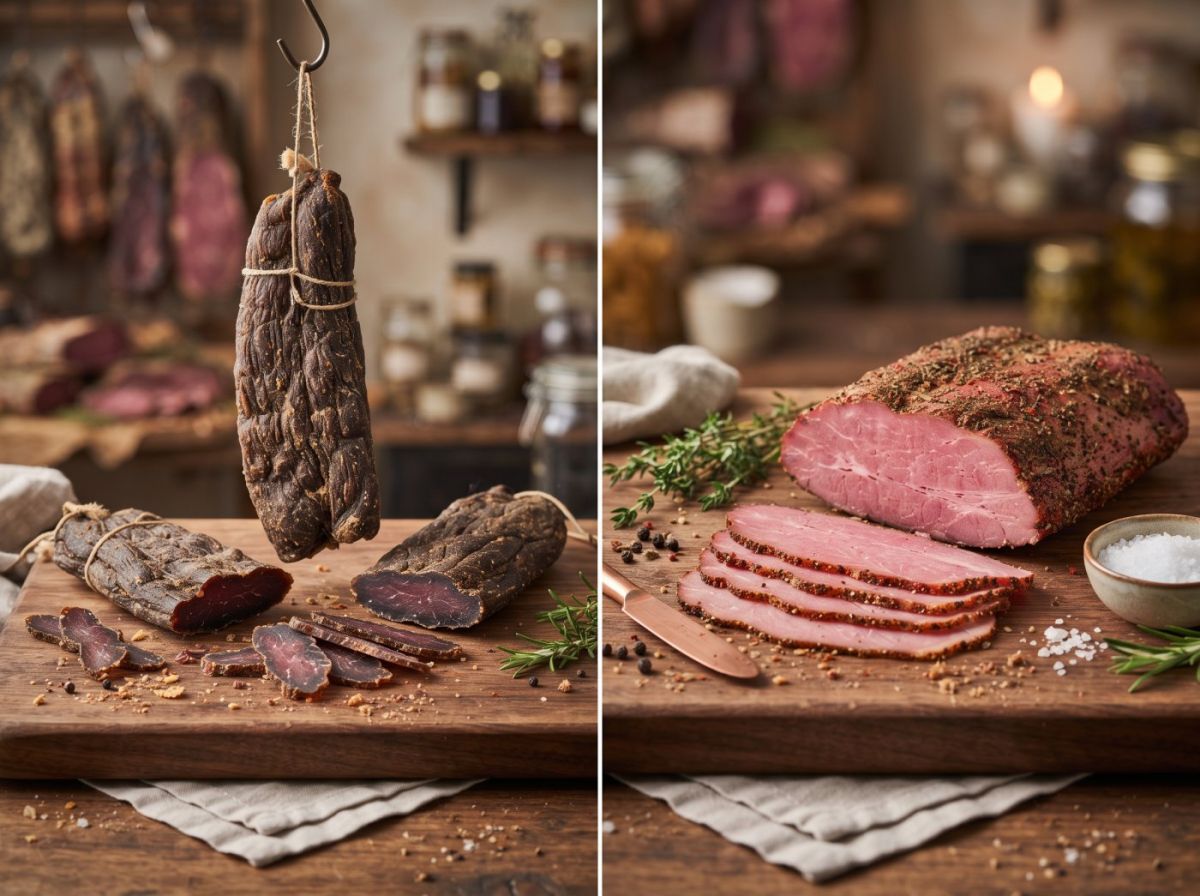
Muscles from the leg are the most common choice. The fibres are regular, the fat content low, and the piece large enough to take a clean shape after pressing.
The back is also used, though the fat content rises there. Fat does not dry; it stays soft during drying and eventually oxidises into a bitter note. Visible fat is therefore trimmed away as far as possible from meat destined for drying.
Connective tissue causes problems too. Dried connective tissue hardens and leaves unchewable strands in the slice; it has to be cleaned away during preparation.
How should air-dried beef be sliced?
Air-dried beef is a dense product, and slice thickness determines chewability directly.
The correct thickness is one to two millimetres; held to the light it should look faintly translucent. A thick slice feels tough however good the product.
The knife should be held across the grain. In slices cut along the grain the fibres stay whole and become markedly harder to chew.
The product should be cut straight from the refrigerator. Air-dried beef at room temperature softens and the knife cannot give a clean face; professional kitchens hold it briefly in a freezer before slicing.
How is air-dried beef used in the kitchen?
Air-dried beef is high in salt and umami; even a small quantity creates a pronounced effect.
On a cold plate it is served thinly sliced alongside cheese and pickles. Because its taste dominates, neutral components are chosen to accompany it.
Within a dish it behaves differently. Used in small pieces in beans, lentils or rice, it contributes salt and depth; in that case no additional salt should go into the recipe.
It can also be grated. Grated over pasta or soup, a firmly dried piece performs a function similar to cheese.
It requires no cooking; the product is already safe. Heating compacts its fibres and toughens it, so adding it to hot dishes at the moment of service gives a better result.
What are the storage conditions?
Thanks to its low water activity, air-dried beef is more durable than other meat products, though not indefinitely so.
Kept whole and wrapped in cloth or paper, it keeps for weeks in a refrigerator. It needs to breathe; wrapped tightly in plastic, moisture collects at the surface and mould can develop.
Sliced product dries and darkens far faster. Only as much as is needed should be sliced, with the rest kept whole.
Freezing is possible but unnecessary; the product is already long-lived and freezing loosens its texture somewhat.
White specks on the surface are usually salt crystals and are harmless; rubbed with a finger they disperse. Growths that do not disperse and look fuzzy are mould, and the product should not be eaten.
