


Simit is Türkiye's most widespread street food, and its recipe is surprisingly short: flour, water, salt, yeast. The two things that make it simit are not on that list — molasses water and sesame.
Why is simit dough different from other breads?
Simit dough is prepared firmer and with less water than bread dough. The water ratio is generally around fifty-five per cent of the flour, while bread reaches sixty-five.
The reason for that firmness is shapeability. Simit is rolled into a long rope and twisted into a ring. A wet dough stretches during that process and cannot hold its shape.
The second difference is gluten development. Simit dough is kneaded thoroughly; a strong gluten network prevents the dough breaking during twisting and gives the characteristic chew after baking.
No fat or sugar goes into the dough. Simit is an unenriched dough; its sweetness and colour come entirely from outside, from the molasses.
What does molasses water do?
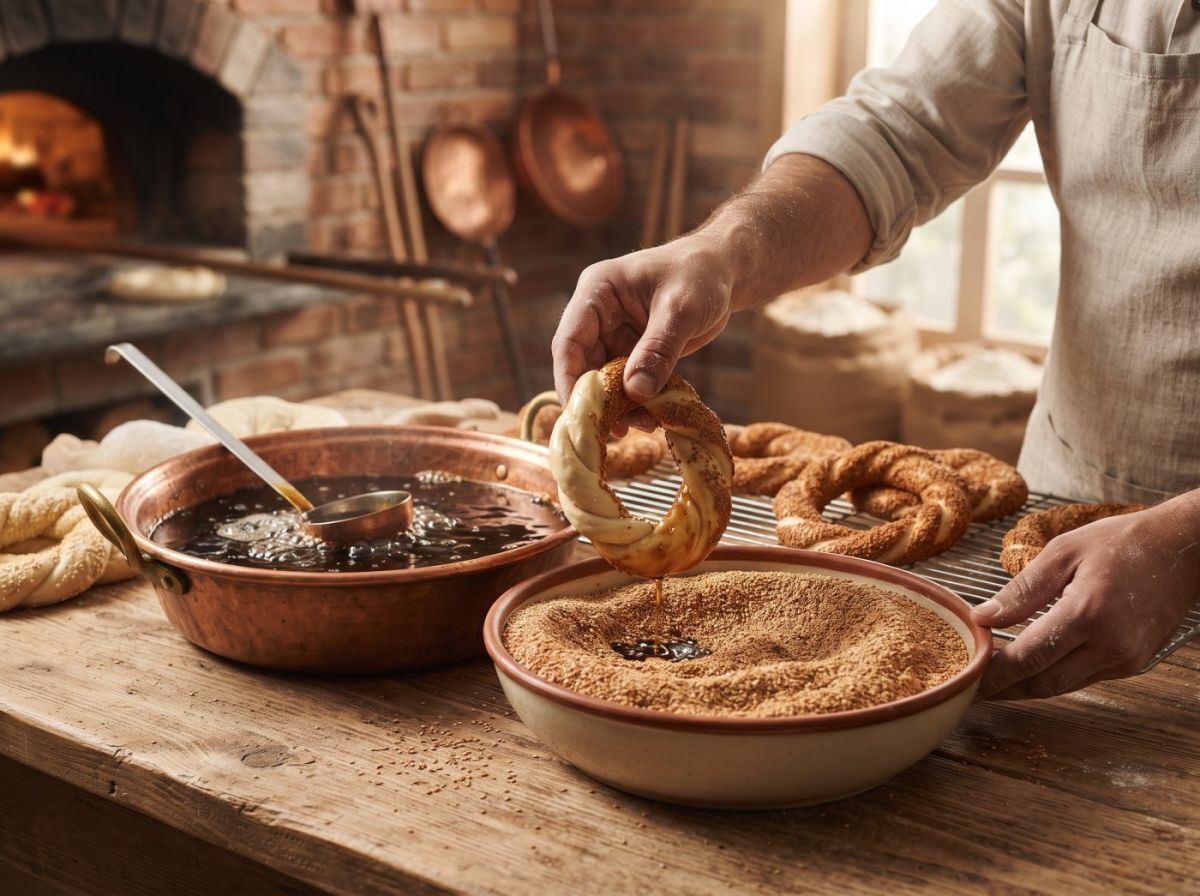
The shaped rings are dipped in diluted grape molasses before going into the oven. This step serves three functions.
The first is colour. The sugars in the molasses caramelise under oven heat and give simit its deep golden shade. Without molasses, simit stays a pale yellow.
The second is taste. Molasses leaves a light sweetness and a characteristic background note. That note is what separates simit from a sesame bread.
The third is adhesion. A surface that is wet and sugared lets the sesame hold. Sesame scattered on dry dough falls off during baking.
The molasses ratio matters. Too concentrated a solution makes simit overly sweet and darkens the surface early; too dilute a solution neither colours it nor holds the sesame. Common practice is one part molasses to three to five parts water.
Why does the sesame matter so much?
Sesame is not merely simit's coating but half of its flavour profile.
Roasting in the oven, the sesame releases its oil and produces a pronounced aroma. That aroma balances the neutral taste of the dough itself.
Sesame quality is felt directly. Unhulled sesame gives a more intense aroma but darkens easily during baking; hulled sesame is lighter in colour and milder.
Freshness is decisive too. Being high in oil, sesame oxidises over time and takes on a bitter note. In simit made with old sesame that bitterness becomes more pronounced in the oven.
How is the ring shaped?
The dough balls are first rolled into a long rope. The thickness of that rope determines the final texture: a thin rope gives a crisper simit, a thick one a softer result.
The rope is then doubled and the two ends twisted around each other. That twisting creates simit's characteristic spiral appearance and lets the layers separate during baking.
In the final step the two ends are joined to close the ring. If the join is not pressed firmly it opens in the oven and the simit ceases to be a ring.
The number of twists is a regional preference. Istanbul simit is twisted tightly and many times; some regions twist more loosely and the simit looks thicker.
What should the baking regime be?
| Stage | Temperature | Time | Purpose |
|---|---|---|---|
| Preheat | 250 °C | 20 minutes | Heating the stone or tray |
| First stage | 240 °C | 8-10 minutes | Rapid rise, crust formation |
| Second stage | 220 °C | 5-8 minutes | Cooking through, setting colour |
Simit is baked at high temperature. At low heat the dough dries and the simit turns hard; high heat forms the outer crust quickly and traps steam inside, leaving a soft crumb.
A hot oven floor matters particularly. Traditional simit ovens use a stone base; at home a preheated tray or baking stone gives a comparable result.
How is raw frozen simit baked?
Raw frozen simit is blast-frozen already shaped, dipped in molasses and coated in sesame. This means the most labour-intensive steps are already complete.
The product is first thawed, then left to prove. Because simit dough is firm, proving takes less time than poğaça; usually between forty-five and seventy minutes.
Once risen, the product goes straight into the oven. Skip the thawing and the centre stays cold, leaving the simit doughy inside.
What does 80 per cent par-baked frozen mean?
This product has been baked at the factory but taken from the oven and frozen before its colour was complete.
The only thing to do at the outlet is a short bake. Within five or six minutes the product takes on its final colour and reaches the state of having just left the oven.
This format is designed for businesses with limited oven capacity. It requires no proving, demands no staff expertise and its service time is very short.
In exchange the texture is somewhat denser than simit prepared from raw frozen dough; dough heated a second time loses a degree of moisture.
What are the regional differences?
Although simit goes by the same name across Türkiye, it varies markedly from region to region.
Istanbul simit is thin with a wide ring; the dough is twisted tightly and crispness comes to the fore. The sesame ratio is high, covering almost the entire surface.
Ankara simit is thicker and softer. The ring diameter is smaller, the crumb stays more open and it offers resistance to the bite.
The product known as gevrek in İzmir is the thickest of all. Its molasses ratio is lower, its colour lighter and its outer crust noticeably harder.
These are not differences of recipe; they arise from small shifts in dough consistency, rope thickness, tightness of the twist and baking time. The same four ingredients produce four distinct products.
Why does simit stale so quickly?
Simit contains no fat, and this is the main reason it is defenceless against staling. Fat delays the recrystallisation of starch; simit has no such protection.
The second factor is surface area. The ring shape creates a far larger surface than a bread of the same weight, and moisture escapes rapidly from it.
In practice simit is at its best within the first few hours after baking. Businesses therefore bake in small batches through the day; simit baked all at once in the morning has hardened by the afternoon.
Stale simit can be partly recovered by a few minutes in the oven; sprinkling a little water over it helps the crumb soften.
