


Tahini halva is a fixture of winter and of the breakfast table in Türkiye. When its nutritional value comes up, a single number is usually expected: how many calories? Yet with this product, where the calories come from tells you more than the figure itself.
How many calories does tahini halva contain?
A hundred grams of tahini halva carries on average 500-560 kilocalories. That places it among the most energy-dense foods; for comparison, the same quantity of white bread contains around 265 kilocalories.
But a hundred grams is not a realistic portion. A typical breakfast slice is between twenty and thirty grams, corresponding to roughly 110-165 kilocalories.
That figure is comparable to a slice of wholemeal bread spread with jam. The density is high but the portion is small; the two have to be considered together.
Where do the calories come from?
The character of the product becomes clear from its macronutrient distribution.
| Nutrient | Per 100 g | Share of calories |
|---|---|---|
| Fat | 30-35 g | About 55% |
| Carbohydrate (sugar) | 45-50 g | About 35% |
| Protein | 11-13 g | About 9% |
| Fibre | 3-4 g | — |
More than half the calories come from fat, and that fat comes from sesame; it is the raw material's own fat rather than something added. Most of sesame oil consists of mono- and polyunsaturated fatty acids.
The carbohydrate portion, by contrast, is largely added sugar. Traditional production uses sugar syrup or grape molasses, and this is the most debated component of the product.
What does sesame contribute?
Sesame is the component that carries halva's nutritional value beyond its calorie count.
It is rich in calcium, ranking among the highest-calcium plant foods. Its iron content is also notable, and this — particularly in combination with molasses — is why it has traditionally been regarded as blood-building.
It also supplies magnesium, zinc, phosphorus and B-group vitamins. Protein content is around twelve grams per hundred, which is above what might be expected of a plant product.
Sesame further contains compounds called sesamin and sesamolin. These have antioxidant properties and are the reason tahini deteriorates more slowly than other oily products.
Do the molasses and pistachio versions differ?
They do, and the difference shows in both calories and nutrient profile.
In molasses halva, some or all of the sugar comes from grape or date molasses. Total calories do not change markedly, but the molasses contributes iron and potassium. Its mineral content is higher than that of refined sugar.
In pistachio halva calories rise somewhat, because pistachio is a nut high in oil. In return the contribution of protein and vitamin E rises as well.
Cocoa versions generally contain additional sugar and reach the highest calorie level.
How much should be eaten in a day?
Rather than giving a blanket recommendation, it is better to frame the approach around portions.
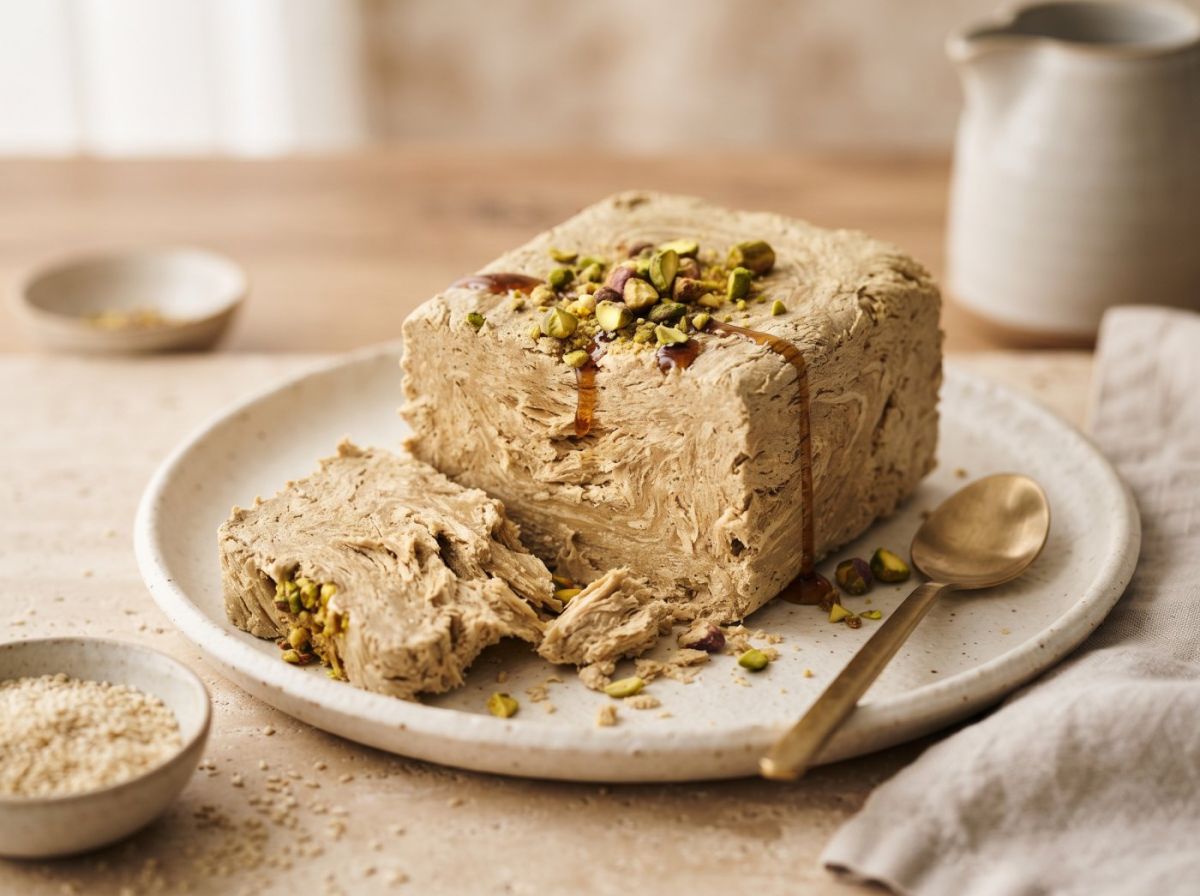
For an adult, a slice of twenty to thirty grams corresponds to roughly five to eight per cent of daily energy needs. That is a reasonable quantity as part of a balanced breakfast.
For children the portion should be smaller; fifteen to twenty grams is an appropriate range. The energy density of halva can easily lead to over-consumption in children.
For those managing their weight, halva belongs within a meal rather than between meals. Eaten alone it raises blood sugar quickly; taken with bread, cheese and olives that effect is softened.
Can people with diabetes eat it?
This is a question for a doctor or dietitian; the general framing, however, is this: tahini halva is high in sugar and produces a rapid rise in blood sugar when eaten on its own.
On the other hand, its fat and protein content slows absorption somewhat. Halva therefore behaves differently from pure sugar.
The approach recommended in practice is to keep the quantity small and always eat it within a mixed meal. Tahini produced without sugar can be considered as an alternative; tahini itself contains no added sugar.
Is it suitable for athletes?
Because it is energy dense, it can be a practical source for athletes with high calorie requirements. It supplies significant energy in a small volume, which is an advantage for those who struggle to take in enough calories.
Before training, however, the high fat content can be a drawback; fat slows gastric emptying and can cause discomfort during exercise. Eating it at least two hours before training is more suitable.
For post-training recovery the combination of carbohydrate and protein is useful; halva offers both, though the protein alone is not sufficient and should be supplemented with a protein source.
How is halva produced?
Production brings two separate lines together, and that combination determines the nutritional profile.
The first line is tahini. Sesame is washed, hulled, roasted and ground in a stone or steel mill. During grinding the sesame releases its own oil and a flowing paste forms; no additional oil is added to tahini.
The second line is sugar syrup. Sugar is boiled with water and brought to a particular density. An extract from a plant root called soapwort is added to this syrup; it makes the syrup foam and hold air. The fibrous, layered texture of halva forms at this stage.
The two lines are combined and pulled, by hand or by machine. Pulling interleaves the tahini and the syrup as fine fibres. The most important variable determining quality is the tahini ratio; halva high in tahini is softer, richer and less sweet.
How should tahini halva be stored?
Tahini halva is kept at room temperature in a cool, dry place. Refrigeration is neither necessary nor advisable; cold hardens the texture and makes slicing difficult.
Once opened, contact with air should be limited. Oil separation may appear at the surface; this is not spoilage but the natural behaviour of tahini, and causes no problem once stirred or when a slice is cut.
If a bitter taste develops in halva kept for a long period, that indicates the oil has oxidised and the product should not be eaten.
