


Tahini halva consists of three main components: tahini, sugar syrup and soapwort extract. Despite that short list, production is highly sensitive to temperature and timing; two makers working with the same ingredients can produce entirely different textures.
How does sesame become tahini?
Production begins with preparing the sesame, in four steps.
The sesame is first soaked in water. This loosens the outer hull, which carries a bitter note that is unwanted in halva.
The hull is then separated. The traditional method uses flotation in salt water: hulled sesame sinks while the hulls float. In industrial production this is done by centrifuge.
The third step is roasting. Sesame is roasted at a set temperature, and this stage determines the colour and aroma of the tahini. Under-roasted sesame gives a pale, flat tahini; over-roasted sesame a dark, bitter one.
The final step is grinding. Ground in a stone or steel mill, the sesame releases its own oil and turns into a flowing paste. No oil is added to tahini; all of it comes from the sesame itself.
What does soapwort root do?
Soapwort is the root of a plant growing in Anatolia and is halva's most critical yet least known component.
The root is boiled in water for a long period and the resulting dark extract is strained. That extract contains natural compounds called saponins, which foam on contact with water.
Added to the sugar syrup, soapwort allows the syrup to hold air. As it is beaten the syrup whitens and increases in volume. That air is the basis of halva's porous, light structure.
Halva made without soapwort is dense and hard; the sugar and tahini combine but no fibrous structure forms. Soapwort is therefore an ingredient used for texture rather than taste.
To what temperature is the syrup brought?
Sugar and water are boiled to a particular density. That density determines the firmness of the halva directly.
| Syrup temperature | Result | Use |
|---|---|---|
| 115-118 °C | Soft, spoonable | Halva in tubs |
| 120-125 °C | Sliceable, standard | Block halva |
| Above 128 °C | Hard, brittle | Not preferred |
If the temperature stays low the halva remains fluid even when cool and cannot be sliced. Too high and the sugar approaches crystallisation; the product leaves a gritty sensation in the mouth.
A thermometer is therefore a necessity rather than a preference in halva production. In traditional making, masters check consistency by dropping syrup into cold water.
Why is the pulling stage so decisive?
Once syrup and tahini are combined, the mixture is pulled: continuously folded, stretched and folded again with a wooden paddle.
That movement does not blend the two components; it interleaves them as fine layers. Every fold doubles the number of layers, and thousands of layers too fine to see are eventually formed.
The fibrous structure visible when halva is cut is those layers. The silky texture felt as it dissolves in the mouth results from the same structure.
The temperature keeps falling during pulling. If the mixture cools too far the layers stop bonding and the product crumbles; if it stays too hot the layers merge and no fibrous structure forms at all. The craft lies precisely in catching that window.
When are additions made?
Components such as pistachio, cocoa or molasses go in towards the end of the pulling.
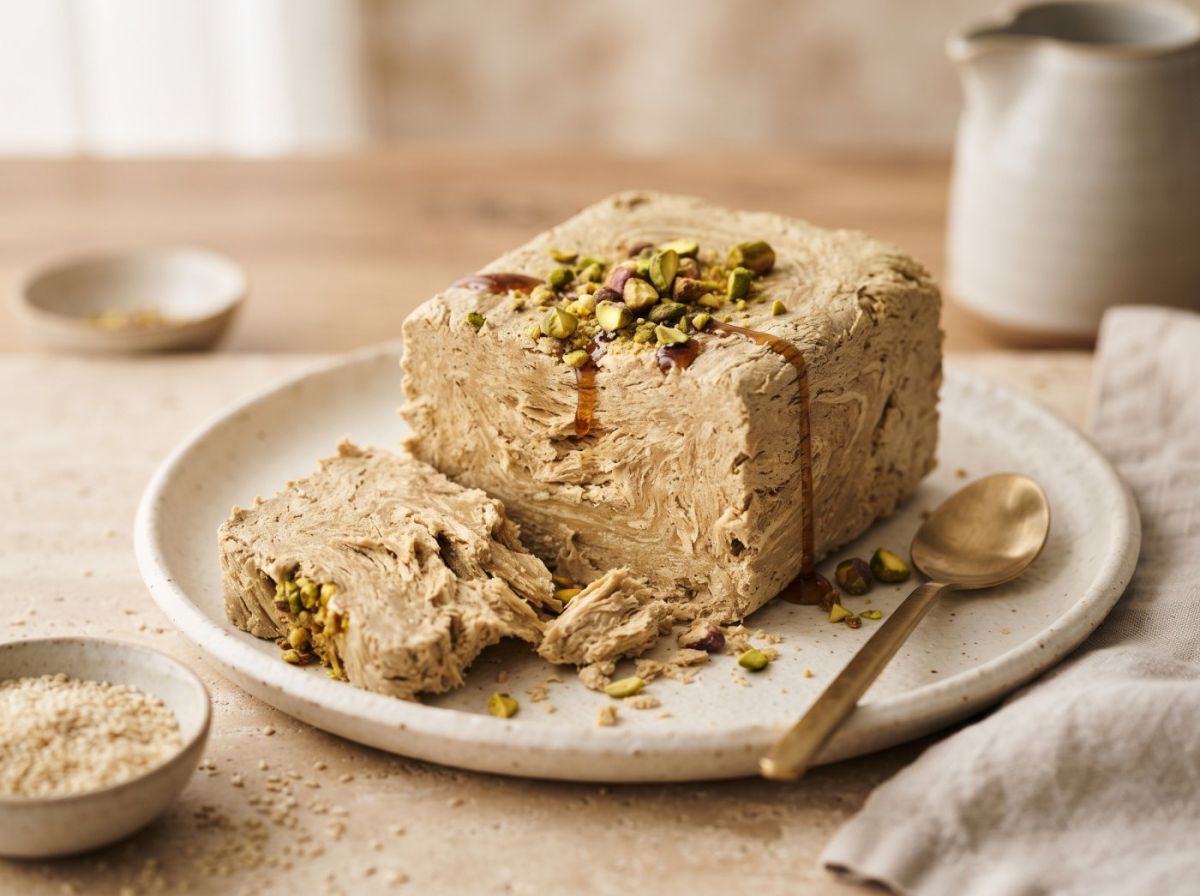
Added early, they disrupt layer formation; pieces of nut get between the layers and break their continuity. Added too late, they fail to distribute evenly.
Molasses halva is a slightly different case: molasses replaces part of the syrup and enters the mixture from the start. This darkens the colour and raises the mineral content.
In cocoa versions the cocoa is generally added by a method called marbling; it is not mixed in fully but pulled so as to leave a veined appearance.
What does the tahini ratio change?
The tahini ratio is the most concrete measure of halva quality, and it appears on the label.
Halva high in tahini is softer, richer and less sweet; it dissolves in the mouth more quickly. In low-tahini halva the sugar share rises; the product hardens and the sweetness comes forward.
The traditional ratio approaches half the total weight in tahini. Below that the product begins to lose its character as halva.
For a buyer the practical indicator is texture: halva that leaves a slight film of oil under a finger is the one with the higher tahini content.
Why does some halva crumble?
Crumbling arises when the layers do not adhere sufficiently, and it can have three causes.
The first is the temperature falling too early during pulling; layers do not bond when cold.
The second is too much soapwort. A mixture holding excessive air builds a porous but weak structure.
The third is grinding the tahini too finely. Over-fine tahini releases too much oil and creates slip between the layers.
A degree of crumbling, however, is not a fault; it is the natural consequence of a fibrous structure, and halva that holds together completely usually means too much sugar.
Is the layer of oil on the surface normal?
It is. Tahini is a naturally separating product; its solid particles settle and the oil rises. The same behaviour appears in halva.
This is not a sign of spoilage and says nothing about quality. On the contrary, halva showing no surface oil at all may contain an emulsifier.
The oil layer is eaten along with the product and need not be poured off. Poured away, the halva dries and its texture hardens.
How does industrial production differ from traditional?
The basic steps are the same; the difference emerges in control and scale.
On industrial lines the syrup temperature and pulling time are managed automatically. This minimises variation between batches; every pack delivers the same texture.
In traditional production the maker decides by the appearance of the mixture and the resistance it gives the paddle. The result can vary from batch to batch; sometimes a fault, sometimes a sought-after characteristic.
The second difference is the use of soapwort. Some industrial production uses standardised plant extracts in its place; the function is the same, though a small difference appears in the flavour profile.
