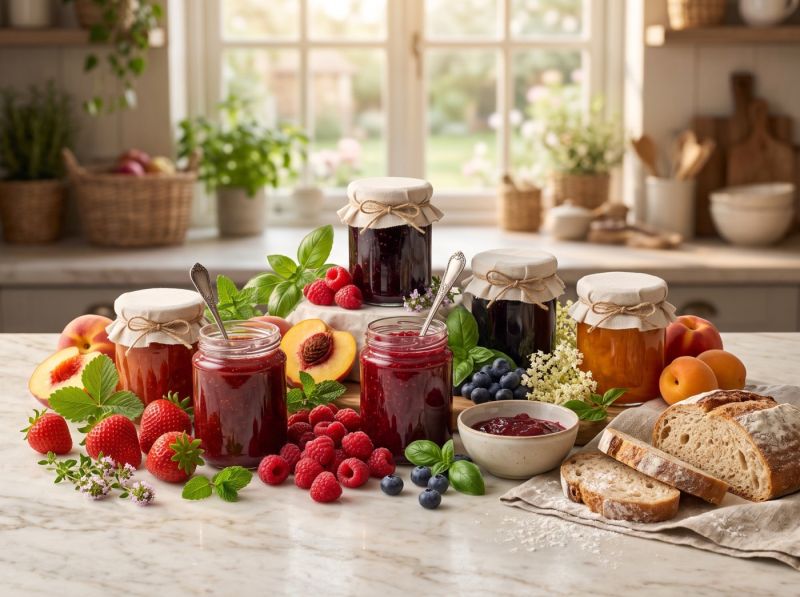
Jars of jam carry statements like "made with 50% fruit". That statement means something different from what people assume, and it is worth understanding when judging a product.
What does fruit content actually indicate?
The figure on the label is the quantity of fruit used per hundred grams of finished product.
Fifty percent fruit means fifty grams of fruit were used to produce a hundred grams of jam.
The amount of fruit in the jar differs from that, because water evaporates from the fruit during production.
A fifty percent figure therefore does not mean the jar is half fruit; it is usually more.
A higher figure means more fruit went into each unit of product, and that is a direct quality indicator.
How are jam, extra jam and marmalade distinguished?
These three names are legally defined and should not be confused.
In jam the fruit content is generally at least thirty-five percent. For some fruits the threshold differs; it can be lower for intense fruits such as blackcurrant and rosehip.
In extra jam the threshold is higher, forty-five percent. Extra jam also uses whole or broken fruit rather than purée.
Marmalade defines a product made from citrus. It contains peel and has a different threshold.
In Turkey the word marmelat is sometimes used for products made from fruit purée, which is why reading the label matters.
Jelly is made from fruit juice and contains no pieces of fruit.
| Product | Fruit content | Fruit form | Texture |
|---|---|---|---|
| Extra jam | At least 45% | Whole or pieces | Visible fruit |
| Jam | At least 35% | Pieces or purée | Mixed |
| Marmalade | Citrus, own threshold | Includes peel | Jelly with peel |
| Jelly | From juice | No pieces | Clear gel |
| Fruit spread | No threshold | Variable | Variable |
What does sugar do in jam?
Sugar is not only a sweetener; it is a preservation and texture system.
Sugar binds water and lowers water activity. Below 0.85, microorganisms cannot develop.
This is why classic jam keeps for years at room temperature without preservatives.
Sugar also works with pectin to form the gel. Pectin needs both acid and sugar to set.
In classic jam the sugar content runs between fifty-five and sixty-five percent. That is the total in the finished product and includes the fruit's own sugar.
When sugar is reduced, both functions weaken, and the formulation has to change accordingly.
What is pectin and why is it added?
Pectin is a polysaccharide found naturally in the cell walls of fruit.
In the presence of acid and sugar it forms a network, and the set of a jam comes from that network.
Fruits differ in pectin. Apple, quince and citrus peel are high; strawberry, cherry and peach are low.
Jam made from low-pectin fruit will not set. Added pectin is used for that reason.
Added pectin is an additive but its source is fruit; it is generally extracted from apple pomace or citrus peel.
"Pectin" on a label does not indicate lower quality; it is a technical necessity with low-pectin fruits.
What about reduced-sugar jams?
When sugar is reduced, preservation weakens and something has to compensate.
Some products add a preservative: potassium sorbate or sodium benzoate.
Others replace preservatives with a requirement for refrigeration. In those products the instruction "refrigerate after opening" is more critical.
The texture changes too. Setting is harder with less sugar, so modified pectin or an additional gelling agent is generally used.
Shelf life shortens. Where classic jam keeps for months in the fridge after opening, a reduced-sugar product is measured in weeks.
In versions with sweeteners the calories fall but the texture is markedly different; a sweetener does not perform the structural role of sugar.
How should a jam label be read?
It can be assessed in five steps.
First, the product name. "Jam", "extra jam" and "fruit spread" are different categories.
Second, the fruit content. It is usually stated on the front or just below the ingredients list.
Third, the order of ingredients. Is fruit first, or sugar? The order follows weight.
Fourth, the sugar figure. Above 60 grams per hundred is classic, below 40 counts as reduced.
Fifth, the additive list. Pectin is normal; the presence of preservatives and colourings tells you about the category.
The use of glucose-fructose syrup is also visible on the label. That is a cost-reducing choice generally found in more economical products.
Are visible fruit pieces a mark of quality?
Partly, but not sufficient on their own.
Visible pieces show the product was not made from purée, and that is a positive sign.
But piece size does not indicate fruit content. A few large pieces can mean less fruit than many small ones.
The naturalness of the colour is a clue too. An unusually bright, uniform colour suggests colourings.
Consistency carries information as well. A very runny product is either low in pectin or was not boiled enough; a very stiff one contains a lot of gelling agent.
The most reliable indicator remains the label. Visual assessment complements it rather than replacing it.
How should it be stored after opening?
Classic jam should be refrigerated after opening; it lasts a while at room temperature too, but the mould risk rises.
Use a clean spoon every time. Bread crumbs and butter create starting points for mould.
Wipe the rim after each use. Jam left at the edge dries and prevents the lid from sealing fully.
If mould appears at the surface, the whole jar should be discarded. What you see is only the surface; the mycelium has reached deeper into the product.
For reduced-sugar products that rule is stricter and the window shorter.
Freezing is possible but unnecessary; classic jam already has a long shelf life.