


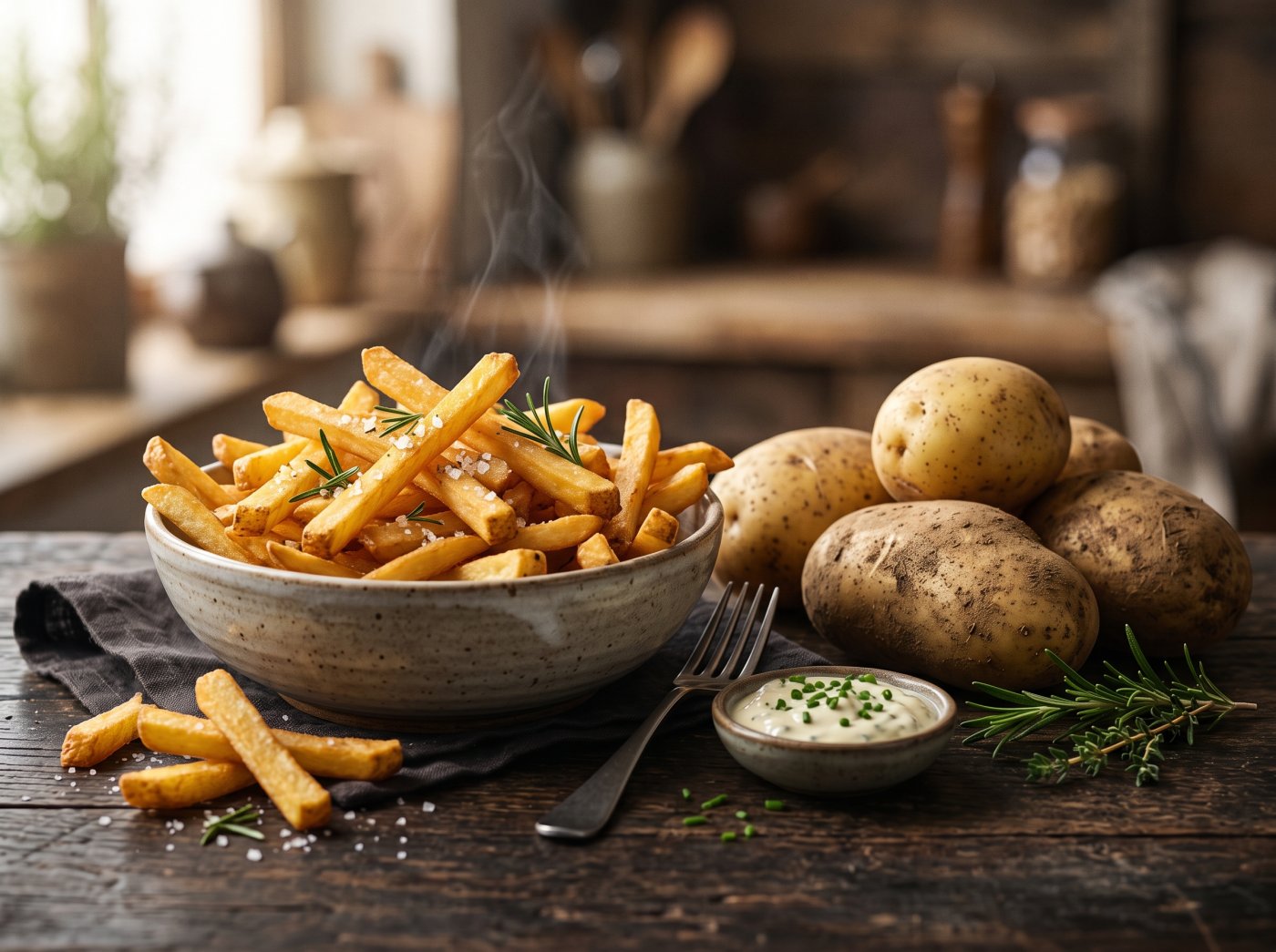
The "A+" seen on frozen potato packaging looks like a marketing label, but there are measurable criteria behind it. Those criteria concern not how the potato looks but its internal composition and the consistency of the cut.
Why is dry matter the first criterion?
About three-quarters of a potato by weight is water. What remains is called dry matter, most of it starch. What frying potatoes need is high dry matter; the target is generally between twenty and twenty-three per cent.
The reason is straightforward. Water leaves as steam during frying. A potato holding a great deal of water loses a great deal as it fries, shrivels and stays soft. In a potato high in dry matter the remaining starch structure holds the skeleton up; a crisp shell forms outside while a floury, substantial texture remains within.
The second consequence is oil uptake. The pores vacated by water fill with oil. As water content falls, so does absorbed oil. A potato high in dry matter gives a less greasy result for the same frying time.
What does sugar content decide?
The quantity of reducing sugars in a potato directly determines the colour after frying. At high temperatures sugars and amino acids react and browning begins. Where sugar content is high the potato darkens before it has properly crisped, and can even turn faintly bitter.
Frying potatoes therefore need low sugar content. The target value is usually below 0.25 per cent.
The factor influencing sugar content most is storage temperature. Stored below four degrees, a potato converts starch into sugar; this is called cold sweetening. For this reason frying potatoes are not kept in a refrigerator, and industrial stores hold temperature between seven and ten degrees.
Why is cut consistency a mark of quality?
This is perhaps the most practical expression of an A+ grading: the length distribution of the potatoes in a single pack. In the higher grade the great majority of pieces fall within the stated length range and the proportion of short fragments is low.
The consequence in the kitchen is immediate. Every potato fried in the same basket cooks in the same time. Short pieces darken early, long pieces cook late; with both present, whichever you set the timer by, the other is ruined.
For a business this is also a cost question. In a product with many fragments the quantity going into a portion becomes uncertain and waste rises.
What separates the grades?
| Criterion | Standard grade | A+ grade |
|---|---|---|
| Dry matter | 17-20% | 20-23% |
| Reducing sugars | 0.25-0.40% | Below 0.25% |
| Length consistency | 70-80% | Above 90% |
| Fragment ratio | High | Low |
| Fry colour | Variable | Uniform golden |
| Oil uptake | Higher | Lower |
The last row shows that an A+ product, though it looks dearer at first, can lower cost per portion: a product absorbing less oil also extends the life of the fryer oil.
Which varieties are grown for frying?
Varieties suited to frying are those high in dry matter and long in form. Agria, Russet Burbank and Innovator are common examples. Their tubers are elongated, which makes it easier to obtain long, even chips.
Boiling and salad varieties, by contrast, are high in moisture and low in starch. Fried, they fall apart inside before the outside browns. This is not a difference in quality but in use; the same potato holds together when boiled and is preferred in salads.
What does blanching achieve?
In frozen potato production the cut potato is held briefly in hot water before freezing. This is called blanching and it does three jobs.
The first is halting enzymes. Enzymes in the potato cause darkening once it is cut; heat deactivates them.
The second is removing free starch from the surface. That starch causes sticking during frying; once removed, the pieces do not cling together.
The third is drawing excess sugar into the water, so that colour develops more predictably during frying.
After blanching the potato is lightly par-fried and blast-frozen. This is why the product reaching the customer cooks in a short time.
Why is it fried without thawing?
When frozen potato thaws, the ice in its cell structure melts and the released water comes to the surface. A potato with a wet surface entering hot oil spits, drops the temperature sharply, and sits in the oil instead of frying.
The result is soft and greasy. Frozen potatoes are therefore fried straight from the freezer. The same rule applies to oven and air fryer use.
What does cut size change?
Cut thickness sets the ratio of surface area to volume, and that ratio writes the character of the fry. A thin cut has a large surface area; the proportion of crust is high, there is little interior and the result is crisp throughout. A thick cut increases the internal volume, so the outside crisps while a floury, soft texture remains inside.
For service this shows up in temperature. Thin fries cool quickly and soften fast; they need to reach the table immediately. A thick cut holds its internal moisture longer and keeps its heat, making it safer for takeaway and long transport times.
Oil consumption changes with the cut too. Because a thin cut has more surface area, it absorbs more oil per unit of weight. At the same portion weight, thin fries are noticeably greasier than thick ones.
What should the fryer temperature be?
The correct range is 175-180 °C. Below that the potato absorbs oil; above it the surface darkens before the interior cooks.
Overfilling the basket is the most common mistake that lowers temperature. When oil temperature drops suddenly, crust formation is delayed and oil uptake rises. The basket should be filled to no more than a third of the oil volume.
After frying, the potatoes are drained and salted immediately. Salt adheres to a hot, moist surface; on a cooled potato it will not hold and simply falls to the bottom of the plate.
