


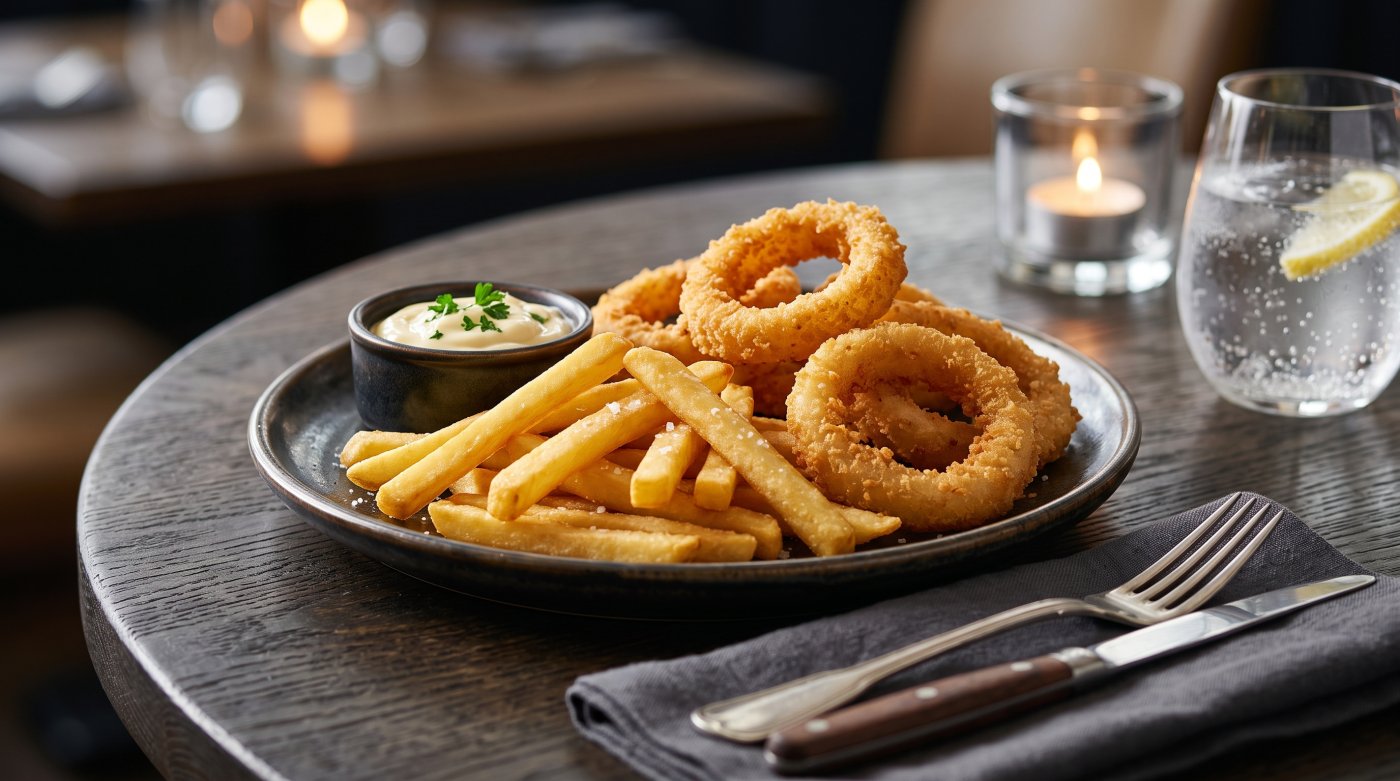
The same frozen chips give two different results in two kitchens. The difference lies not in the recipe but in how the fryer gets used.
Why does the fryer dial mislead?
The thermostat reads the oil near the element.
The temperature inside the basket sits three to five degrees below that.
The moment product goes in, that gap widens to fifteen or twenty degrees.
The thermostat detects it and starts heating, but recovery takes time.
So a serious kitchen uses an independent thermometer and measures the offset against the dial once, then notes it down.
| Measure | Correct practice | Common mistake |
|---|---|---|
| Oil temperature | 175-180 °C | 160 °C or 200 °C |
| Basket load | A sixth of the oil | Filled to the rim |
| Recovery time | 60-90 sec | Not waited for |
| Shaking | Once in the first 30 sec | Never or constantly |
| Draining | 15-20 sec | Straight to the plate |
Which temperature applies?
For frozen thick-cut chips, a hundred and seventy-five to a hundred and eighty degrees.
Below that the potato takes up oil; the inside cooks before a shell forms.
Above it the surface darkens fast while the centre stays frozen.
A thick cut wants five degrees less than a thin one; the interior needs a little more time.
The frying time runs six to eight minutes.
How full should the basket be?
No more than a sixth of the weight of the oil goes in.
A ten-litre fryer takes at most a kilogram and a half of frozen chips at a time.
Beyond that ratio the oil drops more than twenty degrees and cannot recover.
The result is a greasy, soft, pale chip.
Overfilling the basket to gain speed at peak is the most common and most expensive mistake.
Why wait for recovery?
Frozen product entering the fryer drops the temperature of the oil.
The thermostat starts heating and the oil returns to target.
That takes sixty to ninety seconds.
Drop the second batch before that and the temperature falls cumulatively; by the third batch the oil can be down at a hundred and fifty.
In busy service two fryers run alternately; one recovers while the other works.
Which oil suits a fryer?
Oils with a high smoke point get chosen: sunflower, rapeseed and palm.
Sunflower is common, with a smoke point around two hundred and twenty-five degrees.
High-oleic sunflower lasts better; it resists oxidation and gives a longer oil life.
Olive oil has no place in a fryer; its smoke point is low and its cost high.
Where blends get used, the producer's guidance applies; different smoke points together give inconsistent results.
How does the life of the oil get tracked?
Three indicators serve.
The first is colour. As the oil darkens, degradation advances.
The second is foam. Foam when product goes in is normal; foam that does not disperse and stays on the surface says the oil is finished.
The third is smell. A sharp, bitter smell describes an advanced stage of polymerisation.
Professional kitchens use polar compound test strips; past the twenty-five percent threshold the oil gets changed.
How does filtering work?
Filtering daily can double the life of the oil.
It happens after service, once the oil has fallen to a hundred degrees.
Residue left in the oil burns and passes a bitter taste to the next batch.
The base of the fryer gets cleaned during filtering; most of the residue collects there.
Oil lost in filtering gets topped up; a low oil level widens the temperature swings.
When does the basket get shaken?
Once, in the first thirty seconds after the product goes in.
That stops the frozen pieces sticking together.
After that it stays still; constant movement disturbs the shell as it forms.
Out of the oil, the basket drains fifteen to twenty seconds.
Skip the drain and excess oil goes to the plate with the product, leaving the portion greasy.
When does the salt go on thick-cut chips?
Straight out of the fryer, while the product is still hot and oily.
Salt does not go into the basket; salt left there mixes into the oil and speeds its degradation.
The product moves to a separate container and gets salted there.
About half a gram of salt per hundred grams of potato.
Where spices go on, they go at the same moment as the salt.
How wide is the window for thick-cut chips?
Thick-cut chips stay crisp eight to ten minutes after frying.
That runs longer than a thin cut; the interior moisture of a thick cut takes longer to soften the shell.
With coated frozen product the window stretches to twelve minutes.
Chips held under a heat lamp dry out; the answer is fast service rather than warming.
For takeaway, vented packaging gets used; steam trapped in a closed box softens the chips within five minutes.
How does the fryer get maintained?
A deep clean happens weekly; the oil comes out and the tank gets washed with a dedicated detergent.
Carbon deposits on the element lower heat transfer and raise energy consumption.
The thermostat gets calibrated once a year.
Baskets get cleaned separately; starch residue stuck in the mesh works into the oil with every batch.
The lid stays closed when the fryer is not in use; exposed oil meets air and oxidises faster.
How does energy consumption come down?
Outside service the fryer goes into standby with the temperature dropped to a hundred and forty degrees.
Switching it off entirely is an option too, though reheating takes fifteen minutes.
Two small fryers offer more flexibility than one large one; when demand is low, one goes off.
Using the lid reduces heat loss.
The oil level stays full; a low level both degrades faster and produces temperature swings.
