


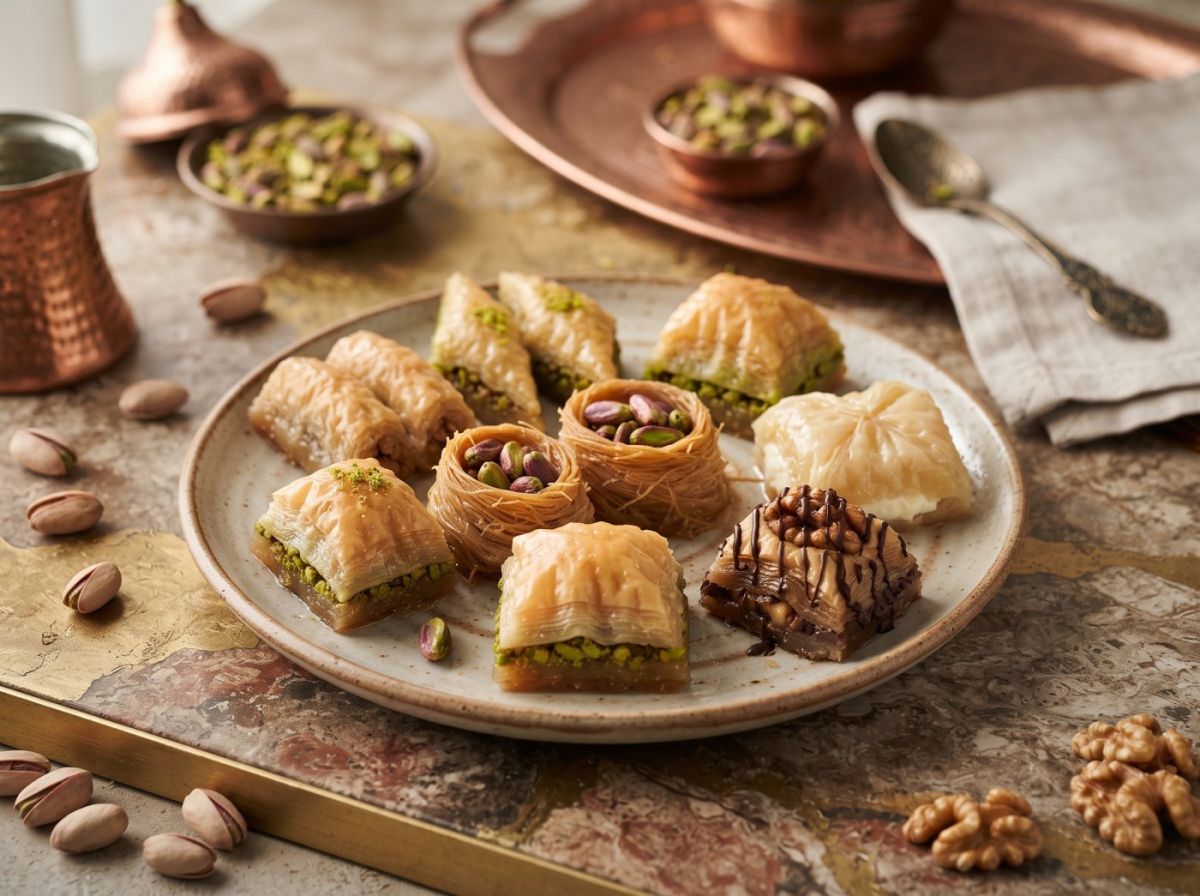
A baklava shop window holds fifteen or twenty separate products, and almost all of them are made from the same three ingredients: pastry, pistachio, syrup. The only thing creating the difference is shape — and shape determines far more than is generally assumed.
What does shape change?
What determines the texture of a baklava variety is the ratio of surface area to volume.
In shapes with a large surface area the syrup enters at more points and the layers wet faster; but at the same time more surface dries in the oven and crispness increases. In dense shapes with little surface, the interior stays moist.
The second factor is the number of layers. The same pastry produces different layer counts in different shapes; where a sliced baklava stacks thirty or forty layers, rolled shapes turn the layers around an axis and reach far higher counts.
The third is the position of the filling. When the filling sits in a single layer a distinct line appears in cross-section; in rolled shapes it distributes between the layers.
What kind of structure is classic sliced baklava?
It is the most widespread form. Sheets are stacked in the tray, filling is scattered in the middle and the remaining sheets go on top. It is cut into diamonds or squares before baking.
In this structure the layers are horizontal and the syrup enters from the sides. The cut face is the only route the syrup has, which is why the cut must reach the base of the tray.
The texture is balanced: the top layers crisp, the middle layers softened by syrup, the bottom layers dense. Three different textures occur in the same mouthful, and that is the character of classic baklava.
Why is midye baklava different?
Midye baklava is made by rolling the pastry around a rod and gathering it in from both ends. The result is a wrinkled product resembling the shellfish it is named after.
That gathering increases the surface area markedly. Each wrinkle is a separate surface and dries separately in the oven. The result is a crisper product than sliced baklava.
The second difference is the filling ratio. The internal space is limited during rolling; the pistachio proportion in midye baklava is generally higher than in sliced, because the volume is small and the filling occupies relatively more of it.
The third is presentation. It can be picked up whole and needs no fork, which is why it is favoured for hospitality and boxed sales.
What does şöbiyet add?
Şöbiyet is the only common variety in the baklava family containing kaymak. The pastry is folded into a triangle and clotted cream goes in alongside the pistachio.
Adding kaymak changes the product in two ways. The first is texture; a soft, rich layer sits within a syrupy, crisp structure. That contrast is what separates şöbiyet from the others.
The second is shelf life. Kaymak is a fresh dairy product and spoils far faster than baklava's dry fillings. Şöbiyet is therefore a product to be eaten the same day and must be refrigerated.
The triangular shape is a technical choice too: the fold closes in a way that stops the kaymak running during baking.
How is sarı burma made?
Sarı burma is made by rolling pastry around a pin and pushing it in from both ends to wrinkle it. The result is a long roll with a crumpled surface, served in slices.
The consequence of that method is a great many fine folds. Each fold absorbs syrup separately and the product draws more syrup than sliced baklava; sarı burma is therefore perceived as sweeter.
The texture differs too. Because the folds do not adhere fully, the product breaks up gradually when bitten; instead of the brittle snap of sliced baklava it gives a softer fragmentation.
It is traditionally made with walnut. The oil in walnut leaves a soft texture between the folds and contributes to sarı burma's familiar character.
What is dolama baklava?
Dolama, also known as yeşil dürüm, is the variety with the highest pistachio ratio. The pastry is wrapped around a generous quantity of nuts; in cross-section the layer of pistachio looks thicker than the pastry.
That ratio makes it the most expensive member of the baklava family. The cost of pistachio accounts for most of the total.
It differs in texture as well. Because the proportion of pastry is low, crispness is secondary; what comes forward is the texture and taste of the nuts themselves. Syrup is used sparingly too, since too much would mask the pistachio.
The appearance of the cross-section is this product's selling argument. Dolama is therefore usually sliced across and presented so the cut face is visible.
How do the varieties compare?
| Variety | Shape | Filling ratio | Crispness | Shelf life |
|---|---|---|---|---|
| Sliced baklava | Horizontal layers | Medium | Medium-high | Medium |
| Midye | Gathered roll | High | High | Medium |
| Şöbiyet | Triangular fold | Medium, with kaymak | Medium | Very short |
| Sarı burma | Wrinkled roll | Medium | Low-medium | Medium |
| Dolama | Thick roll | Very high | Low | Medium |
| Cold baklava | Horizontal layers | Medium | None, soft | Short |
The table shows crispness and filling ratio moving in opposite directions. As filling rises the pastry share falls and crispness declines; this is an unavoidable trade-off.
Which variety suits which use?
For hospitality and gift boxes, midye and dolama come to the fore; they can be picked up whole, do not fall apart and have visually strong cross-sections.
At crowded tables sliced baklava is more practical; portioning from a tray is easy and its cost is lower than the others.
Şöbiyet is chosen where it will be eaten the same day. Because of the kaymak it is unsuitable where long transport or waiting is involved.
Sarı burma suits tea time and everyday eating; its softer texture lends itself to being eaten on its own.
For businesses sourcing frozen product, midye and dolama are the safest choices; a tight roll minimises loss of shape during thawing.
