


Baklava is a dessert with a short ingredient list and a long list of steps. Flour, water, salt, starch, clarified butter, pistachio, sugar. Seven items. The difference between makers emerges entirely from how those seven are brought together.
How is the dough prepared?
Baklava dough is plain: flour, water, salt and, in some recipes, an egg. No fat goes into it; fat is brushed between the sheets after they are rolled.
The protein content of the flour is decisive. Flour for baklava is higher in protein than bread flour, because the filo must not tear as it stretches. With weak flour the sheet perforates beyond a certain thinness.
After mixing, the dough rests for at least an hour. That period is critical: the gluten network tensed during kneading relaxes and the dough becomes ready to roll. Unrested dough resists the pin and springs back.
The rested dough is divided into small balls. A tray of baklava usually takes between thirty and forty; in quality production the count exceeds forty-five.
How is the filo rolled?
The balls are rolled not individually but stacked. Starch is scattered between them; it prevents sticking and keeps the sheets separable.
Using starch rather than flour is an important detail of the technique. Flour blends into the dough and thickens the sheet; starch stays on the surface, does not burn during baking, and provides slip between the layers.
Rolling is done with a long pin, working from the centre outward. At intervals the maker unfolds the stack, scatters more starch and rolls it up again. That repetition distributes the thinning evenly.
The thinness aimed for is the point at which writing beneath the sheet can be read. Sheets reaching that point are ready for the tray.
What is the layering order?
Half the sheets are laid into the base of the tray first. Melted clarified butter is brushed over each; layers left unbuttered fuse together during baking into a single mass.
The filling is scattered in the middle. Pistachio or walnut must be distributed evenly; a build-up in one area makes that area behave differently during baking.
The remaining half of the sheets goes on top, each again buttered. The topmost layer receives more butter; it will take the most heat in the oven, and the butter protects it from burning.
Why is it cut before baking?
Baklava is cut before it goes into the oven. There is a technical necessity to this: cutting baked baklava cracks the layers and breaks it apart.
The cut has to reach the base of the tray. Where baklava is only half cut, syrup cannot reach the lower layers and that area stays dry.
The knife should be sharp and thin. A thick blade presses the layers and sticks them together as it cuts; that area will not rise during baking.
The style of cut determines the product's name: diamond, square, triangle, midye or dolama. Each shape gives a different surface-to-volume ratio, and therefore a different degree of crispness.
What is the baking regime?
| Stage | Temperature | Time | Purpose |
|---|---|---|---|
| Preheat | 200 °C | 20 minutes | Even heating of the oven |
| First stage | 180 °C | 25-30 minutes | Layers rising, moisture leaving |
| Second stage | 160 °C | 20-25 minutes | Drying and colouring |
| Rest | Oven off | 10 minutes | Temperature equalising |
The purpose of baking is not only colour but removing moisture from the layers. Baklava that has not dried sufficiently absorbs too much syrup and stays doughy.
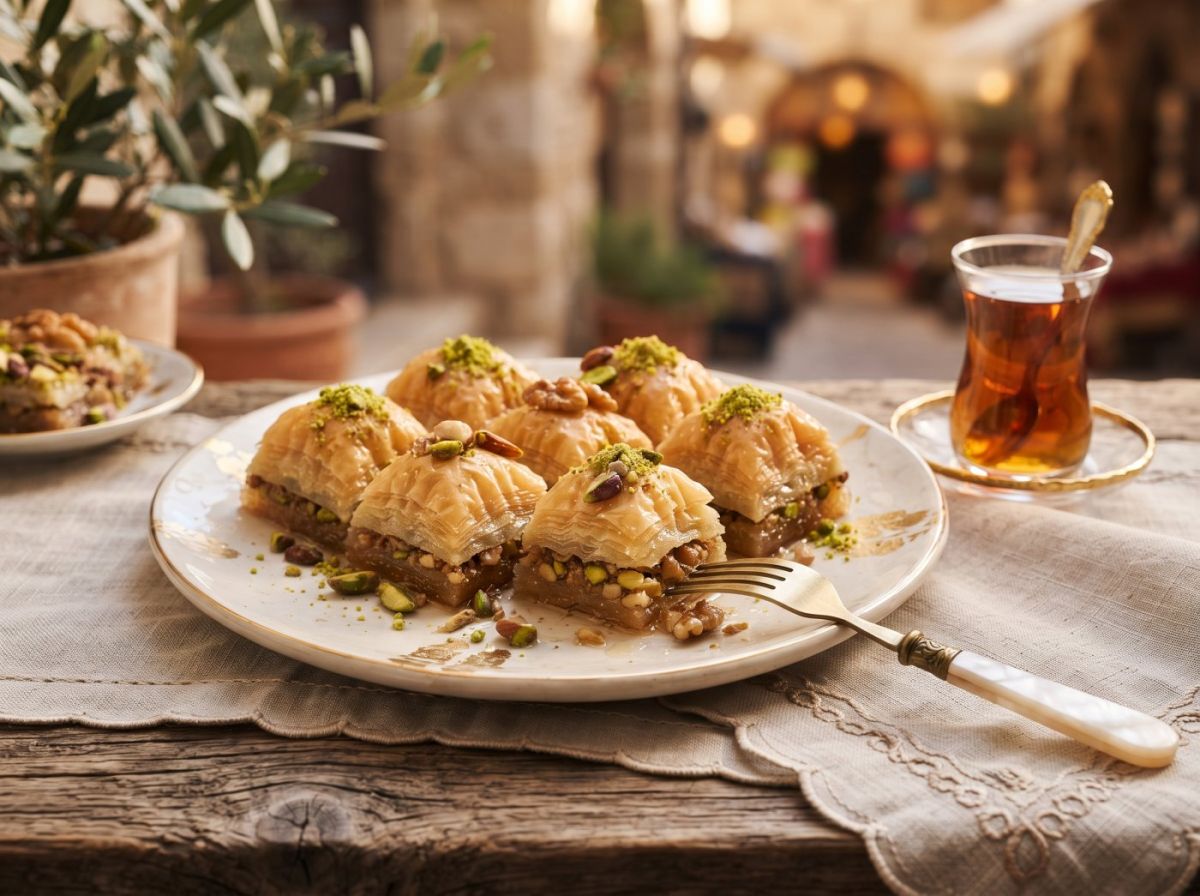
The sign of doneness is sound. Tapped with tongs, the tray should give a dry, clear note; a dull sound indicates moisture remaining inside.
How is the syrup made?
Syrup is made by boiling sugar and water. The ratio is generally two parts sugar to one and a half parts water, which gives a syrup with body that still flows.
A few drops of lemon juice go in during boiling. Its function is not taste but preventing the sugar crystallising. Without lemon, the syrup forms gritty crystals as it cools.
Boiling time is short; the syrup comes off the heat before it thickens. Over-boiled syrup sets as it cools and cannot penetrate the baklava.
When is the syrup poured?
The rule is clear: both sides must not be hot. Two methods are used in practice.
The first is pouring cold syrup over hot baklava. Syrup prepared and cooled in advance is spooned over the tray as it leaves the oven. The hot layers draw it in rapidly.
The second is pouring hot syrup over cooled baklava. This method gives slower absorption and preserves the crispness of the layers better.
If both are hot the layers collapse and the baklava takes on a doughy, heavy structure. This is the mistake made most often at home.
Once the syrup is poured, the tray rests for at least four hours and preferably overnight. Over that period the liquid distributes through all the layers by capillary action.
Why is clarified butter indispensable?
Clarified butter is butter with its water and milk protein removed. With those two components gone its smoke point is high, and it does not darken during long baking.
Its second function is separating the layers. The film of fat between sheets allows the steam generated during baking to push the layers apart; they separate and the characteristic leafed structure forms.
The third is its melting point, which sits close to body temperature; it therefore dissolves in the mouth and leaves no film on the palate. Vegetable fats do not share this property.
How is the filling prepared?
Pistachio or walnut is broken coarsely before going into the filling, never reduced to powder. A powdered filling releases its oil during baking and soaks the layers; coarsely broken nuts keep their texture and stay visible in cross-section.
The breaking is done by hand or in a low-speed mill rather than a machine. High speed generates heat through friction and releases the nut's oil prematurely.
Whether sugar is added to the filling is a regional preference. In the Gaziantep tradition the filling is plain and all sweetness comes from the syrup. In some regions a little caster sugar is mixed in.
The moisture content of the filling matters as well. Damp nuts create steam between the layers and the sheets fuse in that area. The filling is therefore held in a dry place before use.
The most common mistakes
- Not resting the dough enough: the filo tears while being rolled.
- Using flour instead of starch: the sheets thicken and stick together.
- Skipping the butter between layers: the baklava bakes as a single mass.
- Not cutting before baking: baked baklava breaks apart when cut.
- Syrup with both sides hot: the layers collapse.
- Over-boiling the syrup: it sets on cooling and cannot penetrate.
- Not waiting long enough: syrup never reaches the lower layers.
