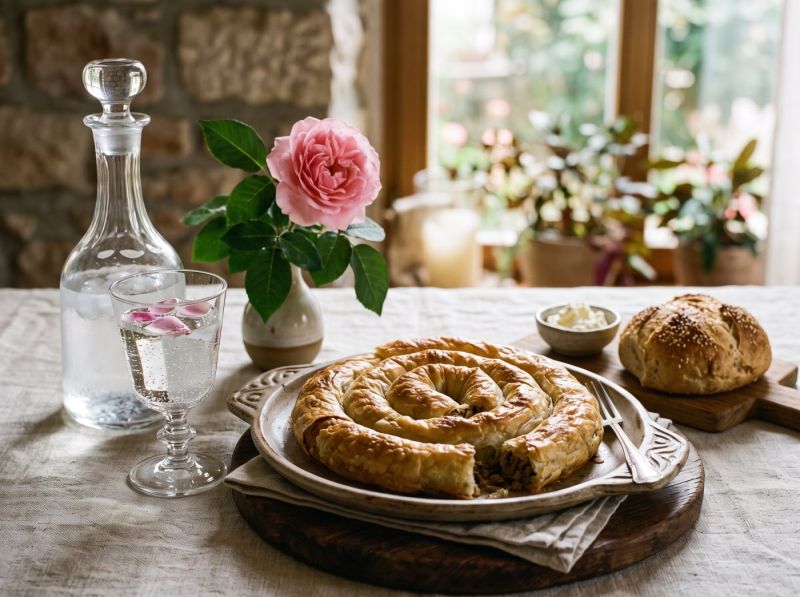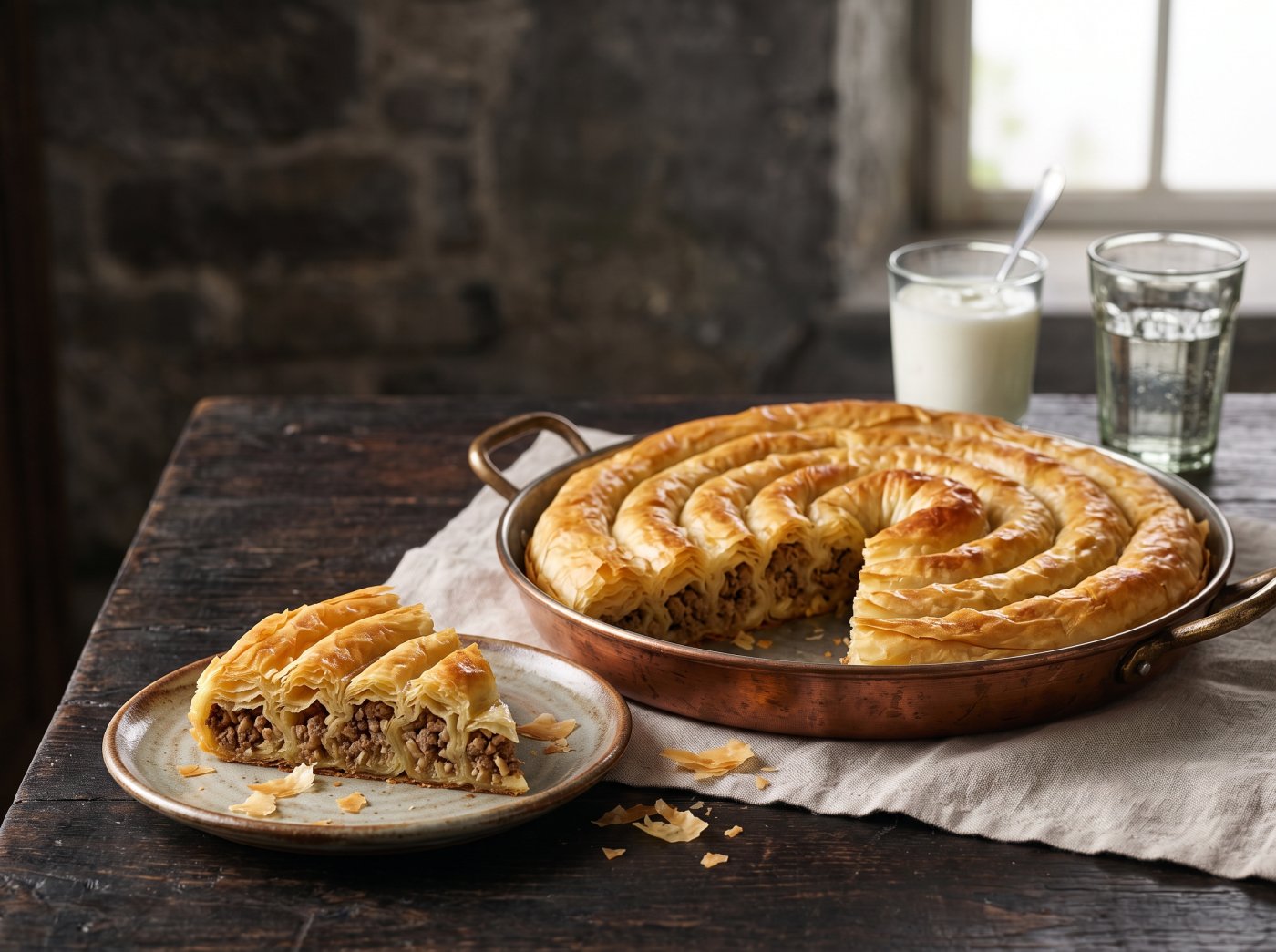
Balkan cuisine has its own word for this pastry, and the word describes a shape: a long, thin strip of dough filled and rolled, then laid into a tray as a spiral. What is called Bosnian börek or kol böreği in Türkiye is a direct continuation of that tradition.
What makes a börek "Bosnian"?
The distinguishing feature is not the filling but how the dough is prepared. Classic filo is rolled out with a pin and stops at a certain thickness. In Bosnian börek the dough is thinned by hand, in the air. The maker spreads it to the edge of the table, lets it hang under its own weight and widens it outward with the hands.
This method brings the dough down to the thickness of newsprint. In the oven that thinness lets the stacked layers crisp separately. The same thinness cannot be reached with a rolling pin; past a certain point the dough tears.
For dough to stretch this way its gluten network has to be both strong and relaxed. So after kneading it is oiled, covered and rested for at least half an hour. Unrested dough resists the stretch and splits.
What does the spiral achieve?
Laying the roll into the tray as a spiral is not merely a visual choice. It has three functions.
First, the spiral lets the börek expand as it bakes. Rolls arranged in straight rows push against each other, whereas a spiral distributes the tension outward.
Second, slicing becomes easier. Cut from the centre outward, a spiral gives each portion roughly the same ratio of pastry to filling.
Third, because the whole base of the tray is covered, the fat and water seeping from the filling are absorbed by the bottom layer, which takes on its own soft texture. In Bosnian börek the base being different from the top is not a flaw but the character of the dish.
Which fillings are used?
| Filling | Base ingredients | What to watch |
|---|---|---|
| Cheese | White cheese, egg, parsley | Soak the cheese if it is very salty |
| Spinach and cheese | Spinach, cheese, onion | The spinach must be squeezed dry |
| Potato | Boiled potato, onion, spices | Coarsely crushed, never puréed |
| Minced meat | Mince, onion, black pepper | Cook the mince first and cool it |
The rule common to all fillings is moisture control. A wet filling soaks the thin dough from the inside and the layers stick together; the börek comes out of the oven without any crispness. With water-releasing ingredients such as spinach and potato this step cannot be skipped.
Why is it made in a large tray?
Bosnian börek is traditionally made for large tables, and trays approaching two kilograms are common. There is a practical reason: a spiral can only be formed from a roll of sufficient length, and a short roll produces no proper coil.
A large tray also makes even baking easier. Edges heat faster than the centre; across a wide surface that difference shrinks proportionally and the result is more uniform.
How do you bake a large tray evenly?
In domestic ovens with a single heat source the base cooks later than the top. For this reason the börek starts on the lower shelf with bottom heat only, then moves to the middle shelf once the surface begins to colour.
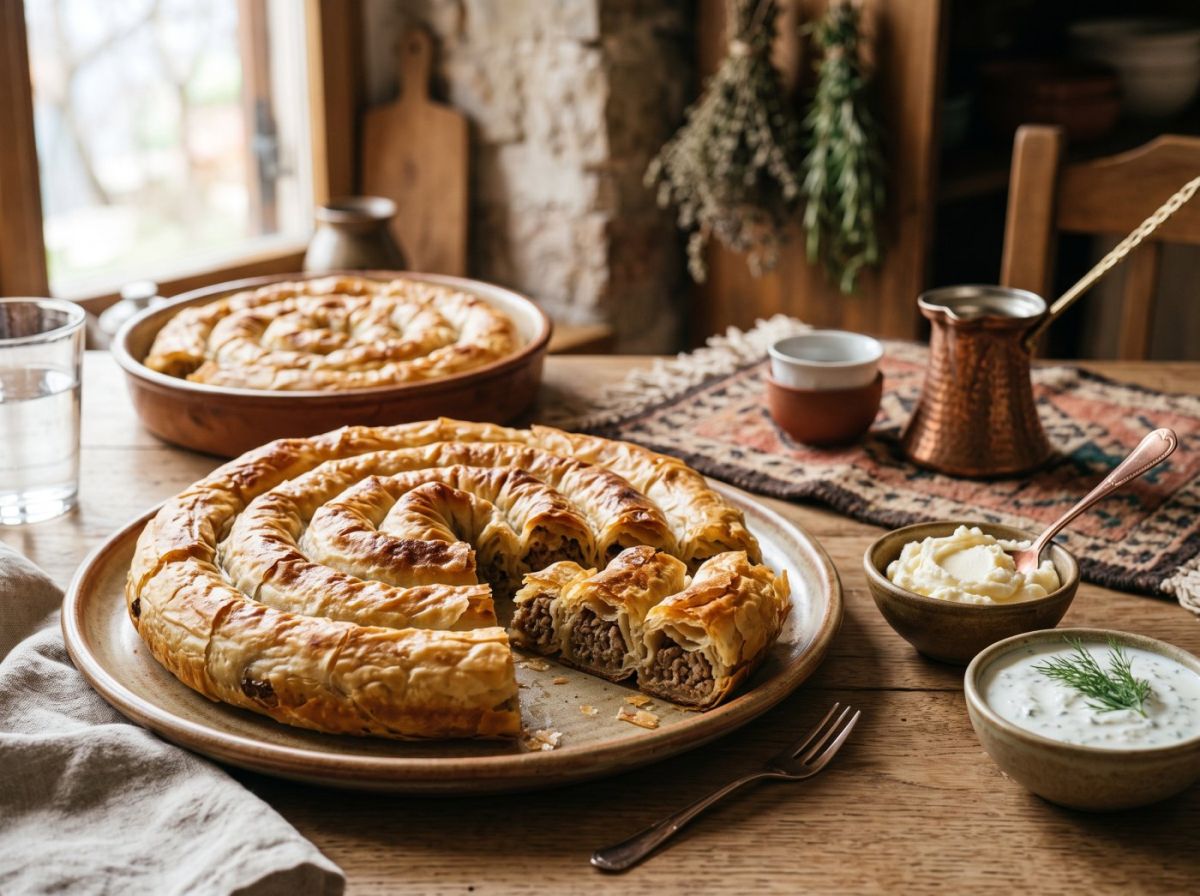
In fan ovens the temperature should be lowered by ten degrees; circulating air dries the surface quickly and the crust hardens before the interior is done.
Greasing the tray is enough, and lining it with paper is not advised. Greaseproof paper prevents the bottom layer from browning and leaves it tasting like raw dough.
What goes into the dough?
The dough is plain: flour, water, salt and a little vinegar or lemon juice. Fat does not go into the dough but is brushed onto the surface once it is stretched. That distinction sits at the centre of the technique; fat worked into the dough shortens the gluten network and the dough tears as it is pulled.
The role of the vinegar is often misunderstood. It is added not for flavour but to relax the gluten network slightly. Acid softens the protein bonds and lets the dough stretch more readily. One tablespoon per kilo of flour is enough; more makes the dough short and fragile.
The protein content of the flour matters as well. Bread flour builds a stronger network than plain flour and resists tearing better during stretching. This is why bread flour is preferred for Bosnian börek.
What is brushed between the layers?
Oil or melted butter is brushed onto the surface of the stretched dough. That layer of fat stops the sheets sticking together as they bake and allows steam to form between them; it is in fact the steam that separates the layers.
The choice of fat changes the outcome. Butter gives a more pronounced aroma and a darker colour but has a low smoke point and can blacken over a long bake. Oil stays neutral and withstands higher temperatures. Many makers use a mixture of the two.
Too much fat is its own problem. Over-oiled dough boils rather than browns, and the layers fuse instead of separating. A thin, even film is enough.
How is raw frozen börek baked?
Bosnian börek prepared as raw frozen goes into the oven without thawing. During thawing the water in the filling is released and soaks the thin dough, and the result is layers stuck together.
Baked straight from frozen, the time extends by roughly fifteen minutes compared with fresh dough. The temperature is kept a little low for the first twenty minutes so the ice melts through to the centre, then raised to colour the surface.
How is Bosnian börek served and stored?
Börek should not be cut the moment it leaves the oven. Fifteen minutes of rest lets the steam disperse and the filling set; cut hot, the filling runs.
It is traditionally served with ayran or yoghurt, the acidity balancing the fat. Leftovers keep for a day at room temperature. Reheating should be done in an oven; a microwave traps steam inside the pastry and removes the crispness entirely.