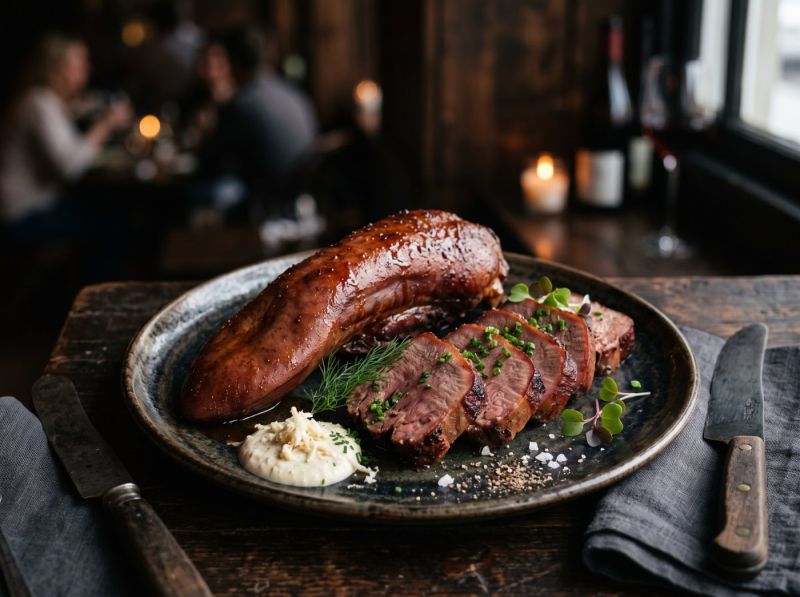
Beef tongue is classed as offal but differs structurally from other offal. Liver and kidney are organ tissue; tongue is entirely muscle.
What is the structure of tongue?
Tongue is a heavily worked muscle group.
Because it moves constantly, its fibres are tight and its connective tissue dense.
That means a structure requiring long cooking. Cooked briefly it stays tough.
Its surface carries a thick, rough layer; that layer is epithelial tissue and is not eaten.
Removing it is the most critical step of preparation.
The meat beneath is fine-grained and tender; cooked properly it resembles a good cut of meat more than offal.
Its fat content is high too, with visible intramuscular distribution.
That fat renders during long cooking and softens the texture.
What is the nutritional profile of tongue?
Beef tongue is a nutrient-dense product.
A hundred grams carries around 220 to 250 calories.
Protein runs 15 to 16 grams, slightly below other cuts because the fat content is high.
Fat runs 16 to 18 grams, above many cuts of beef.
Saturated fat makes up around a third; the rest is mono- and polyunsaturated.
Cholesterol is high: around 100 milligrams per hundred grams.
There is no carbohydrate.
That profile makes tongue a rich product, and portion control matters.
| Per 100 g | Beef tongue | Beef mince (15% fat) | Striploin |
|---|---|---|---|
| Energy | 220-250 kcal | 250 kcal | 180 kcal |
| Protein | 15-16 g | 18 g | 22 g |
| Fat | 16-18 g | 15 g | 9 g |
| B12 | ~4.5 µg | ~2.5 µg | ~2 µg |
| Zinc | ~4 mg | ~4.5 mg | ~4 mg |
| Iron | ~3 mg | ~2.5 mg | ~2.5 mg |
Why do B12 and zinc stand out?
Beef tongue is among the densest meat sources of vitamin B12.
A hundred grams carries around 4.5 micrograms, close to twice the daily requirement.
B12 is found only in animal sources and is required for the nervous system and blood formation.
Zinc content is high too, a mineral important for immunity and wound healing.
Iron is at a notable level and is heme iron; its absorption rate is far higher than from plant sources.
Those three nutrients together make beef tongue nutritionally valuable.
Against that, its fat and cholesterol are high; it does not suit frequent consumption.
One portion a week is a reasonable frequency.
How is it prepared?
Preparation has three steps and the order matters.
The first is washing and soaking. The tongue rests in cold water for a few hours, which removes blood residues.
The second is boiling. The tongue goes into cold water and is brought to the boil; discarding the first water is a common practice.
Fresh water then follows with onion, bay leaf, black pepper and salt, for two to three hours.
Doneness is checked with a fork; if the fork enters easily the tongue is ready.
The third step is peeling, the most critical step, and its timing is decisive.
How should it be peeled?
The outer layer is peeled while hot.
The tongue comes out of the cooking liquid and rests a few minutes; it needs to reach a temperature you can handle.
Starting at the tip, the layer is pulled away. On a properly cooked tongue it comes off in one piece.
Once cool the layer adheres to the meat and peeling becomes difficult; that is the most common mistake.
On an undercooked tongue the layer also will not come away; there the tongue needs more boiling.
The peeled tongue goes back into the cooking liquid to cool, which prevents drying and adds flavour.
The fat and glandular tissue underneath are trimmed away too.
After peeling the tongue is ready to slice.
How is it cooked and served?
Boiling is the most common method and the basis of traditional use.
Boiled tongue is sliced thin and served cold, known as söğüş.
Lemon, a vinegar and olive oil dressing and parsley go alongside.
For hot service the slices are lightly fried, forming a crust at the surface.
Baking under a sauce is another method; it works well with tomato or mushroom sauce.
It is used in sandwiches; thinly sliced boiled tongue pairs with mustard and pickles.
In some cuisines it is smoked after boiling; that is the version sold as a deli product.
It appears in salads and mezes too.
How is it found as a deli product?
Ready beef tongue products remove the preparation steps.
Boiled and peeled tongue is sold in vacuum packaging.
That product can be sliced and used directly; three hours of preparation disappear.
Smoked tongue is the version smoked after boiling, with a more intense flavour profile.
Pre-sliced product is available too, practical for breakfast and sandwiches.
The label states whether the product is boiled or smoked.
These products require a cold chain; their water activity is high.
Unopened in vacuum packaging they keep two to four weeks, and three to five days after opening.
How should tongue be stored?
Home-boiled tongue should be kept in its cooking liquid.
The liquid prevents drying and reduces loss of flavour.
It keeps three to four days in the fridge.
If stored sliced it belongs in an airtight container and should be eaten within two days.
Freezing is possible and gives a good result; tongue withstands freezing better than much other offal.
Freezing it whole and slicing after thawing gives the best result.
If frozen sliced, paper should go between the slices.
Frozen storage runs three months; beyond that fat oxidation changes the flavour.
Thawing should happen in the fridge.
The cooking liquid can be frozen too; used as stock in soups and dishes it carries nutritional value.