


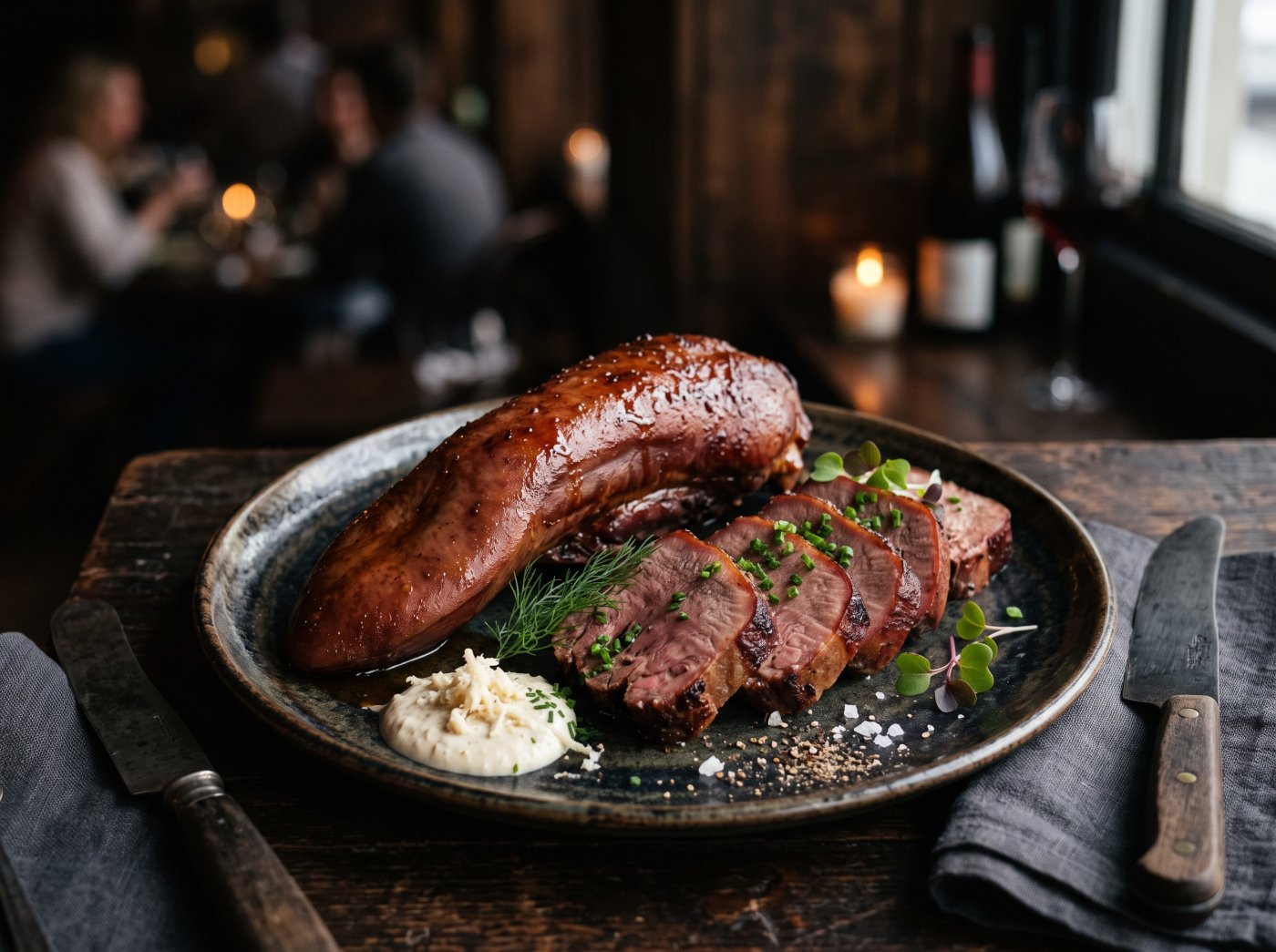
Beef tongue is prized in most of the world's kitchens: filling for tacos in Mexico, grilled in Japan, poached and served with sauce in France. In Türkiye it is best known in its smoked form, sliced thin. There is a single reason for that popularity: prepared correctly, the texture of tongue has a softness found in no muscle cut.
Why does tongue have a different texture?
Tongue is a muscle, but one that moves constantly and in every direction. Its fibres are arranged not in one direction but as interwoven bundles. That structure lets a slice part uniformly after long cooking, without showing any grain.
The second factor is fat. A fine layer of fat runs between the muscle fibres inside the tongue. Under long cooking that fat melts and the texture becomes silky.
The third is collagen. Tongue is high in collagen, which turns to gelatin under long, low heat and holds the slices together. Together these three give tongue a distinct place among offal products.
Why is the outer skin removed?
The outer surface of the tongue is covered by a thick, rough layer of tissue that serves a protective role in the mouth. That layer does not soften with cooking; it stays tough and unpleasant. It is therefore always removed.
The skin cannot be peeled while raw. The tongue is poached first; heat loosens the bond between the skin and the meat beneath. Once poaching is finished, the skin lifts away easily with fingers or the back of a knife while the tongue is still hot. After cooling the bond tightens again and peeling becomes difficult.
The practical trick is this: as soon as the poached tongue comes out of its hot liquid, dip it into cold water for a few seconds. That sudden temperature change contracts the skin and lets it come away in one piece.
How long is it poached?
Poaching time depends on weight and cannot be shortened. A one-kilo beef tongue needs roughly two and a half hours; larger tongues approach three.
The water is not boiled but held at a bare tremble over low heat. Boiling water tightens the muscle fibres and the outside turns stringy before the centre is cooked. Adding onion, carrot, bay leaf and peppercorns balances the smell and leaves a faint background note.
The sign of doneness is a skewer entering the thickest point without resistance. A tongue that has not reached this point falls apart when sliced.
How is smoked beef tongue made?
The smoked version follows a longer, three-stage process. First the tongue is brined; it rests for several days in a mixture of salt and spices, which both seasons it and draws off part of its moisture.
The surface is then dried. A dry surface is necessary for smoke to adhere; smoke will not cling to a wet surface and simply runs over it.
The final stage is smoking. The tongue sits for hours at low temperature in controlled smoke. Over that time it both cooks and takes up the aroma compounds of the smoke. Smoking also forms a protective layer on the surface and extends shelf life.
Smoked tongue reaches the consumer already cooked; it requires no further work and is served sliced.
How should it be sliced?
Slice thickness decides the result directly. A thick slice feels heavy and loses the delicacy of the texture.
| Use | Slice thickness | Note |
|---|---|---|
| Cold plate, breakfast | 1-2 mm | Near translucent; shows the texture best |
| Sandwich | 2-3 mm | Stays balanced against the bread |
| Hot service, with sauce | 4-5 mm | Holds together when reheated |
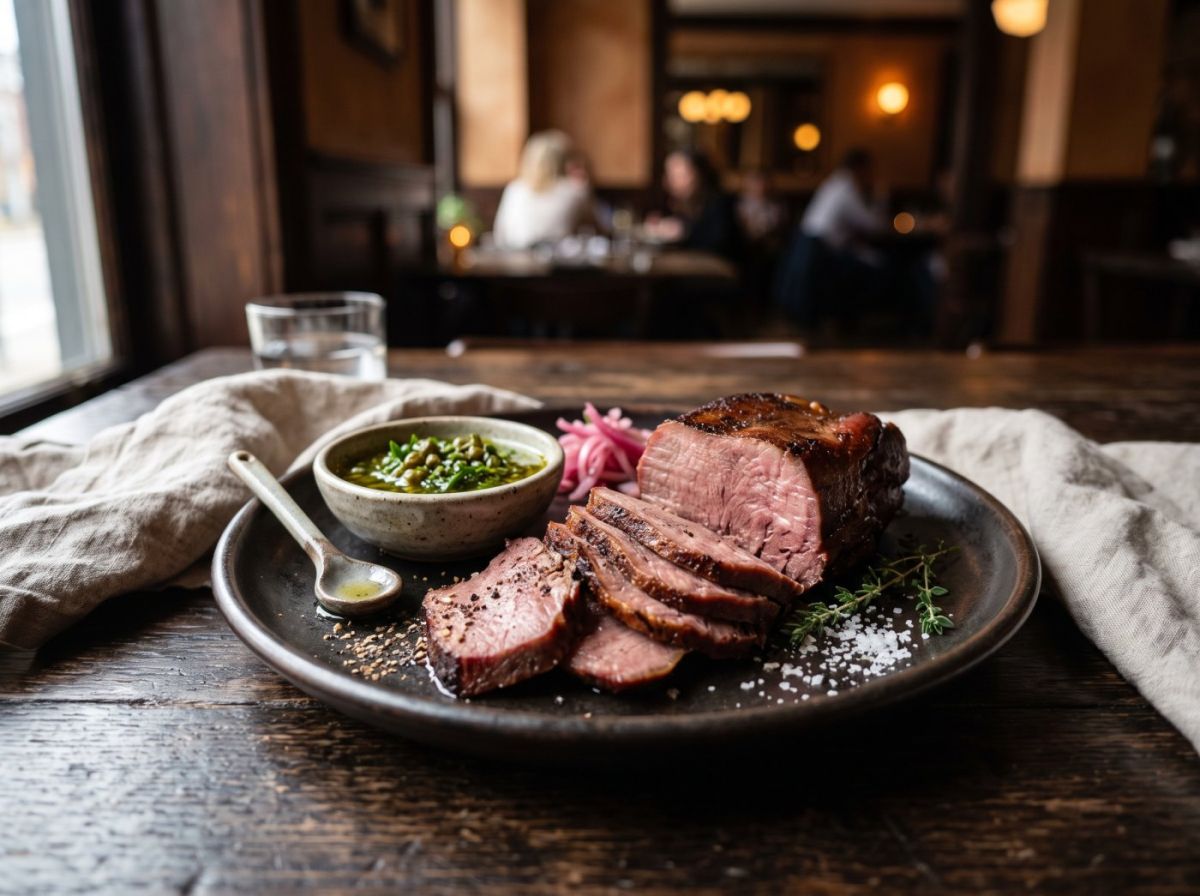
Slicing starts from the thick end rather than the tip, with the knife held across the fibres. Cutting straight from the refrigerator gives cleaner slices; a tongue at room temperature sticks to the blade.
What goes with it?
The flavour of tongue is mild and unassertive, so it wants acid and sharpness alongside. Traditional partners are gherkins, mustard and charred peppers. In French cooking a green sauce of parsley, capers and vinegar suits it particularly well.
At breakfast, thinly sliced smoked tongue with fresh cheese and greens makes a light plate. In a sandwich, mustard or a yoghurt-based sauce is preferable to a rich one; the fat in the tongue already supplies body.
How does tongue differ from other offal?
The products gathered under the heading of offal give very different textures and will not tolerate the same kitchen approach.
Organs such as liver and kidney are not muscle tissue; they carry an intense flavour of their own and cook quickly. Long cooking dries them to a grainy texture. Tripe and trotters, at the other extreme, consist almost entirely of connective tissue; they must cook for hours and end up with a gelatinous consistency.
Tongue sits between these two poles. It is muscle tissue, so it carries no organ flavour; but it is high in collagen, so it needs long cooking. That intermediate position makes it the easiest entry point for anyone unaccustomed to offal: the taste is close to a beef roast, while the texture is far softer.
What is its nutritional value?
Tongue carries protein levels similar to muscle cuts, but its fat content is higher. It is rich in iron, zinc and vitamin B12. The B12 content in particular stands out and is the main reason offal products are valued nutritionally.
The higher fat content makes portion control worthwhile. A hundred grams, thinly sliced, is an adequate serving for most adults.
How should beef tongue be stored?
Smoked tongue in vacuum packaging keeps in the refrigerator for the period stated on the label while the pack remains sealed. Once opened it should be eaten within three or four days.
Sliced product dries and loses colour faster than a whole piece, so only as much as needed is sliced and the remainder kept whole. If it is to be frozen, greaseproof paper between the slices prevents them sticking together during thawing.
