


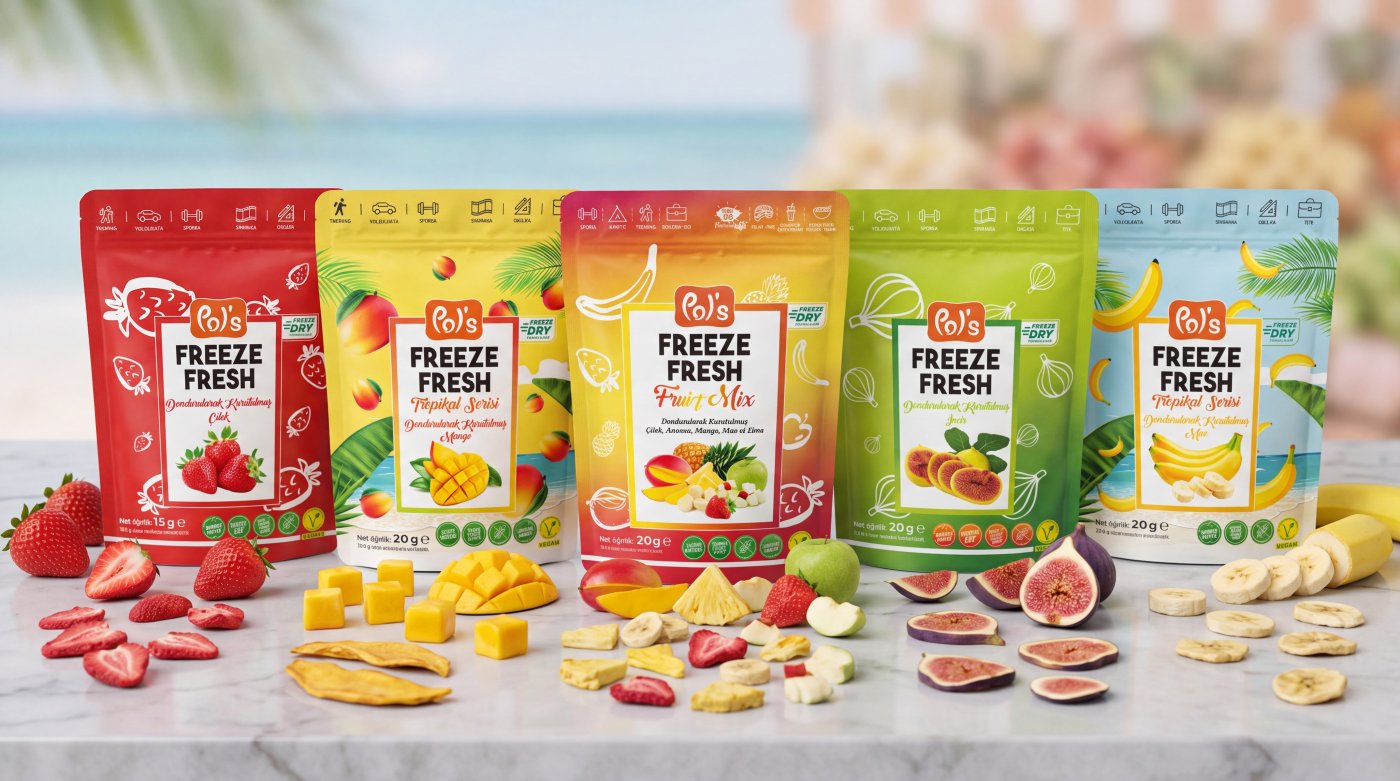
Comparing two packets side by side on a shelf, most people place them in the same category: dried fruit. Yet the difference in production is large enough to create two separate products.
How does each method remove water?
In conventional drying the fruit is heated. The temperature usually sits between 50 and 70 degrees and hot air evaporates water from the surface.
As water passes from liquid to gas it pulls the cell walls inward. The fruit shrivels, loses volume and its texture concentrates.
In freeze drying the fruit is first frozen at minus thirty to minus forty degrees. The water inside turns to ice.
The ambient pressure is then lowered and gentle heat applied. Under those conditions the ice turns straight into vapour without passing through a liquid phase; this is sublimation.
Because the water never passes through a liquid phase it does not pull on the cell walls. The fruit does not shrivel; a porous structure remains where the ice was.
Why is the textural difference so pronounced?
Conventionally dried fruit is soft, pliable and tacky. Residual moisture runs between 15 and 25 percent, and that moisture leaves flexibility in the product.
In freeze-dried fruit moisture falls to 2 to 4 percent. At that dryness no flexibility remains; the product is brittle and porous.
Their behaviour in the mouth differs too. Dried fruit is chewed; freeze-dried fruit fills its pores on contact with saliva and disperses.
That porosity also lets freeze-dried product rehydrate. Freeze-dried strawberry in water returns to something close to fresh texture within minutes; with conventionally dried fruit that recovery is limited.
Why do colour and flavour diverge?
The heat applied in conventional drying triggers two reactions.
The first is non-enzymatic browning. Sugars and amino acids react under heat and the product darkens.
The second is the loss of volatile aroma compounds. The compounds giving fruit its fresh smell evaporate even at low temperature.
In freeze drying the temperature stays low and both reactions are largely avoided. The product keeps the colour of fresh fruit and its aroma is markedly closer.
There is a difference in flavour intensity too. In conventionally dried fruit the sugar concentrates in the same volume, so sweetness dominates. In freeze-dried product the flavour stays more balanced and closer to fresh.
| Property | Conventional drying | Freeze drying |
|---|---|---|
| Temperature | 50-70 °C | Minus 30 plus gentle heat |
| Water removal | Evaporation | Sublimation |
| Residual moisture | 15-25% | 2-4% |
| Texture | Pliable, tacky | Brittle, porous |
| Volume | Shrinks | Preserved |
| Shelf life | 6-12 months | 12-24 months |
How large is the nutritional difference?
Pronounced in heat-sensitive nutrients, small in the rest.
Vitamin C can lose 30 to 50 percent in conventional drying. In freeze drying that loss is generally under 10 percent.
Some B vitamins are affected by heat as well, and a similar picture applies.
Minerals, fibre and carbohydrate are preserved by both methods. Those nutrients are not affected by heat.
For antioxidants the picture varies by fruit. Anthocyanins are heat-sensitive and are better preserved in freeze-dried product; that also explains the colour difference in red fruits.
Sugar concentrates in both. Because water is removed, the sugar per hundred grams is far higher than in fresh fruit.
Why is freeze-dried product more expensive?
Three reasons, all on the production side.
The first is time. Conventional drying finishes in a few hours; freeze drying takes twenty-four to forty-eight.
The second is energy. The process requires freezing, vacuum and heating together; energy consumption is several times that of conventional drying.
The third is equipment. A vacuum freeze dryer is a high-capital machine with limited batch capacity.
Yield is low too. A kilogram of fresh strawberries produces around 90 to 100 grams of freeze-dried product, a ratio close to ten to one.
Why does freeze-dried fruit need different packaging?
Conventionally dried fruit contains moisture and is roughly in balance with ambient humidity. A simple bag is often enough.
Freeze-dried product is extremely dry and draws moisture from the air quickly. A pack left open softens within hours and loses its porous structure.
Freeze-dried products are therefore sold in moisture-barrier packaging, usually with an aluminium layer. Some packs include a desiccant sachet.
After opening, the product should go into an airtight container. Softened freeze-dried fruit is not a safety problem, but it has lost its character.
Where does each belong in a kitchen?
Conventionally dried fruit is superior where cooking is involved. It holds its shape in cakes, biscuits and desserts and balances moisture.
Freeze-dried fruit leads where no cooking happens. It is ideal for yoghurt, granola, ice cream garnish and chocolate fillings.
Powdered freeze-dried fruit is used to add colour and flavour. In creams and confectionery it is an alternative to artificial colouring.
In sports nutrition freeze-dried product is preferred for its lightness; the same carbohydrate is carried in a far smaller volume.
Freeze-dried fruit in baked goods needs care. It draws water from the batter and swells, which can dry the batter around it.
Which should you choose?
The decision follows the intended use, not a ranking of quality.
If you want an economical snack or an ingredient for baking, conventionally dried fruit is the right choice.
If you want colour, flavour and texture close to fresh and the product will not be cooked, freeze-dried is clearly superior.
Where long shelf life and low weight come first, freeze-dried wins again; that is why products designed for camping and travel use the method.
If budget decides, a blend can be the answer: conventionally dried fruit as the base with a small amount of freeze-dried on top.
