


Pick up a pack of freeze-dried strawberries and you feel almost no weight. That lightness can create a false impression about the product's nutritional content, in both directions. Some conclude "there is nothing in it", others that "a pack this small is harmless". Both are incomplete.
Why do the calories concentrate?
Between eighty and ninety per cent of fresh fruit by weight is water, and water has no calories. When that water is removed during drying, everything remaining — sugar, fibre, minerals — is gathered into the same mass.
The result is a marked rise in calories per gram. A hundred grams of fresh strawberries carries about 33 kilocalories, while a hundred grams of freeze-dried strawberries is around 350.
That comparison misleads, however, because nobody eats a hundred grams of freeze-dried strawberries. A hundred grams of the dried product corresponds to roughly a kilo of fresh fruit. The correct comparison is not by weight but by the quantity of fresh fruit it represents.
How many calories are in each fruit?
| Product (20 g pack) | Calories | Fresh equivalent | Sugar |
|---|---|---|---|
| Strawberry | 65-75 kcal | ~200 g | 12-14 g |
| Apple | 70-80 kcal | ~160 g | 15-17 g |
| Banana | 75-85 kcal | ~70 g | 14-16 g |
| Pineapple | 70-80 kcal | ~180 g | 15-17 g |
| Raspberry | 60-70 kcal | ~180 g | 8-10 g |
| Blackberry | 60-70 kcal | ~170 g | 8-10 g |
| Mango | 75-85 kcal | ~130 g | 16-18 g |
What stands out is that although the calorie figures sit close together, the fresh equivalents differ widely. The reason is the difference in water content; banana holds less water than the others, so the same dry weight corresponds to less fresh fruit.
How many portions is one pack?
Under the World Health Organization's definition, one portion of fruit corresponds to roughly eighty grams fresh. Looking at the values above, a twenty-gram pack comes close to two portions for most fruits.
That means an important share of a five-a-day target can be met from a single small pack.
One caveat is required, however: health bodies generally limit dried fruit to a maximum of one portion per day in their guidance. The reason is sugar density; fruit with its water removed is consumed faster and produces less satiety.
Should the sugar content be a concern?
It depends on context. The sugar in freeze-dried fruit is the fruit's own; none has been added. That sugar arrives with fibre, and the pairing slows the rate of absorption.
The density is real nonetheless. A twenty-gram pack contains natural sugar equivalent to more than a teaspoon. That is comparable to a slice of bread or a glass of milk; not alarming, but not to be ignored either.
For comparison: the same twenty-gram pack carries markedly fewer calories, and far more fibre, minerals and vitamins, than a confectionery product of similar weight.
Why is it less filling?
The main reason fresh fruit satisfies is its volume. Water physically fills the stomach and sends a signal of fullness.
The dried product has no such volume. The same quantity of sugar and fibre is consumed, but because the stomach does not fill, the sensation of fullness is delayed. The result is eating more than intended without noticing.
The simplest way to counter this is to eat dried fruit with water or another drink. The product draws moisture in the stomach and gains volume, bringing the sense of fullness closer to that of fresh fruit.
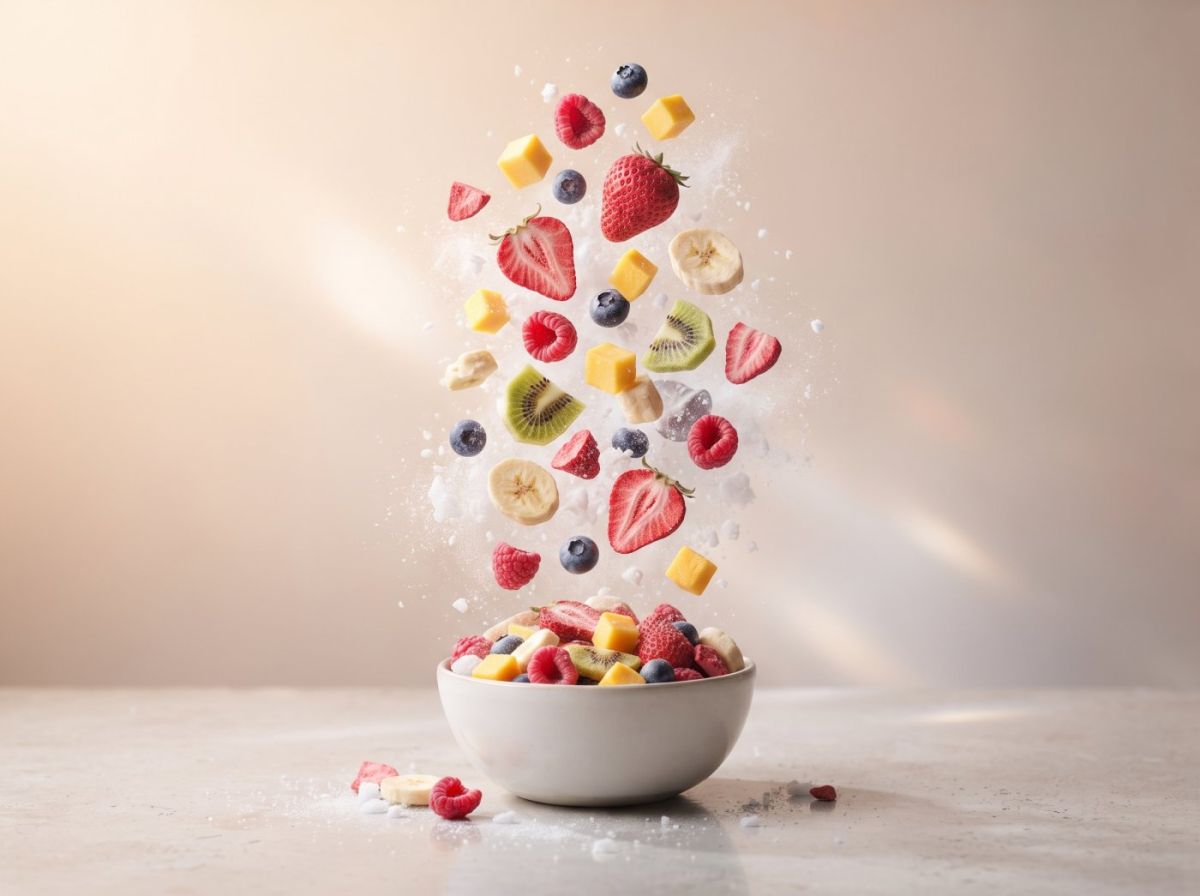
The second method is eating it alongside another food rather than alone. Freeze-dried fruit stirred into yoghurt or scattered over oats is far more filling than the same amount eaten on its own.
How should a portion be set?
The most practical approach is to tip the product into a small bowl rather than eating straight from the pack. Eating from an open pack makes tracking the quantity impossible.
For an adult a portion of fifteen to twenty-five grams is reasonable, and that is the size of most single-serve packs. It is no accident that the product is sold in portioned packs; the packaging itself is a portion-control tool.
For children, ten to fifteen grams is an appropriate range. In younger age groups there is also a choking consideration; although the product dissolves rapidly in the mouth, large pieces should not be given to small children.
How does it suit athletes?
Being easy to carry and quick to digest makes freeze-dried fruit suitable before training. Because its fibre content is high, it sits more comfortably eaten around an hour beforehand rather than immediately before.
In long endurance sport its lightness is a distinct advantage. Carrying the same energy as fresh fruit would mean roughly ten times the weight.
It can serve as a carbohydrate source during recovery, but it contains no protein and is not sufficient on its own.
What are the label values based on?
Nutrition tables on dried fruit labels are usually given per hundred grams. Where the pack is twenty grams, every value in the table has to be divided by five.
This detail is frequently overlooked, and the product looks far more calorific than it is. If the label carries a "per portion" column, that is the column to read.
The second point to watch is that the sugar shown is total sugar. Unless added sugar appears on a separate line, the fruit's natural sugar and any added sugar sit within the same figure. The only way to distinguish them is the ingredients list.
Does it have a place in weight management?
It does, depending on how it is used. Replacing sugary snacks, it delivers a clear gain: fewer calories, more fibre and more micronutrients.
Replacing fresh fruit, however, produces a loss; the same calories come with less volume and less satiety.
The practical rule is this: where fresh fruit is available, choose fresh fruit. Where it is not, or where portability is required, freeze-dried fruit is a reasonable alternative. Positioning the two as complements rather than substitutes is the sounder approach.
