What decides how much of a snack gets eaten once the packet is open is usually not hunger. The form of the product and its packaging make much of that decision in advance.
What is a stopping point?
At some moment during eating, a decision to stop gets made.
That decision rests on two signals: physiological fullness and environmental cues.
Physiological fullness develops slowly; the signals from the stomach and gut take fifteen to twenty minutes to reach the brain.
Eating continues throughout that period.
Environmental cues are immediate.
A plate emptying, a packet finishing, a unit being completed.
Those cues trigger the decision to stop.
Eating from a large packet offers no environmental cue.
Taking the hand out of the packet requires a decision, and that decision keeps getting postponed.
Single-bite and portioned products place the environmental cue inside the product itself.
How influential is unit size?
Nutrition research calls this the unit bias.
People tend to complete a unit.
One biscuit, one packet, one slice; whatever its size, a unit is perceived as the amount to be eaten.
Total consumption therefore falls as the unit gets smaller.
Presented in small packets, the same product is generally eaten in lower quantity.
The effect is not unlimited; where the unit is very small, more than one gets opened.
But every opening creates a decision point.
As the number of decision points rises, so does the likelihood of stopping.
That is the essence of the mechanism.
| Presentation | Decision points | Tendency to eat |
|---|---|---|
| Large packet, direct | None | High |
| Large packet, into a bowl | One | Moderate |
| Multipack of small packets | At every packet | Low |
| Single-bite, portioned | At every bite | Lowest |
| Whole fruit | At every fruit | Low |
What does the packaging change?
Packaging is the strongest determinant of a stopping point.
Single-portion packs of twenty-five grams are produced for that purpose.
A clear ending forms when the packet finishes.
Opening a second is a new decision.
That decision gets made consciously, and often does not get made.
Transferring from a large packet into a bowl serves a similar function.
A stopping point forms when the bowl empties.
But refilling a bowl is easy; the effect is weaker.
The weakest case is eating directly from the packet.
There is no cue at all, and eating generally ends when the packet does.
Portion information printed on the pack helps too; "this pack contains 2 portions" gives a reference point.
How does chewing time affect fullness?
A product's texture determines the speed at which it is eaten.
Hard, fibrous products take longer to chew.
Long chewing buys time for satiety signals to develop.
The number of chews also plays a part in how the brain registers the quantity eaten.
Soft products that dissolve fast offer no such advantage.
A handful of nuts takes far longer to eat than a chocolate bar of the same calories.
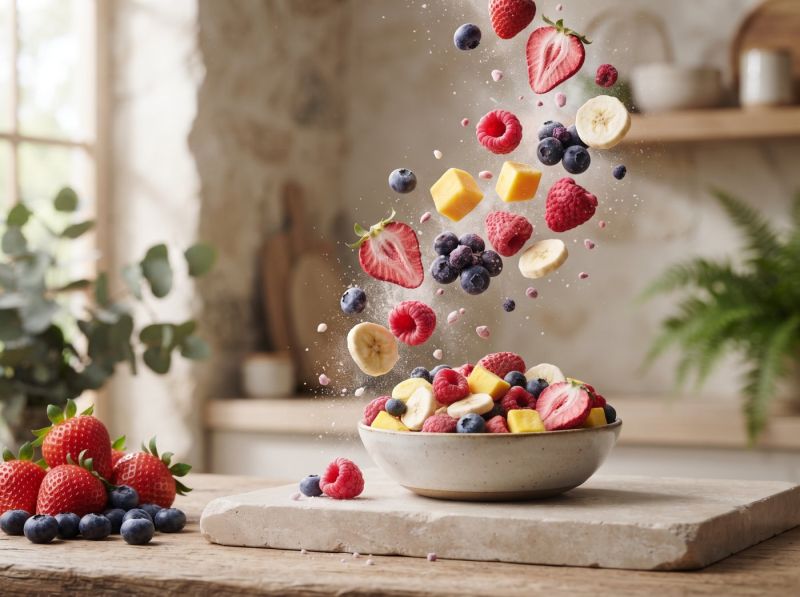
Freeze-dried fruit sits at an interesting midpoint here.
Its porous structure dissolves quickly in the mouth, but the size of the pieces and their crisp structure require chewing.
Because it contains no water its volume is large and its weight small.
That gives a presentation the eye reads as filling.
Drinking water alongside increases both its expansion in the stomach and the sensation of fullness.
Why does calorie density matter?
Portion control is not only about quantity.
Two products of the same volume can carry very different calories.
Calorie density means calories per gram.
Fresh strawberries are 0.3 calories per gram.
Freeze-dried strawberries are 3.7; with the water gone, the density rises tenfold.
But the portion shrinks too; a fifteen-gram pack corresponds to around a hundred and fifty grams of fresh fruit.
In calories the two are similar.
Nuts are different; their high fat content pushes calorie density to 6 calories per gram.
A small portion is more critical there.
A twenty-five-gram portion of almonds is around 145 calories, a practical upper limit.
Density rises further in chocolate-coated products and the portion should fall below ten grams.
Where does freeze-dried fruit stand?
That product group offers several advantages for portion control.
The first is natural portioning; the products are generally sold in small packs.
The second is the absence of added sugar; the fruit's own sugar is what is there.
The third is preserved fibre; the drying method largely leaves the fibre structure intact.
The fourth is an illusion of volume; few grams look like many.
But there are points to watch.
Because the product contains no water, the sensation of fullness is lower than with fresh fruit.
Drinking water alongside closes that gap.
Chocolate-coated varieties belong to a different category; the calorie density doubles.
Plain varieties suit portion control better.
The phrase "no added sugar" is worth looking for on the label.
How is portion control applied in practice?
Three methods work.
The first is buying in portions. Multipacks of small packets cost more per gram than a large packet but deliver control over consumption.
The difference in cost is partly offset by the reduction in total quantity eaten.
The second is portioning it yourself. A large packet is bought and divided into small containers.
That is both economical and controlled.
It gets done once a week.
The third is managing visibility. Snacks should not sit at eye level on open shelves.
Consumption of a product kept in a closed cupboard on a back shelf falls markedly.
Snacks should also not be eaten in front of a screen; with attention divided, the stopping point goes unnoticed.
Putting the product in a bowl and sitting at a table is the simplest and most effective arrangement.