Substituting another flour one-for-one for wheat flour in a gluten-free recipe almost always ends in failure. The problem lies not in the taste or nutrition of the flour but in the fact that no other flour does the job wheat flour performs in a dough.
What does gluten do in dough?
When wheat flour meets water, two proteins called gliadin and glutenin combine to form a three-dimensional, elastic network. That network has two properties: it can stretch, and it can pull back.
Stretching allows the dough to expand as it proves. Yeast produces carbon dioxide, the gas bubbles grow, and the network permits that expansion. Pulling back holds the structure up; the dough does not collapse after expanding.
The network also traps gas. Without it, the carbon dioxide produced escapes and no rise occurs.
In the oven the network sets under heat and forms the permanent structure. Bread holding its open crumb when cut is due to that network being fixed during baking.
What is missing in gluten-free flours?
Rice, maize, buckwheat, almond and chickpea flours all contain protein; but those proteins are not gliadin and glutenin, and they do not form an elastic network when combined.
The result is a mixture that cannot hold gas. The yeast works and produces carbon dioxide, but the gas escapes the structure. The dough either fails to rise at all or rises and immediately collapses.
The second problem is binding. The gluten network holds a dough together as one body. Without it the mixture tends to fall apart; it breaks up during shaping and crumbles when cut after baking.
The third is water management. Gluten-free flours absorb water at different rates and in different quantities. Rice flour absorbs little and the mixture stays wet; chickpea flour absorbs a great deal and the mixture dries.
How do binders work?
Substances called hydrocolloids are used to take over gluten's function. Combined with water they form a gel and establish a viscous structure.
| Binder | Source | Main function | Typical ratio |
|---|---|---|---|
| Psyllium | Plant seed husk | Elasticity and moisture retention | 3-5% of flour |
| Xanthan gum | Fermentation product | Viscosity, gas retention | 0.5-1% of flour |
| Locust bean gum | Carob seed | Softness, body | 0.5-1% of flour |
| Chia and flaxseed | Ground seed | Binding, added fibre | 2-4% of flour |
| Egg | — | Binding and structure | Per recipe |
These substances do not replicate gluten's elasticity exactly. What they do is create a viscous medium that slows the escape of gas. The result is a dough that rises, though its crumb differs from wheat bread: the pores are smaller and more regular.
Why is it mixed rather than kneaded?
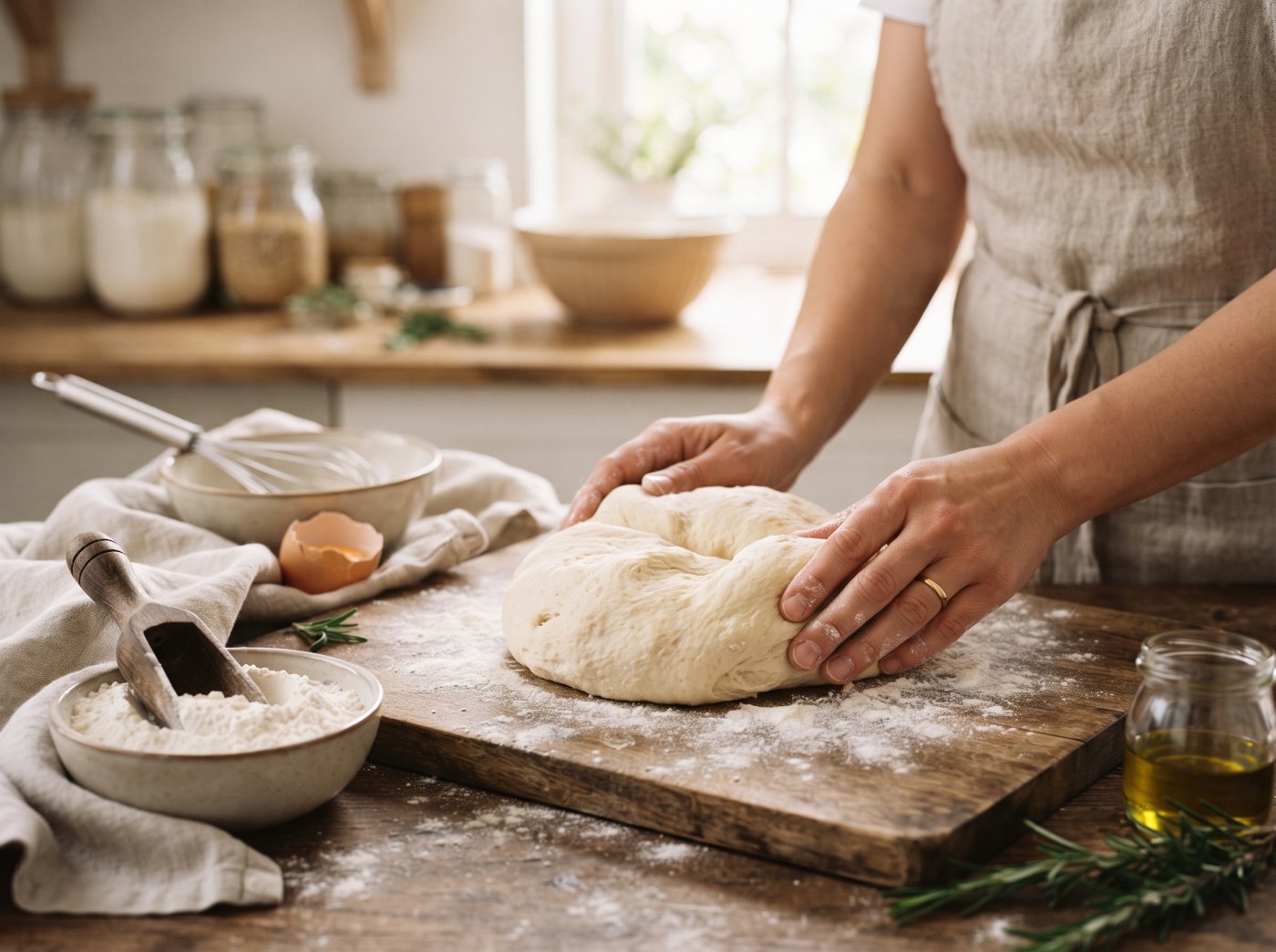
In wheat dough, kneading aligns the protein chains and strengthens the network. It is a mechanical act of building structure.
Because there is no network to build in gluten-free dough, kneading contributes nothing. Prolonged mixing only drives out air and tightens the mixture.
Gluten-free recipes therefore generally say "mix until the ingredients come together". The time is kept short and the mixture is usually prepared with a spatula rather than a whisk.
The consistency differs as well. Gluten-free bread dough is not a dough that can be shaped by hand but a mixture closer to cake batter. It is poured into a tin rather than shaped.
Why must gluten-free dough rest?
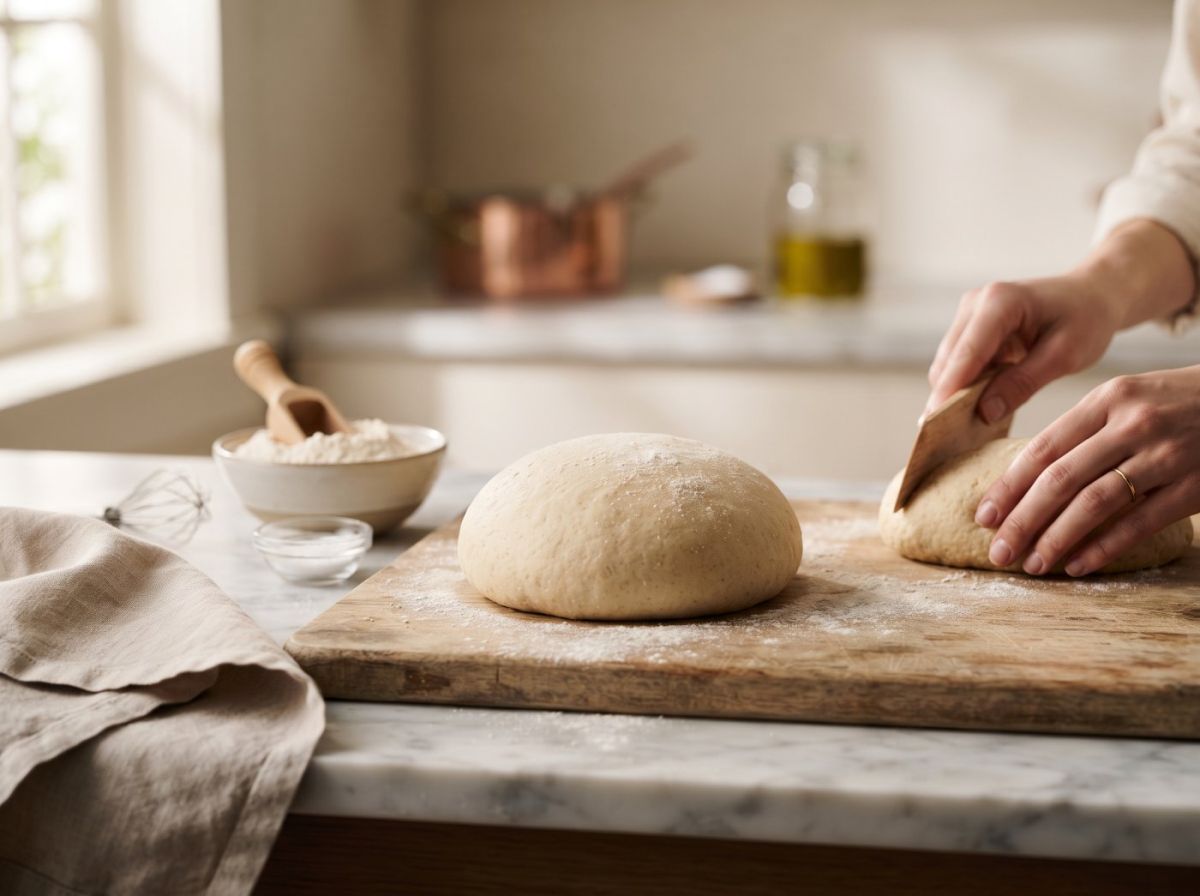
The particles of gluten-free flours absorb water more slowly than wheat flour. Immediately after mixing, the mixture looks wet; left to stand, the flour draws in the water and the consistency thickens noticeably.
Many gluten-free recipes therefore call for resting the mixture for twenty to forty minutes. Skip that step and extra flour gets added to a "wet" batter, and the product comes out dry.
Resting matters even more in recipes using psyllium; psyllium needs time to form its gel, and without that gel the structure never establishes.
Why does it stale faster?
Gluten-free products generally have a shorter shelf life, for two reasons.
The first is the proportion of starch. Gluten-free formulations are high in starch, and starch recrystallises as it cools, separating water from the structure. That process is staling itself.
The second is water-holding capacity. The gluten network holds water within the structure; without it, water is released and evaporates more readily.
Producers offset this with moisture-retaining components: raising the fat content, adding psyllium, or using ingredients with high water-holding capacity such as potato starch. This also explains why gluten-free products are sometimes higher in fat.
Why is a flour blend better than a single flour?
A single gluten-free flour covers only part of what wheat flour does. Professional formulations therefore use blends.
The general logic is a three-part structure: a neutral base flour (rice, maize), a starch that builds structure (potato, tapioca), and a flour contributing taste and nutrition (almond, buckwheat, chickpea).
The ratios vary by product. In bread the starch share is kept high; in biscuits and cakes the share of almond or hazelnut flour can rise, because elasticity is not required in those products.
Does yeast work in gluten-free dough?
It does; yeast needs sugar rather than gluten, and gluten-free flours contain sugar. The problem is not the yeast's production but the fact that the gas produced cannot be held.
That distinction matters in practice. When gluten-free bread fails to rise, the first thought is usually "the yeast is dead"; in most cases the yeast has worked perfectly well and the gas has escaped the structure. The remedy is not more yeast but a review of the binder ratio.
Proving time differs too. The second prove in gluten-free dough is generally kept shorter; in a mixture left standing, gas continues to escape and the dough collapses before it reaches the oven. Gluten-free bread therefore goes into the oven the moment it has risen.
What should you watch when baking gluten-free at home?
- Start from a ready blend: certified gluten-free flour blends come with the ratios already resolved; formulating from scratch requires experience.
- Use scales: the volume-to-weight relationship of gluten-free flours differs greatly from wheat; cup measures are not reliable.
- Do not skip the rest: the mixture will be thicker than it first appears.
- Use a tin: the dough will not hold its own shape.
- Do not add extra flour: a mixture that looks wet is usually correct.
- Watch for cross-contamination: if wheat flour has been used on the same surface, it must be cleaned.