The same brand, the same batch of raw frozen poğaça can give entirely different results in two different businesses. If the product is identical, the difference belongs not to the product but to the hour before baking. That hour is spent in a proving cabinet.
What does a proving cabinet do?
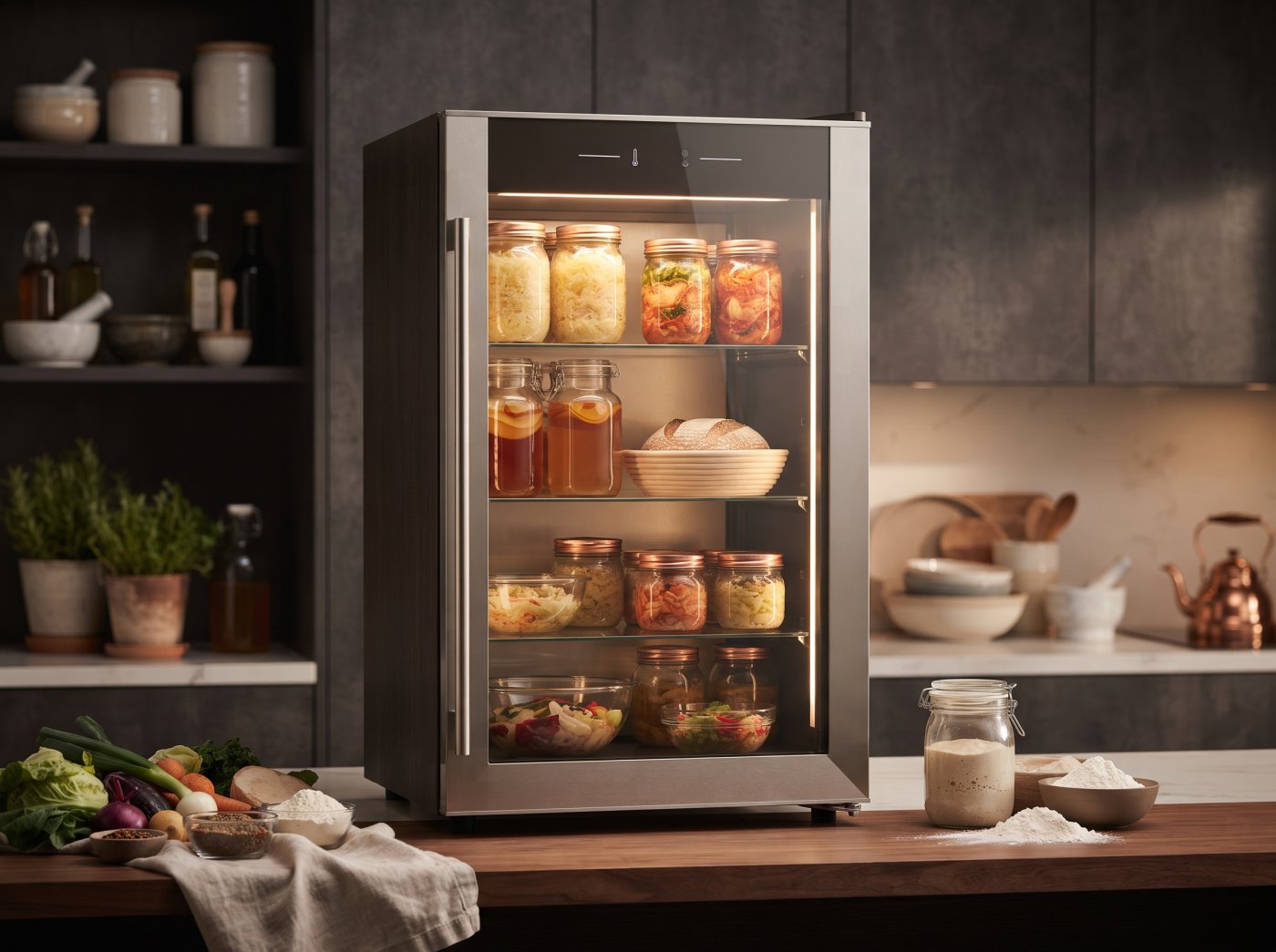
A proving cabinet is an enclosure that holds the temperature and humidity of the air inside it constant, independently of one another. It contains a water reservoir, a heater, and a control unit managing both.
Temperature determines how fast the yeast works. Yeast is slow at 20 °C and most productive around 30 °C. Above 40 °C it begins to suffer damage and the dough takes on a sour note.
Humidity prevents the surface of the dough from drying. The dough expands as it rises; where the surface has dried, that expansion produces cracks.
Managing these two variables together is the reason the cabinet exists. An enclosure that only heats is not a proving cabinet.
What are the correct settings?
| Product | Temperature | Humidity | Time |
|---|---|---|---|
| Poğaça | 30-32 °C | 80% | 60-90 minutes |
| Açma | 30-32 °C | 80% | 70-100 minutes |
| Simit | 28-30 °C | 75% | 45-70 minutes |
| Sweet dough buns | 28-30 °C | 75-80% | 90-120 minutes |
| Pizza base | 26-28 °C | 70% | 40-60 minutes |
Times vary with the temperature at which the product leaves the freezer and with its weight. The values in the table are proving times after thawing is complete.
Enriched doughs take longer, because fat makes the yeast's work harder. This is why sweet bun doughs require the longest times.
How do you know the dough is ready?
Relying on time is misleading, because the starting temperature is never identical between batches. Two checks, by eye and by hand, are more dependable.
The volume check is simple: the dough should have roughly doubled. For most products that is a sufficient indicator.
The finger test is more precise. Press gently into the edge of the dough. If the mark fills back slowly, the dough is ready. If it disappears immediately, proving is not complete; if it does not fill at all, the dough has over-proved.
What happens with under-proving?
The dough enters the oven without having produced enough gas. It rises a little further in the short time before oven heat kills the yeast, but not enough.
The result is a dense, heavy crumb. The product comes out smaller than expected, with small, tight pores in cross-section. The taste is also flat, because the aroma compounds formed during proving have not accumulated.
The only remedy is to extend the time. Raising the temperature to shorten it does not work; yeast working fast produces gas but not aroma.
What happens with over-proving?
The dough has risen beyond its capacity and the gluten network has stretched and weakened. In the oven the product first rises and then collapses in the middle.
The second sign is taste. Prolonged proving increases the yeast's production of alcohol and acid, and the product takes on a sour, sharp flavour.
Over-proved dough cannot be recovered. Working with a proving cabinet therefore calls for a timer and for visual checks on the products.
What should a business without one do?
Small operations do not always have a proving cabinet. Three alternatives are workable.

The first is the closed-oven method. The oven is heated briefly and switched off, a dish of hot water is placed inside, and the products rest in that environment. The enclosed space stays warm and picks up humidity.
The second is covering. Trays are covered with a damp cloth and left in the warmest spot in the kitchen. The cloth prevents the surface drying; but because temperature cannot be controlled, the timing stays approximate.
The third is a long cold prove. The products rise slowly overnight in the refrigerator. This method takes longer but gives the best results in aroma; it is a technique deliberately chosen in professional baking.
Are thawing and proving the same thing?
They are not, and confusing the two stages is one of the commonest mistakes made with raw frozen products.
Thawing is the melting of the ice in the product; it is a physical process, and the yeast does almost nothing during it. Proving is the yeast producing gas; it is a biological process, and it only accelerates once the product has thawed completely.
When the two are treated as one stage, the product goes into the proving cabinet straight from the freezer. The outside then thaws and begins to rise while the centre is still frozen. In the oven the outer layer is over-proved and the interior dense.
The correct practice is to thaw the product first, in a refrigerator or at room temperature, and then move it into the proving cabinet. Some cabinets run these two stages in programmed sequence; models with this feature are known as retarder-provers.
How should the shelves be arranged?
Hot air rises, so the upper shelves of a cabinet run a degree or two warmer than the lower ones. A fan reduces that gap but does not remove it entirely.
The practical solution is to group the same product at the same level and separate different products onto different shelves. Each group then rises evenly within itself.
Space must be left between trays for air to circulate. Where trays are stacked tightly, the products underneath cannot draw enough warm air and fall behind.
Why does maintenance matter?
If the water reservoir is not cleaned regularly, limescale builds up and steam output falls. Even with the humidity set correctly, actual humidity stays below target and the doughs dry out.
The second maintenance point is air circulation. When the fan filter clogs, temperature distributes unevenly inside the cabinet and products on upper shelves rise at a different rate from those below.
The third is the sensors. Temperature and humidity sensors drift over time. Verifying the cabinet's readings occasionally against a separate thermometer and hygrometer prevents unexplained changes in results.
Does the season have an effect?
It does, and markedly so in businesses working without a cabinet. In winter the kitchen is colder and proving takes longer; in summer it shortens. Working to the same time produces under-proving in winter and over-proving in summer.
A proving cabinet removes that variable. A business with one gets the same result every day, independent of the weather outside.
That consistency is decisive for multi-site operations in particular; a product being identical from branch to branch is only possible if proving conditions are identical.