


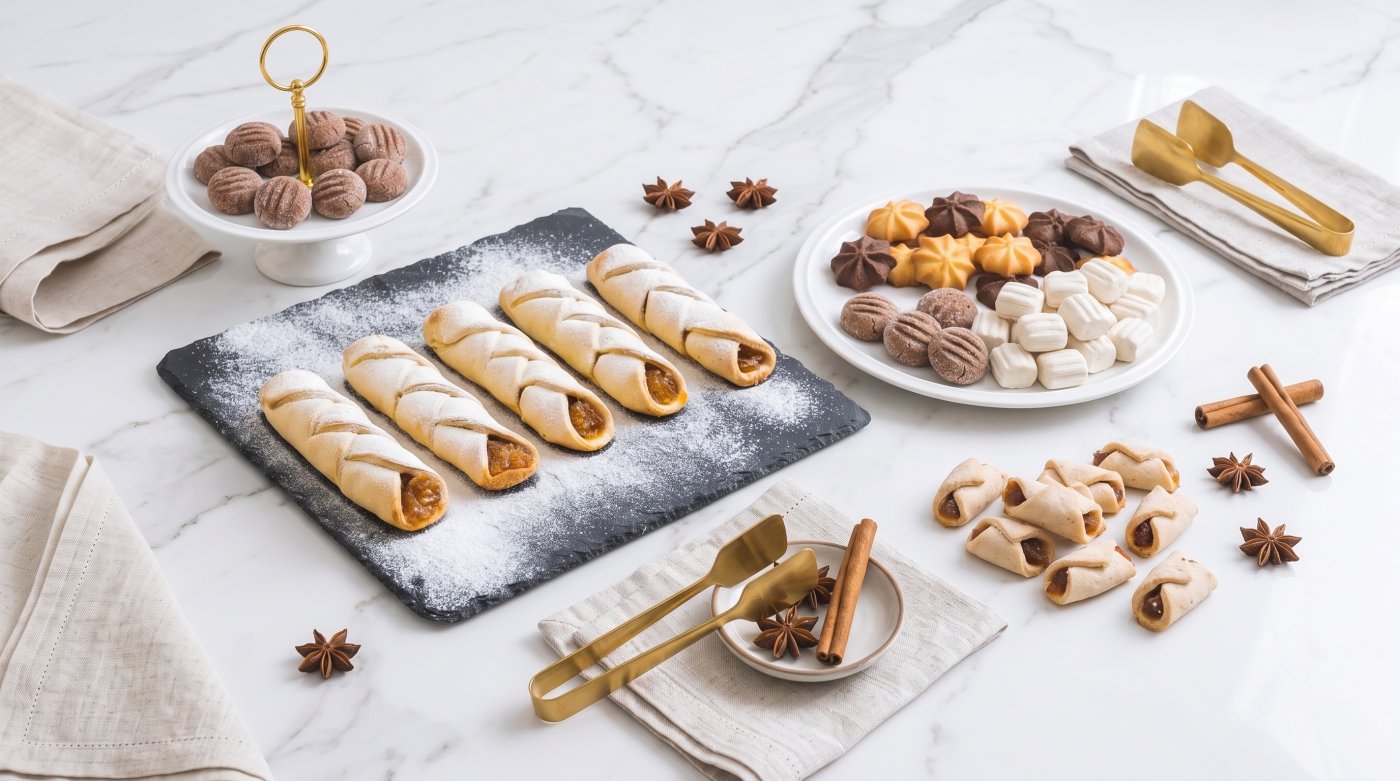
Bosnian börek has a different structure from a flat tray börek. That difference proves particularly useful with vegetable fillings.
What kind of structure is Bosnian börek?
The pastry gets rolled into a long strip in Bosnian börek.
The filling goes along one edge of the strip.
The strip rolls lengthwise into a log.
That log goes into the tray as a spiral.
It coils from the centre outward.
The result is a single spiral börek.
Sheets lie flat on top of each other in a classic tray börek; a horizontal coil forms in Bosnian börek and that produces different results during baking.
| Measure | Bosnian börek | Flat tray börek |
|---|---|---|
| Arrangement | A spiral log | Flat, stacked |
| Browned surface | High | Moderate |
| Escape of steam | Easy | Difficult |
| Portioning | By cutting | By cutting |
| Baking time | 40-50 minutes | 45-55 minutes |
| Suitability for vegetables | High | Moderate |
What is the advantage of the coil?
Three advantages exist.
The first is surface area; the spiral creates more outer surface and those surfaces brown in the oven.
The second is the escape of steam; gaps exist between the coils.
Steam from the filling escapes through them.
Steam gets trapped between the layers in a flat tray börek.
The third is portioning; the spiral naturally marks the lines for cutting.
Those three advantages become particularly valuable with vegetable fillings, since vegetable fillings are the group releasing most water.
What is the water problem with spinach?
Spinach is 91 percent water by weight.
That is among the highest proportions of any vegetable.
Raw spinach put into a filling releases that water during baking.
The pastry wets.
The base turns doughy.
A kilogram of raw spinach releases a hundred and fifty to two hundred millilitres of water during cooking.
That is enough to ruin a tray of börek; spinach therefore always gets processed before it goes into a filling.
How is the spinach filling prepared?
The preparation has three stages and none gets skipped.
In the first the spinach gets washed and finely chopped.
Salt gets scattered over it and it waits fifteen minutes.
The salt draws the water out by osmosis.
In the second the spinach gets squeezed by hand.
The liquid released gets discarded or used in a soup.
In the third the squeezed spinach joins browned onion in a pan and the remaining moisture evaporates; cheese then joins and the filling cools.
Which pastry suits Bosnian börek?
The pastry has to be thin and flexible in Bosnian börek.
It should not tear while rolling.
The best choice is börek filo, medium in thickness with enough give.
Baklava filo is very thin; it tears while rolling.
Home-rolled pastry gets used too, and hand-rolled filo gets preferred in the traditional method.
The pastry should not be dry; dry pastry cracks while rolling.
It stays covered with a damp cloth before use, and a light sprinkle of water goes on if necessary.
How does buttering work in Bosnian börek?
Fat both separates the layers and browns the surface.
Oil or melted butter goes over the sheet once rolled out.
A thin layer suffices.
Fat goes on a second time once the log sits in the tray.
That second application reaches between the coils.
Some recipes use a mixture of yoghurt and egg as well.
That mixture both glazes the surface and softens it slightly; where a completely crisp result is wanted only fat goes on.
What settings suit Bosnian börek?
A hundred and ninety degrees is where the oven sits before the tray goes in.
The time runs forty to fifty minutes.
The colour turns golden.
Nobody opens the door during the first twenty minutes.
The upper shelf can serve for the last ten.
The underside needs browning too; the base of the tray gets checked.
A damp cloth goes over it for ten minutes once it leaves the oven; that is a classic technique softening the börek slightly and easing the cutting.
How is Bosnian börek portioned?
The spiral form eases the cutting.
The lines between the coils form natural points to cut.
A sharp knife cuts along the coil.
Each piece runs one or two coils wide.
A standard portion runs a hundred to a hundred and fifty grams.
A thirty-two-centimetre tray gives eight to ten portions.
The cutting happens while the börek is warm; cut hot it falls apart, and once completely cool the pastry hardens and the cut comes out ragged.
How is Bosnian börek stored?
Baked börek keeps a day at room temperature.
Three days in a fridge, though it loses its crispness.
Reheating restores the texture; ten minutes at a hundred and sixty degrees.
It can be frozen raw, and that is the most practical method.
Coiled into the tray it freezes together with the tray.
It keeps two months.
Frozen börek goes straight into the oven; the time extends fifteen minutes and a freshly baked product emerges every time.
Which cheese gets used?
Cheese serves as both flavour and binder in a spinach filling.
White cheese is the most widespread; its salt and acidity balance the earthy note of the spinach.
Curd is softer but releases water; it gets drained where it goes in.
Kaşar binds the filling as it melts but partly covers the taste of the spinach.
Bosnian cooking generally uses a fresh cow's milk cheese.
The cheese runs 30 to 40 percent of the spinach weight; more turns the filling into a cheese börek and the spinach falls into the background.
Do other vegetable fillings work?
The same structure serves other vegetables too.
Leek; finely chopped, fried and its water evaporated.
Courgette; grated, salted and squeezed, exactly like spinach.
Potato; boiled and mashed, with no problem of water.
Mushroom; the group releasing most water, always fried in advance.
Mixed vegetable fillings get made as well; because the water content of each vegetable differs, each gets fried separately and only then combined.
