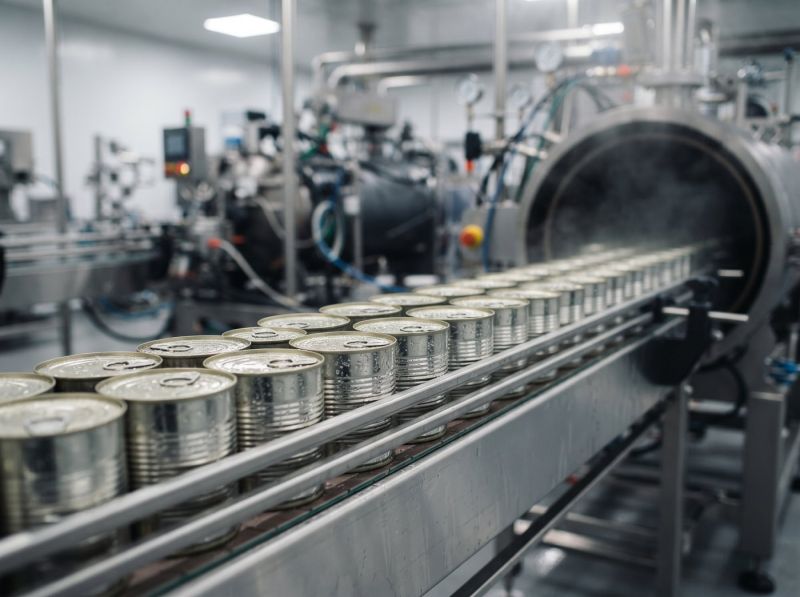
A can carries a date two or five years away. That date holds under particular conditions; change the conditions and it loses its meaning.
What deteriorates after sterilisation?
In canning the product is heat-treated inside a sealed can and microorganisms are killed.
While the can stays sealed no new microorganism can enter.
Microbial spoilage is therefore off the table as long as the can's integrity holds.
But three processes continue.
The first is chemical reaction. Components inside react slowly with one another.
The colour darkens and the flavour shifts.
The second is metal interaction. Even with a lined interior, interaction occurs at a microscopic level over time.
The third is textural change. Vegetables and fruit soften and meat fibres loosen.
Those three do not make the product dangerous but they lower its quality.
Shelf life is therefore a limit of quality rather than of safety.
Why does temperature matter more than the date?
The rate of chemical reactions rises with temperature.
Roughly, every 10-degree rise doubles the rate.
A can stored at fifteen degrees can hold its quality for five years.
The same product at thirty degrees shows clear quality loss within two.
At forty degrees — in a storeroom that heats in summer, or a car boot — that can fall to six months.
The date on the label therefore holds only "when stored under suitable conditions".
Suitable conditions are generally defined as 10 to 21 degrees.
Storeroom temperature should be measured and recorded, particularly in summer.
A freezer or anything below freezing is unsuitable too; freezing expands the contents and strains the seams.
| Storage temperature | Expected quality life | Note |
|---|---|---|
| 10-15 °C | 4-5 years | Ideal |
| 16-21 °C | 2-3 years | Acceptable |
| 22-27 °C | 1-2 years | Quality loss accelerates |
| 28-35 °C | 6-12 months | Marked loss |
| Above 35 °C | 3-6 months | Not advised |
| Below 0 °C | Variable | The can can be damaged |
What changes in acidic products?
The acidity of the product determines its interaction with the can.
High-acid products — tomatoes, fruit, pickles — react more with the metal.
The interior lining is more critical in those products.
Micro-cracks can develop in the lining over time and metal migration begins.
A metallic taste develops and the colour shifts.
Acidic products therefore have a shorter shelf life than low-acid ones.
For tomato products, 18 to 24 months is typical.
For low-acid products — vegetables, meat, pulses — three to five years.
For canned fruit, 12 to 18 months.
Where acidic products are sold in glass jars that problem disappears; glass does not react.
Glass-packed products can have a longer shelf life but require protection from light.
What storage conditions are needed?
Five conditions should hold together.
The first is temperature: 10 to 21 degrees.
The second is humidity, below 60 percent.
High humidity creates rust on the outside of the can, and rust eventually perforates it.
The third is darkness. Light degrades the colour and vitamins of products in glass.
The fourth is height above the floor. Cans should not sit directly on the ground; pallets or shelving should be used.
Moisture from the floor condenses beneath the cans.
The fifth is stacking. Cans should not be stacked too high; those underneath deform under pressure.
Stacking against a wall blocks ventilation too; ten centimetres of clearance should be left.
The storeroom should be cleaned regularly; dust and moisture accelerate rust.
What do the date types mean on a can?
Two different phrasings can appear on packaging.
"Use by" is a safety limit; the product should not be eaten after that date.
It is generally used on perishable products.
"Best before" is a quality limit.
A product can still be safe after that date but its quality has declined.
Canned goods generally carry the second phrasing.
A can past its date but structurally sound is safe in most cases, though its colour, texture and nutritional value have fallen.
That assessment depends on inspecting the can; on a swollen, rusted or dented can the date is irrelevant.
Businesses should not use product past its date; it creates legal liability and problems at inspection.
How is a can inspected?
Five checks apply.
The first is swelling. Neither lid nor base should bulge outward.
Swelling indicates gas production, and such a can must never be opened.
The second is rust. Surface rust can be cleaned, but deep rust and perforation render the product unusable.
The third is dents. Dents at the seam are critical; the seal there can be compromised.
Light dents on the body are generally not a problem.
The fourth is signs of leakage. Dried product residue on the outside indicates a leak.
The fifth is the sound on opening. A vacuum-sealed can draws air in with a characteristic sound.
If that sound is absent the vacuum has been lost.
Those five checks belong before every use; looking at the date is not enough on its own.
How should stock rotation work?
Order in the storeroom is what actually determines shelf life.
First in, first out should be applied.
New arrivals go to the back and older stock to the front.
That is the most commonly skipped practice; new stock goes to the front because it is easier.
The result is product forgotten at the back and passing its date.
Shelves should be labelled and every product group should have a fixed place.
A monthly count should be taken and products approaching their date marked.
A plan should be made for anything due to expire within three months.
Stock levels should be controlled too; excessive stock ties up capital and creates date risk.
Two or three times monthly consumption is a sufficient level.
With that system in place, losses from expired product disappear almost entirely.