


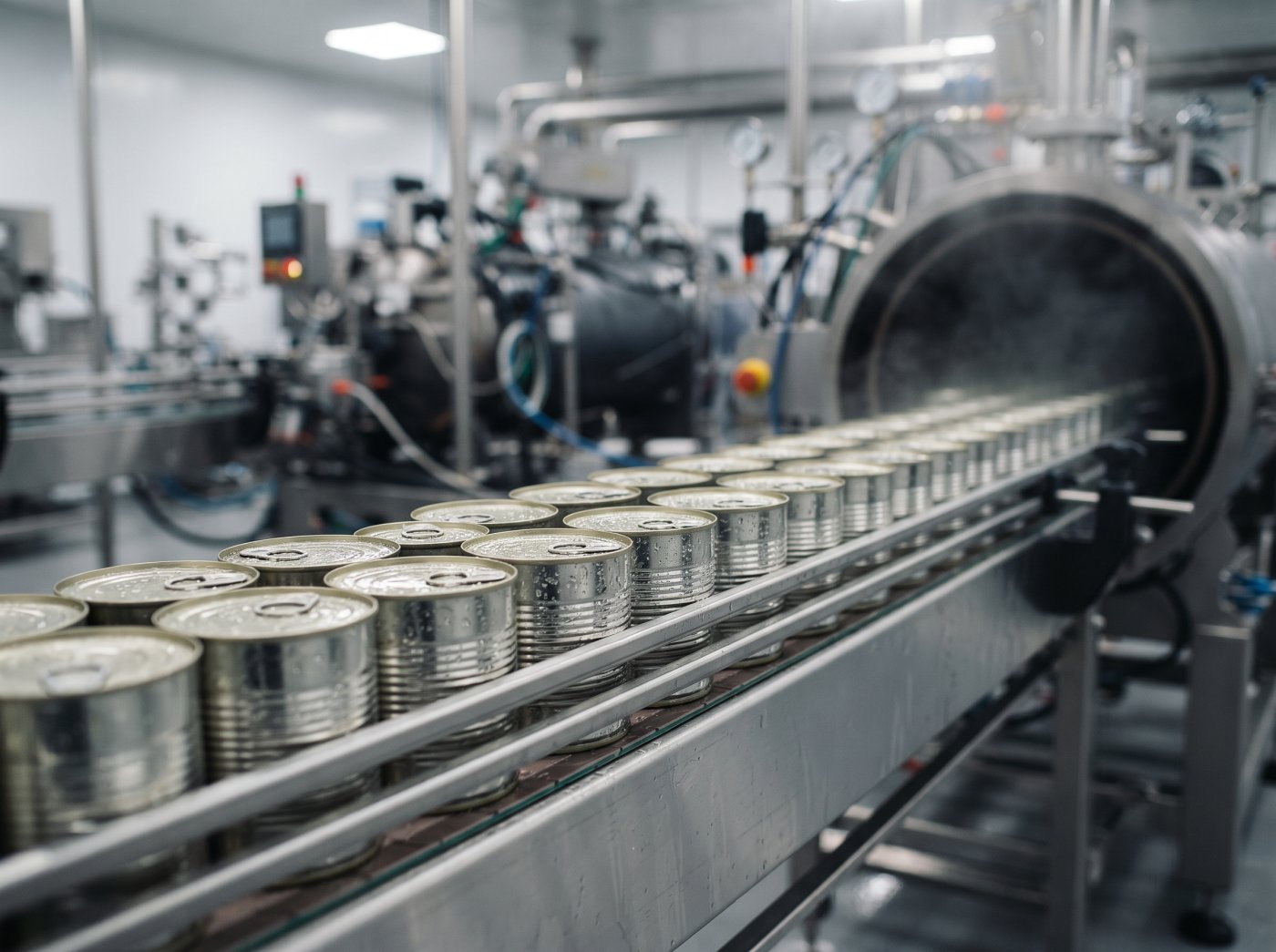
Canning is the most misunderstood of food preservation methods. The common belief is that canned products contain large quantities of preservatives. The truth is the opposite: canning is the one method that removes the need for preservatives altogether.
How does canning work?
Food spoils for two reasons: microorganisms and enzymes. Canning disables both at once.
The product is placed in a container which is then sealed airtight. The container is brought to a temperature that kills every living organism inside and held there for a set period.
That heat also deactivates the enzymes. When the process ends, nothing capable of causing spoilage remains inside.
As long as the container stays sealed, no new microorganism can enter. The product can therefore keep for years; no preservative is needed because there is nothing left to preserve against.
Why is such a high temperature required?
Most bacteria die at around 70-80 °C. But some form a resistant structure called a spore when conditions deteriorate, and those spores survive even at boiling point.
The most critical is Clostridium botulinum. Its spores wake in oxygen-free conditions and produce the toxin that causes botulism. A sealed can is precisely the environment this bacterium seeks.
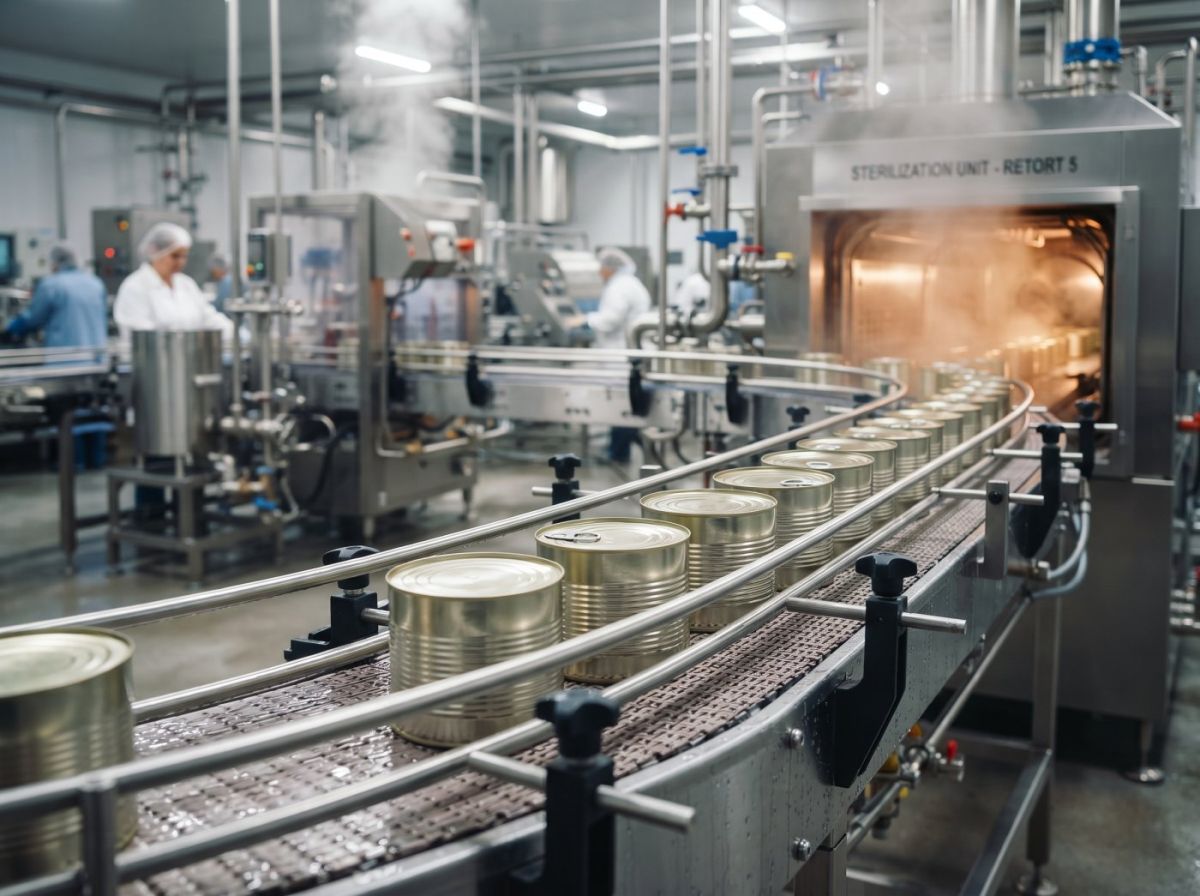
Killing the spores requires 121 °C, and that temperature cannot be reached at normal pressure; water boils at 100 °C. Industrial sterilisation is therefore carried out in pressure vessels.
This process is called retorting, and it sits at the centre of canning technology.
Does every product get the same treatment?
It does not. What decides is the acidity of the product.
| Product group | pH | Treatment applied | Temperature |
|---|---|---|---|
| Meat, poultry, vegetables, fish | Above 4.6 | Pressure sterilisation | 116-121 °C |
| Tomato, fruit, pickles | Below 4.6 | Boiling water pasteurisation | 90-100 °C |
The distinction is not arbitrary. Botulinum cannot multiply below pH 4.6; an acid environment stops it. In acidic products, boiling temperature is therefore sufficient.
Low-acid products such as meat and vegetables have no such natural protection, and pressure treatment is essential. This is the greatest risk in home canning: meat and vegetable preserves prepared without a pressure canner are not safe.
How does the vacuum form?
The container is sealed while hot. The air and steam inside are expanded by the heat.
As the product cools, the steam condenses and its volume shrinks. In a sealed container this means the pressure falls, and atmospheric pressure outside presses the lid inward.
In glass jars this is why the metal disc at the centre of the lid dips and makes no sound when pressed. In tin cans the lid sits slightly concave.
That vacuum is visible proof of the product's safety. A vacuum that has been lost indicates the container has admitted air somewhere and sterility has been broken.
Does canned food keep its nutritional value?
Partly. Losses occur in heat-sensitive compounds; the loss is pronounced in vitamin C and some B vitamins.
Minerals, protein and fibre, by contrast, are almost unaffected. Fat-soluble vitamins are also largely preserved.
In some cases canned food can have the advantage over fresh. A vegetable harvested, transported for days and left on shelves loses vitamins over time. In a vegetable canned immediately after harvest the loss happens once and stops there.
Tomato is a particular case: heat treatment increases the absorbability of the lycopene it contains. Canned tomato products are more efficient than fresh in that respect.
What is the lining inside the can?
The inner surface of a tin can is coated so that the food does not contact the metal directly. Without a lining, acid would dissolve the metal, spoiling the taste and transferring metal into the food.
These linings are produced for food contact and are subject to regulation. In recent years some lining materials have been debated and manufacturers have moved to alternatives.
The lining is only damaged when the can is scratched internally or dented. For this reason an opened can should not be left standing with its contents inside; they should be transferred to a glass or plastic container.
That rule applies after opening. There is no such risk for a product sitting in a sealed can.
Which signs indicate danger?
- A swollen can or lid: gas has been produced inside, and that is almost always microbial activity. The can should be discarded unopened.
- Liquid spurting on opening: internal pressure has risen; the same reasoning applies.
- No vacuum: if the lid makes a sound when pressed, the seal has failed.
- Cloudy or foaming liquid: cloudiness in liquid that should be clear is a sign of spoilage.
- A sour or sharp smell: if there is an unexpected odour on opening, the product should not be eaten.
- Deep dents and rust: dents on the seam in particular can break the seal.
None of these should ever be checked by tasting; botulinum toxin is tasteless and odourless.
Is the shelf life really unlimited?
In theory, if sterilisation was complete and the container does not leak, the product is microbiologically safe indefinitely.
Labels nonetheless carry a date, and that date is a quality limit rather than a safety one. Over time colour fades, texture softens and taste flattens. In acidic products the lining is also slowly affected.
In practice two to five years for meat products and one to three years for fruit and vegetables are reasonable ranges.
Storage conditions affect that period directly. A can kept somewhere cool and dry comfortably meets the period on its label; quality declines faster in a warm store or on a shelf exposed to sunlight. Freezing is harmful too: the contents expand and the seal at the seam can be broken.
