"Don't eat canned food, it's full of preservatives" is a common line. Yet the ingredients list on a classic can is usually three lines long: the product, water, salt.
What actually keeps canned food from spoiling?
What protects it is physical rather than chemical: heat and an airtight seal.
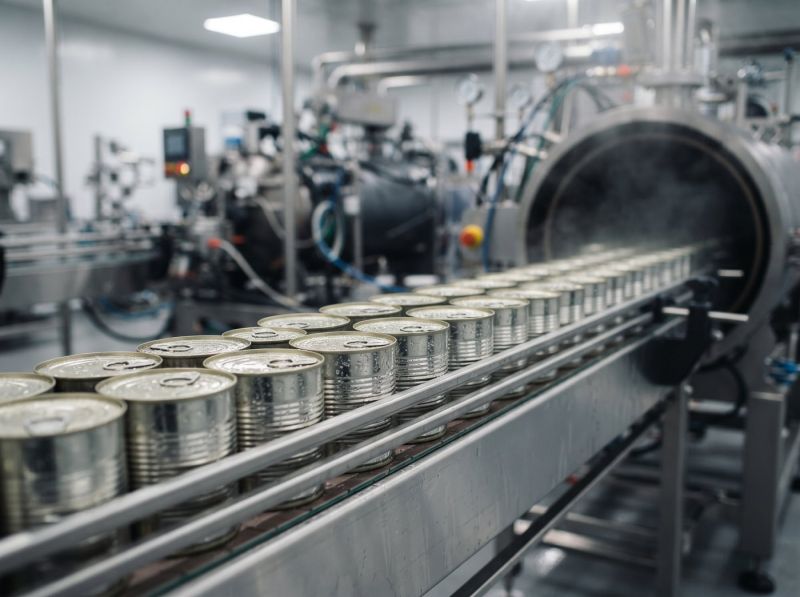
The product is filled into the can, the can is sealed, and it is processed at high temperature while closed. That process kills the microorganisms inside along with their spores.
Because the can is sealed, no new microorganisms can enter. With nothing alive inside and nothing able to get in, the product keeps for years.
The logic has not changed since the nineteenth century. The only thing that changed is the precision of the equipment.
At what temperature is sterilisation carried out?
The temperature depends on the acidity of the product, and that distinction sits at the foundation of food safety.
For acidic products below pH 4.6 — tomatoes, pickles, fruit — around 100 degrees is enough. At that acidity, dangerous spores cannot develop in the first place.
For low-acid products above pH 4.6 — meat, fish, vegetables, mushrooms — 116 to 121 degrees is required. That temperature is only reached in a pressurised retort.
The difference is not academic. Processing a low-acid product at 100 degrees leaves the spores of the bacterium responsible for botulism alive.
This is why making vegetable or meat conserves at home is not safe without a pressure canner.
Why does botulism matter so much here?
Because the inside of a can is an ideal environment for that bacterium.
Clostridium botulinum grows in the absence of oxygen. A sealed can is exactly such an environment.
The bacterium itself dies readily with heat, but its spores are resilient; they can survive hours at 100 degrees. Killing them requires 121 degrees and sufficient time.
In production plants that time is calculated and recorded. Botulism from industrially canned food is consequently very rare; the large majority of cases come from home-made products.
So which cans really do contain additives?
Some do, for different reasons.
Vegetable cans may carry ascorbic acid (vitamin C) or citric acid. These are not preservatives but colour protectants; they prevent darkening through oxidation.
Pickled and brined products contain acetic acid. That is part of the definition of the product; it is vinegar.
Ready meals in cans may contain starch, modified starch or vegetable gum. Those are thickeners.
Meat cans may show nitrite, but that usually applies where the meat was already processed as a deli product.
Classic preservatives such as sodium benzoate and potassium sorbate are unnecessary in heat-processed cans and are generally absent.
| Product type | pH | Process temperature | Typical additive |
|---|---|---|---|
| Canned fruit | 3.0-4.0 | ~100 °C | Ascorbic acid (colour) |
| Tomato products | 4.0-4.6 | ~100 °C | Citric acid, salt |
| Canned vegetables | 5.0-6.0 | 116-121 °C | Usually none |
| Meat and fish | 5.5-6.5 | 116-121 °C | Salt, sometimes nitrite |
| Ready meals | 5.0-6.0 | 116-121 °C | Starch, gum |
What is the salt for?
Salt in a can is there for flavour and texture, not preservation.
In vegetable cans salt also protects texture; the balance it creates across the cell wall keeps the vegetable from going too soft.
If the salt level seems high, draining makes a clear difference. Draining and rinsing canned beans removes close to forty percent of the sodium.
No-salt options exist too. In terms of preservation those products are identical to salted ones; the difference is only taste.
Does canning cost nutritional value?
Some of it, but the picture is not as bad as assumed.
Heat-sensitive vitamins are affected. Part of the vitamin C and some B vitamins are lost during sterilisation.
Heat-stable nutrients hold up: fibre, minerals, protein and fat-soluble vitamins largely remain.
For some nutrients the situation reverses. Lycopene in tomatoes becomes more available through heat treatment; canned tomato is superior to fresh in that respect.
The comparison should be against the real alternative, not an ideal fresh product. Between a tired winter vegetable that travelled a long way and a can processed at harvest, the advantage does not always sit with fresh.
Where does the BPA question stand?
The inside of a metal can is lined with epoxy resin to keep the metal from contacting the food. Classic linings contained bisphenol A.
Regulators tightened the limits on that substance step by step and most producers moved to alternative linings.
You can look for "BPA-free lining" on the label. Products in glass jars do not have the issue at all.
Acidic products put more stress on the lining. Preferring glass for tomato products is a reasonable choice.
Why should a swollen can never be opened?
Swelling means gas is being produced inside, and gas production means living microorganisms.
It indicates either that sterilisation fell short or that the can has a micro-leak somewhere. Either way the product is not safe.
Do not open it, do not smell it, do not taste it. Botulinum toxin has no smell or taste; a product that looks normal can still be dangerous.
Bag the can unopened and discard it. Opening it spreads the contents into the environment.
Dented cans or cans split at a seam count as risky too. Deformation at the lid seam in particular can compromise the integrity of the seal.
How should an opened can be stored?
The moment a can is opened it stops being a canned product and becomes an ordinary fresh one.
Transfer the contents to a glass or plastic container. Product left in an open metal can contacts metal at the cut edge of the lining and picks up a metallic taste.
It keeps two to four days in the fridge. For acidic products that window is slightly shorter.
Freezing the remainder is possible. Beans and corn do well; tomato products lose texture but cause no problem in a sauce.
The date on the can applies to the unopened product. Once it is open that date means nothing.