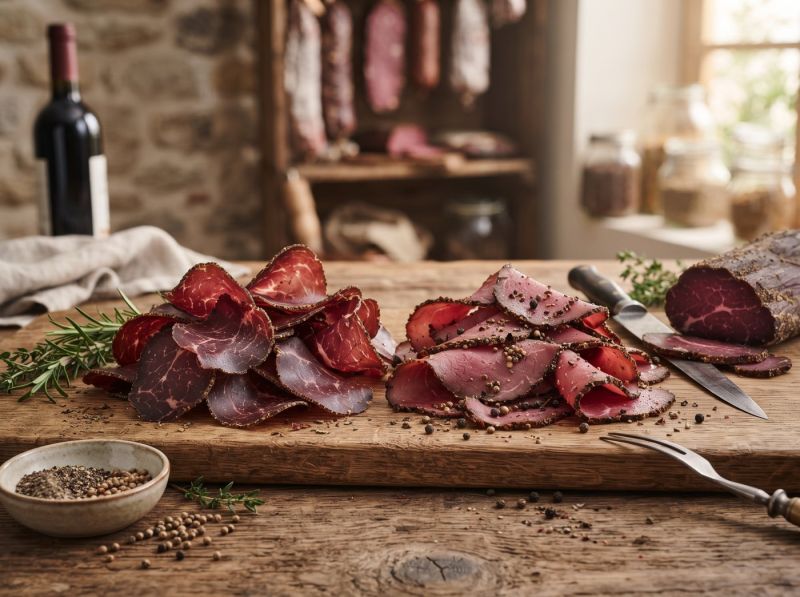
Dried meat keeps for months without refrigeration. That is usually summarised as "salt", but the real mechanism is more interesting.
What does water activity mean?
The amount of water in a food and the availability of that water are not the same thing.
Water activity indicates how much of the water in a food is free.
The value runs from zero to one; pure water is 1.0.
Fresh meat sits around 0.99; nearly all its water is free.
Bacteria use that water to multiply.
As water activity falls, multiplication slows and at some point stops.
But that does not mean the water has gone; what remains is bound to salt and sugar.
Bound water is inaccessible to microorganisms.
Dried meat can hold 30 to 40 percent water while its water activity stays below 0.85, and the product is safe.
What stops at which threshold?
Each group of microorganisms stops at a different threshold.
Salmonella and most pathogens cannot multiply below 0.94.
Staphylococcus is more resistant, reaching down to 0.86.
Yeasts stop around 0.88.
Moulds are the most resistant group; some develop down to 0.70.
The safe threshold for dried meat products is therefore taken as 0.85.
Below 0.85 pathogenic bacteria stop, but mould remains possible; that is managed through packaging and storage.
Below 0.60 no microorganism can multiply and the product is fully stable.
But meat that dry becomes hard and inedible; the target range is 0.85 to 0.90.
| Water activity | State | Example product |
|---|---|---|
| 0.99 | All bacteria multiply | Fresh meat |
| 0.95 | Most pathogens active | Fresh sausage |
| 0.91 | Pathogens slow | Short-fermented product |
| 0.86-0.90 | Pathogens stop | Pastırma, dried meat |
| 0.70-0.85 | Mould risk only | Long-dried product |
| Below 0.60 | Nothing multiplies | Powdered products |
How does salt work?
Salt is the most direct way of lowering water activity.
Sodium and chloride ions bind water molecules to themselves.
Bound water is no longer free; bacteria cannot use it.
One gram of salt binds around three grams of water.
The salt level in dried products is therefore held between 4 and 6 percent.
Salt also draws water out of the meat and speeds the drying.
It has a second function: it weakens bacteria directly by drawing water from their cells.
But salt alone is not enough; making a safe product with salt and no drying would require a salt level so high the product becomes inedible.
When salt and drying work together, both stay at reasonable levels.
What does nitrite add?
Nitrite performs three functions in dried meat products.
The first is safety. Clostridium botulinum spores tolerate low water activity, and nitrite closes that risk.
That is its most critical function and the alternatives are limited.
The second is colour. Nitrite reacts with myoglobin and forms a stable pink colour.
Dried meat made without nitrite turns grey-brown.
The third is aroma. The characteristic flavour of dried meat products comes from compounds formed with nitrite.
The quantity is kept within legal limits and is low.
Most of the nitrite used is consumed during ripening; what remains in the finished product is far below the starting amount.
Why is case hardening a problem?
This is the commonest technical fault in drying.
When the environment is too dry or the airflow too strong, the surface dries rapidly.
The dried surface hardens and loses its permeability.
Water in the interior can no longer get out.
The result is a product dry outside and moist within.
That product is not safe; the water activity at the centre is still high.
The trapped moisture also causes spoilage inside.
The remedy is drying in stages.
Humidity is kept high in the first days and lowered gradually.
Airflow should be low and steady; a fan blowing directly creates a hardened case.
How is the drying curve built?
The process runs in three stages.
The first is salting and resting. The product sits cold and the salt distributes evenly.
Humidity is high in this stage: 85 to 90 percent.
The second is the start of drying. Humidity falls to 75 to 80 percent and the temperature sits at 12 to 15 degrees.
The product begins losing water slowly.
The third is ripening. Humidity 70 to 75 percent, temperature 10 to 14 degrees.
That stage runs for weeks and the product reaches its target weight.
Weight loss is the most reliable indicator of the process; dried meat products target a loss of 35 to 45 percent.
The product is monitored by regular weighing; weight, not time, is what counts.
How should dried meat be stored?
Low water activity notwithstanding, the product does not keep forever.
Two routes to spoilage remain.
The first is oxidation. Fats react with oxygen and turn rancid.
That is not a microbial problem but it renders the product inedible.
Vacuum packaging delays it markedly.
The second is mould. In a humid environment mould can develop on the surface.
Storing somewhere cool and airy prevents it.
A whole piece can hang wrapped in paper somewhere cool.
Sliced product belongs in an airtight container in the fridge; the greater surface area leaves it more vulnerable.
A vacuum pack keeps six to twelve months unopened and two to three weeks after opening.
Freezing is unnecessary and not advised; the texture suffers on thawing.## Can it be dried at home?
The question comes up often and the answer needs care.
Temperature and humidity cannot be controlled at home; the process becomes unpredictable.
Because water activity cannot be measured, there is no way to confirm the product reached a safe threshold.
Drying without nitrite leaves the botulinum risk open.
Tracking weight gives partial control; a product down to 60 to 65 percent of its starting weight is probably within the safe range.
But that does not replace measurement.
Where home production is attempted, cooking before eating is the safest route.