


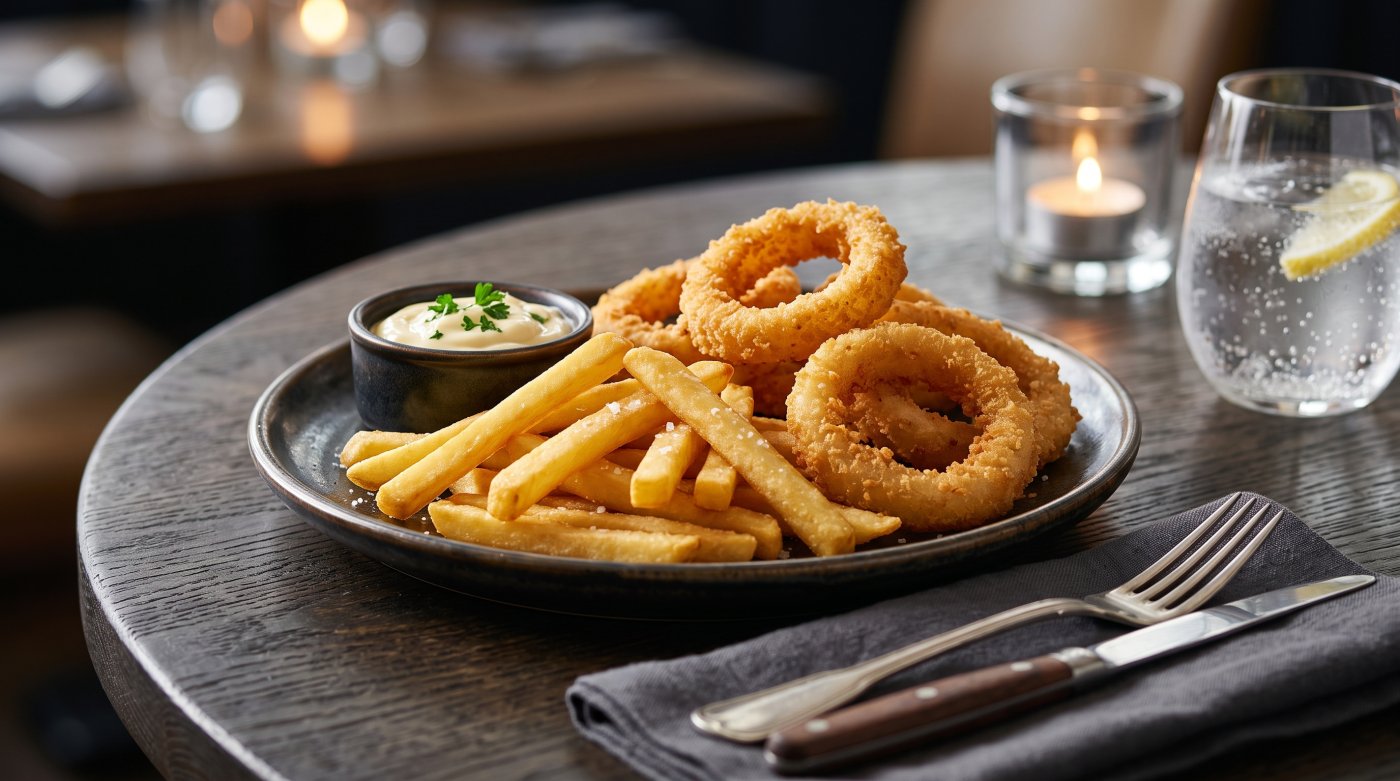
The commonest problem with onion rings is the onion sliding out of the coating when bitten. That usually gets blamed on the cooking, but the cause lies elsewhere.
Why does the coating separate?
Onion contains a high proportion of water.
That water evaporates during cooking and the onion shrinks.
The coating does the opposite; it dries and hardens.
A hardened coating keeps its dimensions.
The gap between them grows and the two layers separate.
That is a physical inevitability; it cannot be prevented entirely but it can be reduced.
The second cause is the slippery surface of the onion.
The thin membrane on the onion prevents the coating gripping.
That membrane must be removed.
The third cause is the onion releasing too much water, which wets the coating from within and weakens the bond.
How is the coating made to grip at home?
Four steps work.
The first is removing the membrane. The thin film on the inner and outer face of each ring is peeled away.
That is the most skipped and most effective step.
The second is drying. The rings are dried thoroughly with paper towel.
Flour does not grip a wet surface.
The third is a layer of flour. The rings are turned in dry flour first.
That thin layer creates the surface the following layers adhere to.
The fourth is resting. The coated rings sit in the fridge for at least thirty minutes.
That time lets the coating adhere to the onion.
Separation is markedly worse in rings fried without resting.
| Step | Effect | If skipped |
|---|---|---|
| Removing the membrane | Surface grip | The coating slides |
| Drying | Flour adhesion | The first layer fails |
| Flour layer | A bonding surface | A wet coating |
| Resting | Adhesion | It separates while cooking |
| Cooking from frozen | Control of shrinkage | The gap grows |
Why is cooking from frozen an advantage?
The problem appears less in ready-made frozen onion rings.
The reason is that the product is cooked frozen.
Frozen onion does not shrink until the coating has set.
Melting the ice takes time.
The coating sets and the bond forms during that time.
Even where the onion shrinks afterwards, the coating has already gripped.
A frozen product should therefore never be thawed.
A thawed product suffers exactly the problem homemade rings do.
Homemade rings can be frozen too; once coated they are frozen individually on a tray and then bagged.
That solves the problem and adds convenience.
Two hours of freezing suffices.
What should the oil temperature be?
The right range is 180 to 190 degrees.
That is slightly higher than for chips.
The reason is that the coating has to set fast.
At a lower temperature it sets late and the onion begins shrinking.
The product also absorbs oil and turns heavy.
At a higher temperature — above 200 — the coating darkens quickly while the onion stays raw.
The time is two and a half to three and a half minutes.
The product comes out as it turns golden.
Only a small quantity should fry at once; the result suffers when the oil temperature drops.
A third of the basket's capacity suits.
A minute should pass between batches for the oil to recover.
How are air fryers and ovens set?
In an air fryer the temperature is 200 degrees and the time eight to ten minutes.
The rings go in a single layer.
A light spray of oil is needed; a dry coating stays pale in an air fryer.
Turning halfway gives even browning.
The result comes close to frying, though the coating is a little drier.
In an oven the temperature is 220 degrees and the time twelve to fifteen minutes.
The tray should be preheated; a product placed on a cold tray does not cook underneath.
Using a wire rack browns the underside too.
The risk of separation is higher in an oven; because heating is slow the onion shrinks before the coating sets.
To reduce that risk the temperature should stay high and the product go onto a preheated tray.
Why is crowding a problem?
That is the most common mistake.
Onion rings are bulky and take up a great deal of space on a tray or in a basket.
There is therefore a tendency to stack them.
But stacked rings touch one another.
The touching points do not brown.
Steam gets trapped too and the coating softens.
The result is a product partly crisp and partly soft.
The right method is to cook small quantities in several batches.
That takes longer but the result is markedly better.
In a business that requires capacity planning.
Where rings are held in a display they should sit in a single layer under a heat lamp.
Product stacked in a pile loses its crispness in ten minutes.
What do the onion type and cut change?
The choice of onion matters in home cooking.
Sweet varieties suit better; low in sulphur compounds, they give a sweet profile when cooked.
Yellow onions can be used too but are sharper.
Red onions lose their colour when cooked and are not preferred.
The cut should be one to one and a half centimetres thick.
Thinly cut rings fall apart while cooking.
In thickly cut ones the onion stays raw.
The rings should be separated; nested rings do not cook evenly.
The small inner rings are set aside and used in other dishes.
After cutting, the rings can sit in iced water for ten minutes; that reduces the sharpness, but they then need drying thoroughly.
How should they be served?
Onion rings should be served immediately after cooking.
The window of crispness is five to eight minutes, shorter even than for chips.
The reason is that the onion releases steam from within.
That steam wets the coating from the inside.
The product should go onto a wire rack; steam gets trapped on a plate or on paper towel.
Salt should be scattered on straight after cooking; it grips a hot surface better.
Sauce should be served in a separate bowl; poured over, it softens the coating at once.
Spiced mayonnaise, barbecue sauce and ranch are the classic matches.
Garlic yoghurt works well in Turkish cuisine.
Where they are served with a burger the rings should sit beside it rather than on it; the steam from the burger ruins the coating.
