


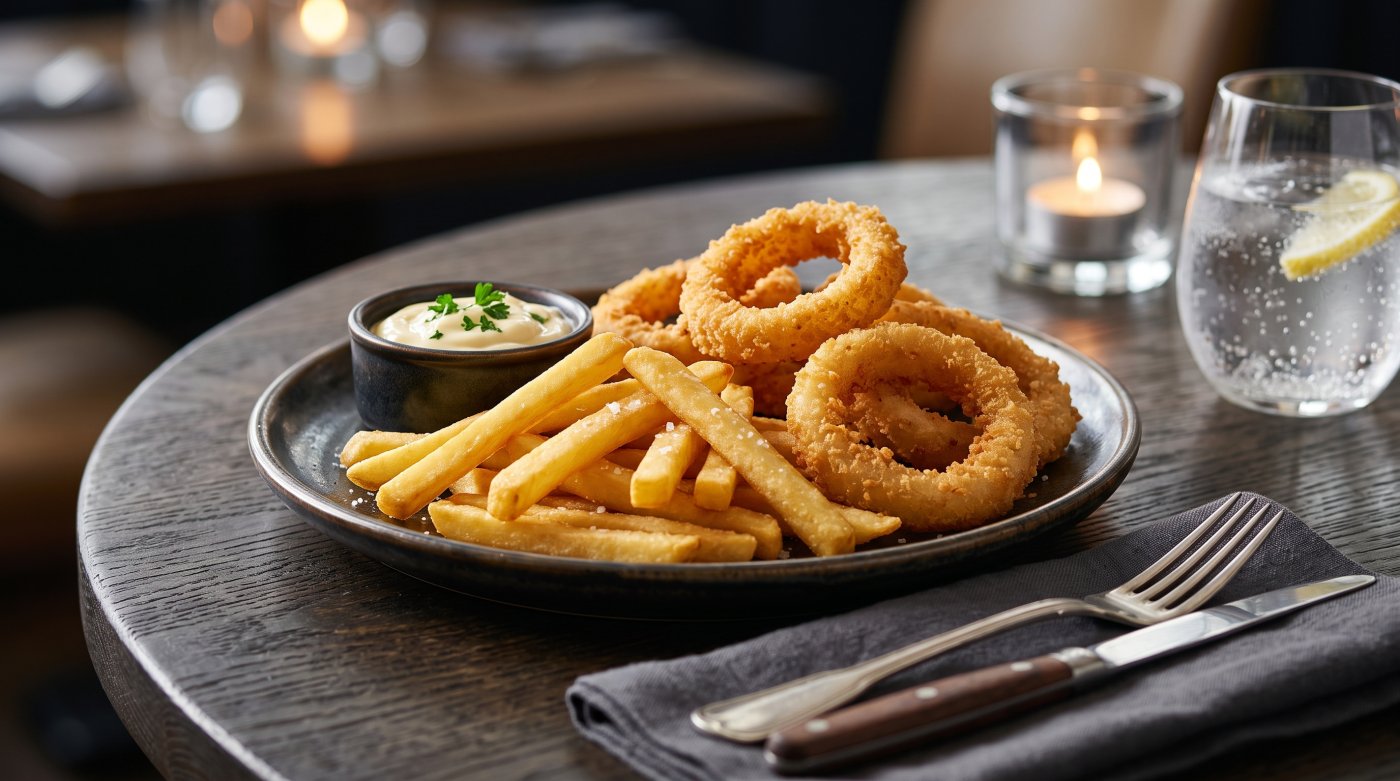
Onion rings fail more often than any other fried item. The coating stays in the oil and the onion arrives bare on the plate.
How does the separation happen?
The problem is the bond between two surfaces breaking.
An onion ring consists of two components.
Onion inside, coating outside.
The onion cooks and contracts during frying.
The coating hardens and holds its shape.
The two components move in different directions.
Where the bond between them is weak, that movement breaks it.
The coating becomes a hollow tube and the onion slips out from within; that is exactly the classic problem of the empty coating.
Why is surface moisture critical?
Onion is high in water: 88 to 90 percent.
A layer of moisture forms at the surface once it is cut.
That layer prevents the coating adhering.
Flour or batter cannot grip a wet surface.
The solution dries the surface.
The rings get patted with paper towel.
They stand uncovered for ten minutes.
Those two steps solve most of the adhesion problem and require nothing extra.
| Mistake | Result | Fix |
|---|---|---|
| Surface moisture | Coating will not grip | Dry, then stand |
| A single coating layer | A weak bond | Flour, egg, crumb |
| Thin batter | Runs off in the oil | Adjust the consistency |
| Low oil temperature | Absorbs oil | 175-180 °C |
| High oil temperature | Outside burns | 175-180 °C |
| Crowded basket | Temperature drops | Half a basket |
How does the layer system work?
A single layer of coating does not suffice.
A three-layer system gives the most reliable result.
The first layer is dry flour; it absorbs moisture and creates a surface with grip.
The second is egg, or a mixture of egg and milk; it acts as a binder.
The third is breadcrumb or batter.
Each layer gets shaken off; excess material stops the next layer gripping.
That system binds the coating mechanically to the onion and tolerates the difference in movement during cooking.
What batter consistency applies?
Where a batter coating gets used the consistency decides.
Very thin batter runs off without gripping the onion.
Very thick batter does not cook and stays doughy inside.
The right consistency runs slowly off a spoon while leaving a trail.
A little thicker than pancake batter.
Cold liquid goes in; cold batter comes out crisper on entering the oil.
Adding sparkling water lends lightness.
The batter gets mixed immediately before use; batter left standing develops gluten and gives a tough coating.
What does the oil temperature change?
Temperature determines both the crispness and the oil absorbed.
A hundred and seventy-five to a hundred and eighty degrees is ideal.
The coating hardens quickly at that temperature.
A hardened coating prevents oil entering.
The coating hardens late at a lower temperature.
Oil gets absorbed during that time and the product turns greasy.
The risk of separation rises too since the coating stays soft.
At a high temperature the outer surface burns while the onion stays raw; that appears particularly in thickly cut rings.
How is the onion prepared?
The cut is part of the result.
The rings run one to one and a half centimetres.
Thin rings fall apart as they cook.
Thick ones stay raw inside.
The rings get separated from each other; nested layers do not coat evenly.
The very small inner rings come out and go into another dish.
Some recipes soak the rings in milk; that both reduces the sharpness and prepares the surface for coating, though drying afterwards remains necessary.
Is frozen product different?
Frozen onion rings are a product whose coating went on at the factory.
The coating gets partly cooked before freezing.
That fixes the bond.
The risk of separation is markedly lower.
But one rule applies: the product does not get thawed.
A thawed ring releases water from the onion and the coating wets from inside.
It goes into the oil straight from frozen.
Frying takes three or four minutes; baking is possible too but the result is less crisp and the coating stays paler.
Why does basket loading matter?
That is the factor most often ignored.
The oil temperature falls where too much product goes into the basket.
A kilogram of frozen product can lower the oil by twenty or thirty degrees.
The product absorbs oil until the temperature recovers.
Product filling half the basket volume goes in.
The rings also stick to each other; two rings join in a crowded basket and the coating tears as they separate.
Frying in two batches always beats a poor result in one.
What service timing applies?
Onion rings lose their crispness faster than any other fried item.
They go out within five minutes of leaving the oil.
They rest on a wire rack; steam gets trapped on paper towel and the underside softens.
Salt goes on immediately; a hot surface holds it.
They do not travel in a closed container; steam softens the coating.
Perforated packaging gets used for takeaway and the product sits apart from other hot dishes; that extends the crispness by a few minutes.
Is baking an alternative?
Frying is not the only method.
An oven markedly reduces the oil consumed.
The rings go onto a tray in a single layer.
A little oil gets sprayed over them.
Fifteen to eighteen minutes at two hundred degrees.
They get turned once halfway.
The result is less crisp than frying but gives an acceptable texture.
An air fryer offers a better middle road; twelve minutes at a hundred and ninety degrees means a crispness close to frying with markedly less oil.
