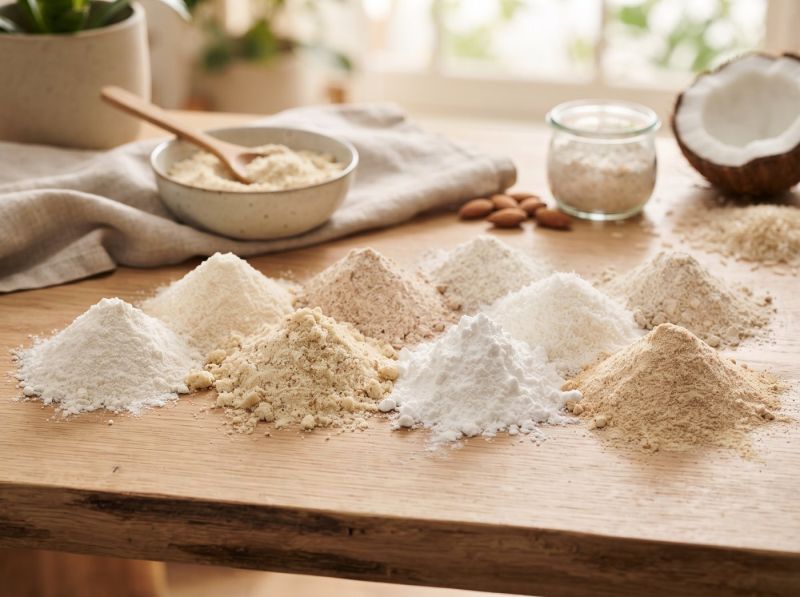
Almond flour is close to a standard component in gluten-free recipes. The reason is not flavour; it is that it performs a function other gluten-free flours cannot.
What is almond's nutritional profile?
A hundred grams of almonds carries 579 calories.
Protein 21 grams; among the highest of any nut.
Fat 50 grams, but mostly monounsaturated, dominated by oleic acid.
Saturated fat is only 3.8 grams.
Carbohydrate 22 grams, of which 12.5 grams is fibre.
Net carbohydrate is therefore 9.5 grams, which makes almond flour useful in low-carbohydrate recipes too.
It is very rich in vitamin E: 25 milligrams per hundred grams, more than twice the daily requirement.
Magnesium 270 milligrams, calcium 269 milligrams.
That profile makes almond flour a markedly different ingredient from wheat flour.
What does it do in gluten-free dough?
The shared problem of gluten-free flours is a lack of structure.
Rice flour and starches provide bulk only; they cannot hold a dough together.
Almond flour brings three things.
The first is fat. Fat gives softness to the dough and delays the product drying out.
Dryness is the commonest fault in gluten-free products, and almond flour addresses it directly.
The second is protein. Almond protein does not replace gluten, but it coagulates under heat and builds partial structure.
The third is texture. Almond flour reduces the sandy, gummy sensation starches produce.
It leaves a fuller texture in the mouth.
Together those three bring a gluten-free product closer to a wheat one.
| Flour | Protein | Fat | Structure | Moisture holding |
|---|---|---|---|---|
| Almond flour | 21 g | 50 g | Moderate | High |
| Rice flour | 6 g | 1 g | Low | Low |
| Corn starch | 0.3 g | 0 g | None | Low |
| Potato starch | 0.1 g | 0 g | None | Moderate |
| Buckwheat flour | 13 g | 3 g | Moderate | Moderate |
| Wheat flour | 10 g | 1 g | High (gluten) | Moderate |
Why can it not be used alone?
Almond flour contains no gluten and very little starch.
Starch builds structure by gelatinising during baking; almond flour has no such mechanism.
Used alone it cannot rise and produces a dense, damp texture.
Its fat content is high too; too much almond flour makes a dough fluid and causes spreading during baking.
A blend is therefore required.
In a typical gluten-free blend, almond flour makes up 20 to 40 percent of the total.
The remainder is rice flour, starch and a binder.
In products not required to rise, such as biscuits and tarts, that can reach 60 to 70 percent.
In cakes and bread it should not exceed 30 percent.
Macarons and some almond-based desserts are the exception; there almond flour is the only flour and the structure comes from egg white.
With skins or blanched?
Two types of almond flour are sold.
Natural almond flour retains the brown skin.
Its colour is dark and flecked; its fibre content is higher.
It delivers a stronger aroma, though the skin adds a faintly astringent note.
Blanched almond flour is made from almonds with the skin removed.
Its colour is pale and even; it gives products a cleaner appearance.
Blanched flour should be used in macarons and pale-coloured cakes.
Natural flour can be used in biscuits, cakes and tart bases; it is both cheaper and higher in fibre.
Nutritionally, natural flour is higher in fibre and antioxidants.
The skin carries a significant share of the almond's antioxidants.
Does grinding your own make sense?
Ready-made almond flour costs 40 to 60 percent more than whole almonds.
Grinding your own is economical but requires technical care.
Almonds are 50 percent fat; over-ground they release their oil and turn into almond butter.
Three rules prevent that.
The first is grinding in short bursts, ten seconds at a time with pauses.
The second is using cold almonds; almonds from the fridge release oil later.
The third is grinding with a little of the recipe's sugar or flour added.
The added dry matter absorbs the oil and the mixture stays powdery.
It should be sieved after grinding, with coarse pieces reground.
A one-millimetre sieve suits; a finer one holds back too much material.
How is it managed as an allergen?
Almond belongs to the tree nut group and is an allergen that must be declared.
Because almond flour is widely used in gluten-free products, that is an important intersection.
For someone with both coeliac disease and a nut allergy, the options narrow markedly.
Alternatives to almond exist for those groups.
Sunflower seed flour offers a similar fat and protein profile and is not an allergen.
But it can react with baking powder and produce a greenish colour; lemon juice prevents that.
Sesame flour can also be used, though sesame is an allergen too.
Coconut flour is another option, but it absorbs a great deal of water and requires recipe adjustment.
Where a business uses almond flour it should be stated on the menu and cross-contact precautions taken.
How should almond flour be stored?
Almond flour deteriorates far faster than whole almonds.
Grinding exposes the oil and leaves it open to oxidation.
Rancid almond flour smells sharp and paint-like; such product cannot be used.
At room temperature in an airtight container it keeps two to three months.
Refrigerated, six months.
In a freezer, twelve months.
Because the fat content is high, cold storage makes a clear difference.
A dry spoon should be used; flour that takes up moisture clumps.
Flour from the freezer should reach room temperature before the container is opened; a cold container opened in a warm room forms condensation.
Buying whole almonds and grinding a week's requirement is the most practical approach, advantageous for both freshness and cost.