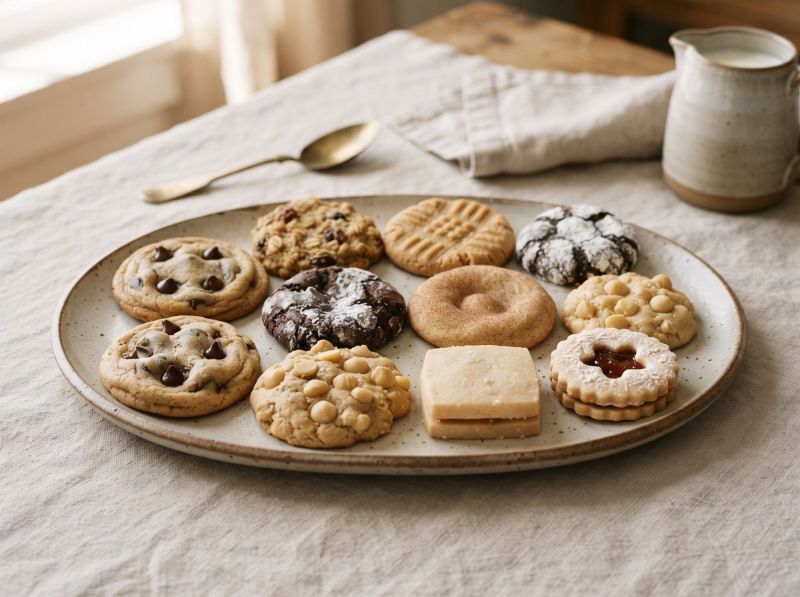
Un kurabiyesi is the constant of holiday plates. The recipe rests on three ingredients, but what decides the result is the ratio and the mixing technique.
Why does it melt in the mouth?
That texture is a consequence of the short pastry mechanism.
In an ordinary dough, flour meets water and a gluten network forms. That network gives structure and chew.
In un kurabiyesi the fat proportion is so high that almost every flour particle is coated in fat.
A coated particle cannot meet water.
There is no water in the recipe anyway; the only liquid comes from the fat.
Without gluten the dough cannot hold together; it is bound only by fat and sugar.
That bond sets in the oven, but at body temperature the fat melts and the structure falls apart.
That is the fundamental property separating un kurabiyesi from other biscuits.
What should the ratios be?
The classic ratio works on weight.
Flour is taken as 100 percent.
Fat runs 50 to 60 percent. That proportion is what places un kurabiyesi in the short pastry category.
Icing sugar runs 25 to 35 percent.
Some recipes add starch, replacing 10 to 20 percent of the flour.
Starch contains no gluten and increases the crumbliness further.
Raising agent is optional; where used, around 1 percent.
Egg is generally not used; where it is, the structure tightens and the melting quality falls.
Vanilla and lemon zest are added for aroma.
| Component | Ratio | Function |
|---|---|---|
| Flour | 100% | Structure |
| Fat (clarified or butter) | 50-60% | Blocking gluten, texture |
| Icing sugar | 25-35% | Flavour, crispness |
| Starch | 0-20% (of the flour) | Increasing crumbliness |
| Raising agent | 0-1% | Light rise |
Why icing sugar rather than caster?
Using icing sugar in place of caster sugar is a technical choice.
Icing sugar is very finely ground and mixes into fat immediately.
Caster sugar is granular; it stays undissolved in the dough and melts in the oven, leaving cavities.
Those cavities make the biscuit porous and give crispness rather than melt.
Icing sugar also contains starch; added to prevent caking, it supports the crumbly texture too.
The result is a smoother, more evenly melting texture.
The icing sugar dusted on top is a separate matter, applied for appearance and flavour after the biscuits have cooled.
Dusted onto hot biscuits it melts and is absorbed.
Clarified butter or butter?
Both are used and the results differ.
Butter contains 80 to 82 percent fat; the rest is water and milk solids.
That water, small as it is, contributes to gluten formation and tightens the structure slightly.
The milk solids brown in the oven and leave a characteristic aroma.
Clarified butter has had its water and milk solids taken out, leaving over 99 percent fat.
With no water, no gluten forms at all and the melting quality is at its highest.
But without milk solids the aroma is flatter.
Traditional un kurabiyesi is made with clarified butter, a choice that prioritises texture.
Some recipes mix the two, achieving both melt and aroma.
How should it be mixed?
There is no kneading in short pastry; there is mixing, and it is brief.
Fat and icing sugar are beaten together first. That step incorporates a little air.
Long beating is unnecessary; too much air makes the biscuits spread in the oven.
Flour and starch are sifted and added.
Mixing continues until no flour is visible and then stops.
Over-mixing develops a little gluten and the biscuits toughen.
The dough should be a consistency that does not stick to the hand and shapes easily.
If it feels too dry, add a spoonful of fat, not water.
Water breaks the whole logic of short pastry.
Shaping and oven settings
The dough is rolled by hand and pressed lightly.
Size matters: large biscuits collapse under their own weight. Twenty to thirty grams is a suitable range.
Space should be left on the tray; the biscuits spread a little in the oven.
The oven runs at 160 to 170 degrees, lower than for most biscuits.
The reason: un kurabiyesi is not meant to take colour. The target is pale cream.
The time is fifteen to twenty minutes.
The biscuits are soft coming out of the oven and firm as they cool. Waiting for them to firm in the oven is a mistake; they overbake.
They should cool on the tray; moved while hot they break.
What about shelf life?
Un kurabiyesi is among the longest-lived products.
With no water, the risk of microbiological spoilage is close to zero.
In a sealed container at room temperature it keeps three to four weeks.
The only enemy is moisture. A biscuit that absorbs moisture softens and loses its melting quality.
Metal or glass tins provide a better barrier than plastic.
It should not be refrigerated; a humid environment damages the texture.
It can be frozen, both as raw dough and as baked biscuits.
Raw dough portioned and frozen can be baked as needed; that method is common in preparation before a holiday.
How should holiday production be planned?
Un kurabiyesi is the product that can be made earliest in holiday preparation.
With its long shelf life it can be made a week ahead.
That spreads the workload before the holiday.
In batch production the dough is made once, portioned and baked in batches.
Where oven capacity is a constraint, the dough is frozen and baked day by day.
Dusting with icing sugar should happen close to serving; sugar applied early draws moisture and goes wet.
The storage container should be closed only once the product has cooled completely; sealed warm, condensation forms and the biscuits soften.
Different biscuit types should not share a container; the moister one softens the drier.