


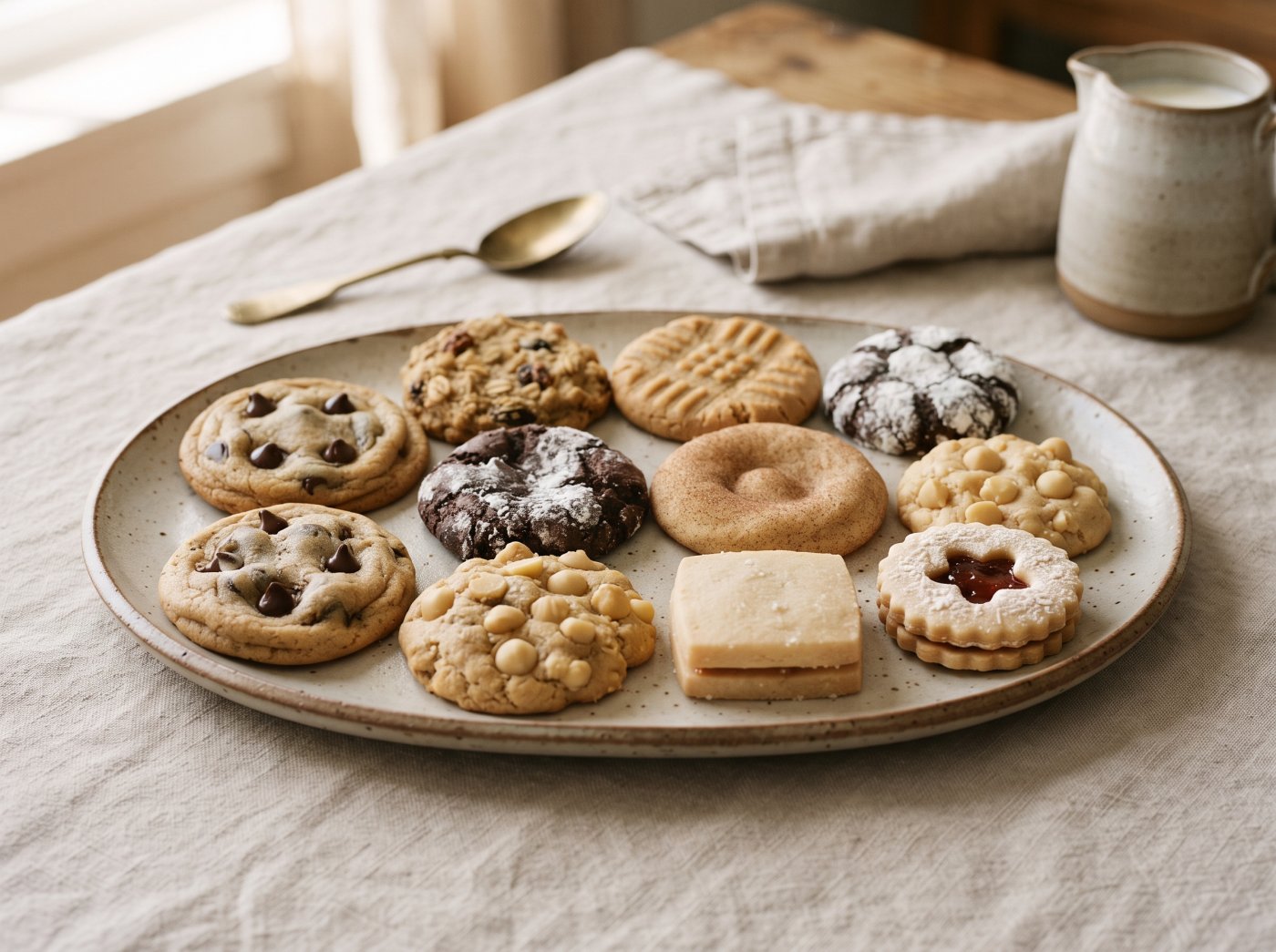
A patisserie window holds dozens of biscuit varieties, and the ingredient list of most is nearly identical: flour, fat, sugar, egg. What creates the difference is proportion and method. Those two variables divide biscuits into texture families with sharp boundaries between them.
What determines biscuit texture?
The decisive factor is the effect of fat on the gluten network. Fat prevents flour and water combining to form a network; as the fat ratio rises the network shortens and the biscuit crumbles more readily. In baking this effect is called shortening.
The second variable is the quantity of liquid. Water and egg support gluten formation; as these increase the biscuit becomes firmer and chewier.
The third is the physical state of the sugar. Caster sugar dissolves in the dough and causes the biscuit to spread; icing sugar disperses without dissolving and the biscuit holds its shape.
The combination of these three produces three main texture families: melting, crisp-snapping, and soft.
Why does un kurabiyesi melt in the mouth?
Un kurabiyesi is the biscuit type highest in fat. In some recipes the fat reaches half the weight of the flour.
At that ratio virtually no gluten network forms. Rather than binding to one another, the flour particles are coated in fat, and the biscuit disintegrates without resistance when bitten.
The second factor is the absence of liquid. Classic un kurabiyesi contains no water and usually no egg; the only binder is fat. This makes the dough shapeable by hand but very fragile.
The third is icing sugar. Because icing sugar does not dissolve in the dough, the biscuit does not spread in the oven and holds the shape given to it. Having no crystal structure, it also leaves no gritty sensation in the mouth.
Why is kavala crisp?
Kavala aims not at softness but at a crisp snap, by a different route from un kurabiyesi. It contains almond or hazelnut, and those nuts add hard points to the structure.
The real difference, though, lies in baking time. Kavala is baked longer and at a slightly lower temperature. This lowers the moisture content markedly, and the dried structure gives a crisp break.
The egg white brushed on the surface is part of the technique too. Egg white hardens as it bakes and gives the biscuit a thin, glossy crust that contributes both appearance and texture.
The biscuit takes its name from the Greek city of Kavala and is one of the recipes carried into Anatolia during the population exchange.
How is hanımeli shaped?
Hanımeli takes its name from its shape: the dough is rolled into thin strips and plaited or curled into a form resembling a flower.
That shape is only possible with a particular dough consistency. The dough has to be cohesive enough not to break when stretched by hand, yet slack enough not to spring back once shaped. That balance comes from careful adjustment of the fat and liquid ratio.
Hanımeli's second characteristic is its filling. Chocolate, jam or nut paste is generally used, set within the shape. Because the filling is moist, the dough has to be robust enough to carry it; for this reason hanımeli dough contains less fat than un kurabiyesi.
How do the three compare?
| Criterion | Un kurabiyesi | Kavala | Hanımeli |
|---|---|---|---|
| Fat ratio | Very high | Medium | Medium |
| Liquid | None or very little | Little | Medium |
| Texture | Melting | Crisp, brittle | Soft-firm |
| Sugar type | Icing | Caster | Caster |
| Baking | 160 °C, short | 150 °C, long | 170 °C, medium |
| Shelf life | Long | Very long | Short |
| Filling | None | Nuts, within | Jam, chocolate |
The shelf life row reflects moisture content directly. The lower the moisture, the longer the life; this is why filled hanımeli has the shortest.
What other varieties are common?
Savoury biscuits form a separate family. They contain salt and usually cheese in place of sugar, with dill, nigella seed and sesame as common additions. In texture they are close to un kurabiyesi, but their taste is entirely different.
Şam kurabiyesi is a citrus-scented variety with a cracked surface. The cracks form as dough rolled in icing sugar expands in the oven.
Rolled biscuits are made by spreading filling over rolled-out dough, rolling it up and baking it in slices. The spiral pattern visible in section is the distinguishing feature of this family.
The cookie family follows different logic from Turkish biscuits: it contains raising agent, spreads in the oven, and its centre is deliberately underbaked to stay soft.
Why is the dough rested?
Biscuit dough is chilled before shaping, and this step affects the result markedly.
In cold dough the fat solidifies. In the oven that solid fat melts slowly, and during that time the structure of the dough sets so the biscuit does not spread. In unrested dough the fat melts immediately and the biscuit widens on the tray.
The second gain is moisture distribution. Over the resting period the flour particles absorb liquid evenly, giving a more consistent result in baking.
For filled biscuits resting is essential. A soft dough cannot carry the weight of the filling and falls apart during shaping.
How is raw frozen biscuit baked?
Biscuits shaped and held frozen go into the oven without thawing. This means the resting step is already complete; the dough is cold and will not spread.
Baking time extends by three to five minutes compared with fresh dough. The temperature stays the same; lowered, the biscuit does not dry sufficiently from within.
A thawed biscuit is the worst case. The fat softens, the dough turns sticky and it spreads excessively in the oven. Biscuits coming out of the freezer therefore go straight onto the tray.
How should they be stored?
Biscuits are a low-moisture product and their greatest threat is humidity in the air. A biscuit that draws moisture softens and loses its snap.
Correct storage is an airtight tin at room temperature. A refrigerator is unsuitable; moisture condensing on cold surfaces passes into the biscuit.
Different varieties should not be stored in the same tin. A moist biscuit passes moisture to the dry one beside it; within days both converge on a middling texture and both lose.
A softened biscuit can largely be recovered by five minutes in a 150 °C oven. Once cool it returns close to its first-day crispness.
