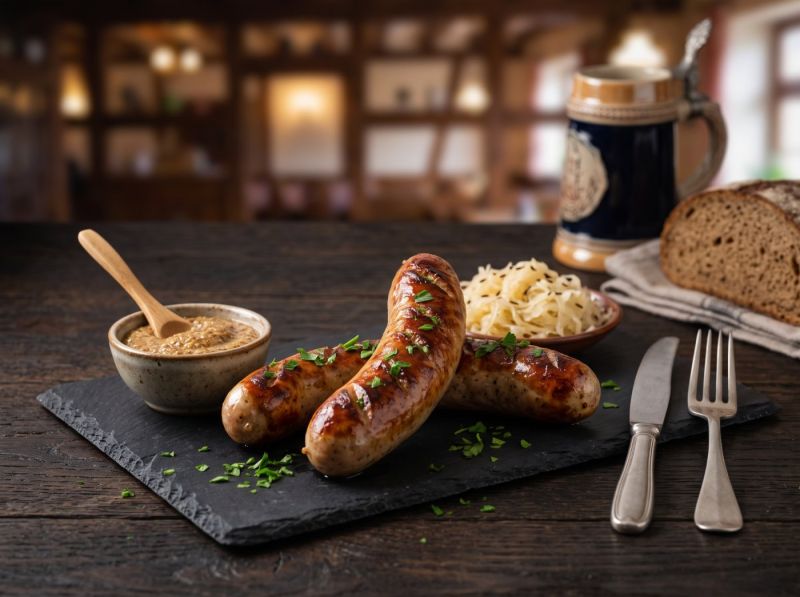
Bratwurst began appearing on Turkish shelves in recent years. But it is a product different from familiar sausages, and that difference produces direct results in the kitchen.
What is bratwurst?
Bratwurst is a fresh sausage from German cooking.
Its name means a sausage for frying.
It generally gets made from a mixture of pork and beef; versions sold in Turkey use beef and chicken.
The meat gets ground at a medium coarseness.
Spice, salt and iced water go in.
It fills a natural casing.
But it does not get cooked or cured; the product sells raw, and that forms its most fundamental difference.
| Measure | Bratwurst | Classic Turkish sausage |
|---|---|---|
| State | Raw | Cooked |
| Curing | None | Present |
| Spices | Nutmeg, ginger | Cumin, red pepper |
| Casing | Natural | Natural or synthetic |
| Shelf life | 2-4 days | 3-4 weeks |
| Cooking time | 12-18 minutes | 4-6 minutes |
What does being raw change?
It changes three things.
The first is cooking time; the centre has to reach seventy-five degrees.
That means twelve to eighteen minutes.
A classic sausage warms through in four or five.
The second is shelf life; a raw sausage keeps two to four days in a fridge.
The third is food safety; because raw meat gets handled, a risk of cross-contamination exists.
Those three make the product an entirely different item in a kitchen, and cooked out of habit its centre stays raw.
What is its spice profile?
The spice profile of bratwurst differs markedly from a Turkish sausage.
Nutmeg is the base spice; it gives a sweetish, warm note.
Ground ginger is second; it adds a light sharpness.
White pepper goes in; softer than black and it does not disturb the colour of the product.
Cumin and red pepper do not appear.
Marjoram and coriander join in some regional versions.
That profile also forms the basis of the traditional presentation pairing it with mustard and sauerkraut.
How is bratwurst cooked?
Four methods get used.
Grilling is the most classic; fifteen minutes over a medium flame, turned often.
Frying in a pan; twelve minutes over a medium flame with a little oil.
In an oven; eighteen minutes at a hundred and ninety degrees, turned once.
Poaching then grilling; the sausage cooks ten minutes in water over a low flame, then three minutes on a grill to sear.
That last method is the safest; the core temperature gets secured in the water and the grill produces only colour and texture.
Why does the casing split?
That is the commonest problem.
Natural casing contracts on heating.
The meat and fat inside expand.
Those two opposing movements create pressure in the casing.
The pressure tears it at some point.
Fat and water escape and the sausage dries.
Three measures exist.
The first is a medium flame; expansion runs too fast over high heat. The second avoids piercing; a sausage pricked with a fork loses its juices. The third is poaching first; gradual heating in water reduces the difference in pressure.
How is bratwurst served?
The traditional service has three components.
The first is bread; a crusty sandwich roll or rye bread.
The second is mustard; German sweet mustard or a sharp one.
The third is a garnish: sauerkraut, fried onions or potato salad.
Ketchup does not appear; mustard is the only sauce in the traditional presentation.
Ketchup and mayonnaise get used widely in Turkey, and that is a local adaptation of the product.
How does bratwurst adapt to a Turkish table?
The product works with components of Turkish cooking too.
Lavash takes the place of bread; it becomes a wrap.
Red cabbage salad with pomegranate molasses takes the place of sauerkraut.
A garlic yoghurt sauce takes the place of mustard.
Roasted peppers and tomatoes go alongside.
That adaptation does not disturb the spice profile; nutmeg and ginger go well with the emphasis on acid and freshness in Turkish cooking, and a bridge forms between the two kitchens.
Does it work at breakfast?
It does, and that is among the most widespread adaptations in Turkey.
The sausage gets sliced and fried in a pan.
Eggs break over it.
But two differences from classic sucuklu yumurta apply.
The first is time; being raw, the bratwurst cooks ten minutes on its own first.
The second is fat; bratwurst releases less fat than sucuk and a spoonful of oil joins the pan.
With those two adaptations the product takes a comfortable place at a Turkish breakfast table.
How is bratwurst stored?
Bratwurst is a fresh, raw product.
It keeps two to four days in a fridge.
That period reaches a week in a vacuum pack.
Two days once the pack has opened.
It keeps three months in a freezer.
It gets frozen in portions with each sausage wrapped separately.
Thawing happens in a fridge and thawed product does not get refrozen; because it is raw meat that rule applies more strictly than with a classic sausage.
What varieties exist?
Bratwurst is a product with regional varieties across Germany.
Nürnberger is the smallest, seven or eight centimetres and seasoned with marjoram.
Thüringer is longer and contains caraway.
Weisswurst is a different product; pale in colour and eaten poached.
Products sold in Turkey generally carry the classic bratwurst profile.
The spice list gets checked on the label.
Where nutmeg and ginger appear the product genuinely carries the bratwurst profile; where only cumin and red pepper appear it sits closer to a Turkish sausage whatever the name says.