


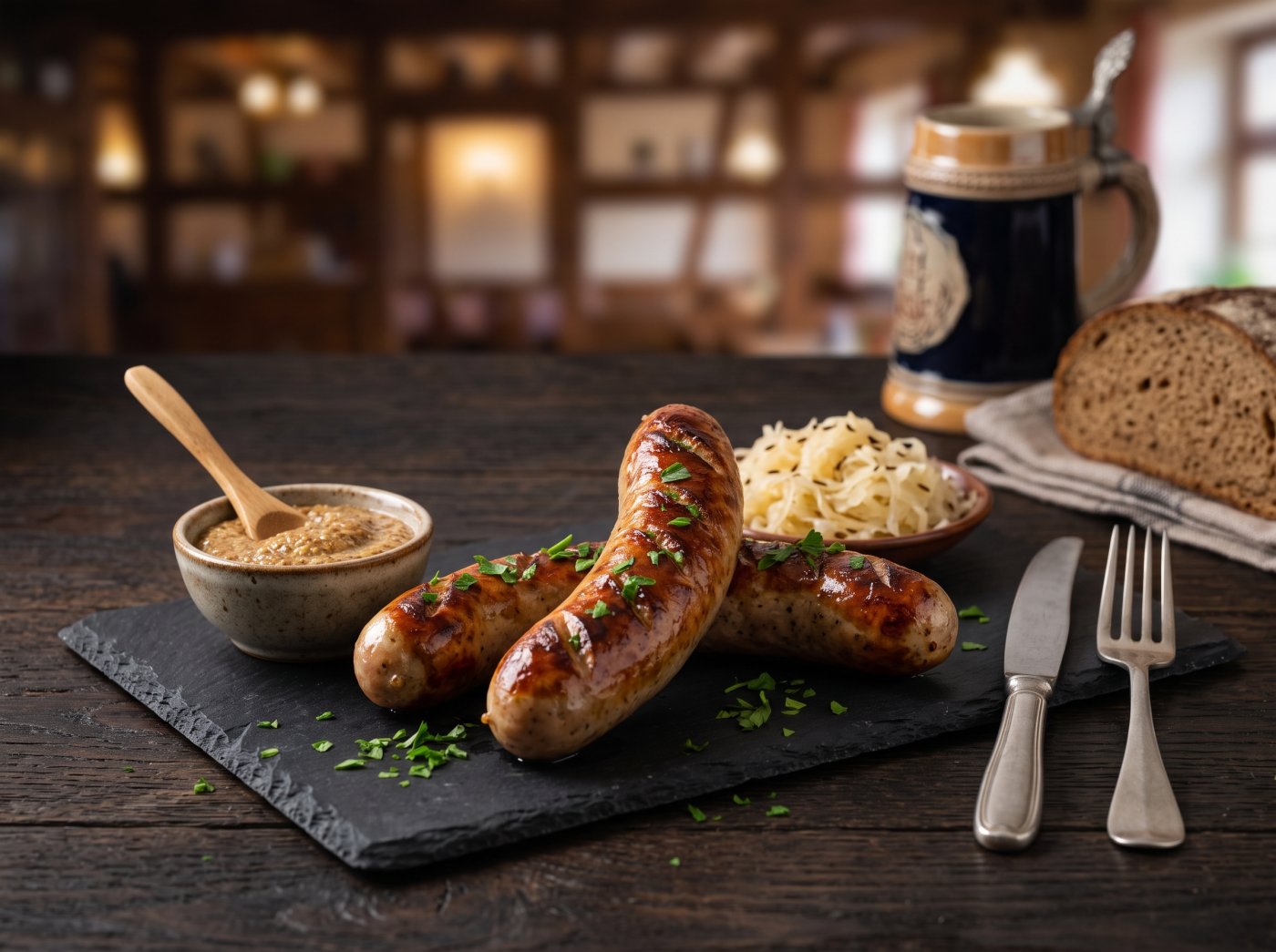
Bratwurst is a family of sausages with hundreds of separate recipes across Germany's regional kitchens. The Nuremberg version is as thin as a finger, the Thuringian one spans a palm; in some regions it stays pale, in others it is cooked until browned. What they share is the consistency: bratwurst is a fresh sausage made by blending finely ground meat with spices and filling it into natural casing.
What meat is bratwurst made from?
Classic bratwurst is made from pork, but the versions produced and sold in Türkiye use beef or turkey. How finely the meat is ground determines the texture directly. Coarsely ground meat leaves distinguishable fibres and gives a granular bite; finely ground meat produces a uniform, springy texture.
The spice blend changes from region to region, but the backbone is the same in almost every recipe: black pepper, caraway, nutmeg and ginger. Some versions add lemon zest or parsley. The quantity is deliberately restrained; the aim is to stand behind the meat, not to cover it.
Why does the casing matter?
Bratwurst is filled into natural casing. During cooking that casing does two jobs: it holds the water and fat inside, and it shrinks under heat to give the sausage its tension. The faint snap you hear at the first bite comes from the casing.
The casing also has a limit. As the water inside heats it turns to steam and expands. If the temperature rises too quickly the pressure exceeds what the casing can hold and the sausage splits. Once it splits, fat and water run out and what remains is a dry, hollowed texture.
This gives the only real rule of sausage cookery: raise the heat slowly. Every technique for cooking bratwurst is in fact an application of that one sentence.
Should it be poached first?
It need not be, but doing so improves the result noticeably. The two-stage method works like this: the sausage first sits for around ten minutes in liquid held below boiling, at roughly 75 °C. At that temperature the interior cooks without the casing tightening. The sausage then moves to a grill or pan for a few minutes purely to take on colour.
Reverse the order — put the sausage straight onto high heat — and the surface browns before the interior is done. Cooking it through then means keeping it on the fire longer, which makes splitting all but inevitable.
Water works as the poaching liquid, though a liquid with onion and bay leaf leaves a faint background note. In some regions beer is preferred for this step.
How long does each method take?
| Method | Temperature | Time | Result |
|---|---|---|---|
| Poach then grill | 75 °C, then high | 10 min + 4 min | Most balanced; lowest splitting risk |
| Covered pan | Medium | 12-15 min | Soft casing, even cooking |
| Direct grilling | Medium-low, indirect | 15-20 min | Pronounced smoke note, needs turning |
| Oven | 180 °C | 20-25 min | Practical for serving a crowd |
| Air fryer | 180 °C | 12-14 min | Crisp casing, little added fat |
No row in that table reads "high heat, short time". The thickness of a bratwurst requires time for heat to reach the centre.
Why should you never prick a sausage?
A common habit is to prick the sausage with a fork to prevent splitting. Rather than solving the problem, this guarantees the outcome: fat and water escape through the holes, and the sausage dries and shrivels. The right way to reduce pressure is to lower the heat, not to make holes.
For the same reason a sausage should not be repeatedly pressed while cooking. Pushing down with a spatula appears to produce better browning; in reality it forces the moisture out.
How does bratwurst differ from frankfurter?
The two are often confused, but they follow different production logic. A frankfurter is heat-treated, meaning cooked at the factory and usually lightly smoked. By the time it reaches the consumer it is already edible; heating is only a matter of temperature.
Bratwurst is a fresh sausage. It is made from raw meat and must be cooked. That difference shows in texture too: the interior of a frankfurter is an emulsion, uniform and springy, while in bratwurst the grains of meat remain distinguishable.
The third difference is the casing. Frankfurters mostly use a thin, even casing, whereas bratwurst favours natural casing that shrinks visibly during cooking. Slight wrinkling on the surface of a sausage is the easiest sign that natural casing was used.
How do you know when it is done?
Colour is misleading; the surface can brown while the centre stays raw. The only reliable measure is internal temperature. Fresh sausages made from beef or turkey should reach 72 °C at the centre.
Without a thermometer, two indirect signs help. The first is firmness: a raw sausage feels soft and slack under a finger, while a cooked one pushes back with a springy resistance. The second is the juice; liquid coming from the sausage should run clear, and any pink tinge means cooking is not complete.
Cutting one open is a last resort, because a cut sausage loses its juices. When cooking a batch, sacrificing a single sausage to check does less damage than pricking them all.
What is served alongside?
The classic German accompaniment is mustard and sauerkraut. The acid in the mustard cuts the fat, while the fermented sourness of the cabbage keeps the plate from feeling heavy. Mashed potato, boiled potato and fried onion are also common.
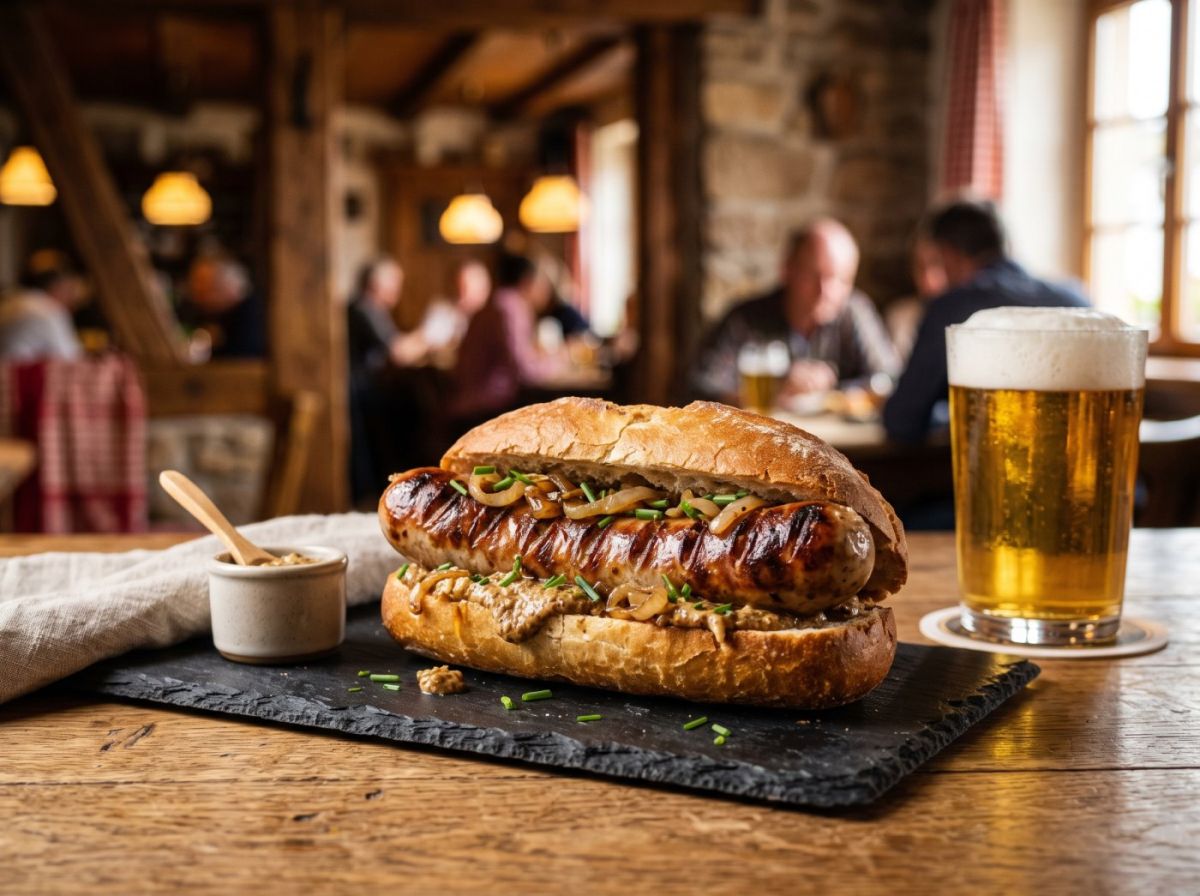
If it is served in bread, a loaf with a defined crust works better than a soft one; it absorbs the juices without falling apart. In presentations adapted to Turkish tables, charred peppers, grilled tomato and sumac onion make well-balanced partners.
How should bratwurst be stored?
Fresh sausage keeps for less time than cured delicatessen products because it has not been fully heat-treated. It belongs on the coldest shelf of the refrigerator, within the period stated on the pack.
If it is to be frozen, separating the sausages and interleaving them with greaseproof paper makes it easy to take out only what is needed later. Thawing should be slow, in the refrigerator; a sausage thawed quickly at room temperature warms on the outside while the centre stays frozen, producing uneven cooking.
Cooked bratwurst should be eaten within two days. When reheating, a low pan rather than a microwave preserves the texture of the casing.
