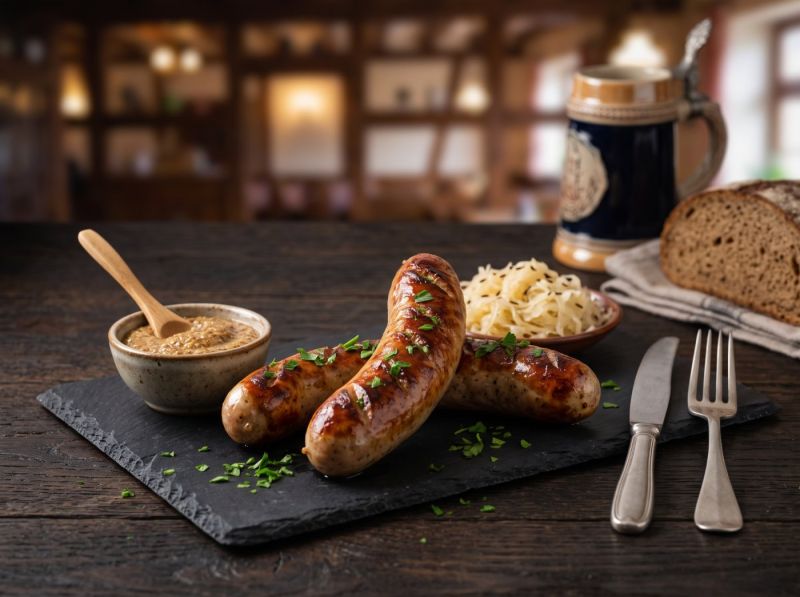
A bratwurst splitting open on the grill and losing its juices ruins both its appearance and its taste. That is a preventable problem.
Why does it split?
Bratwurst is made by filling a casing with minced meat, fat, water and spices.
Two things happen at once as it heats.
First, the water inside evaporates.
Steam occupies far more volume than liquid.
Second, the protein contracts and the internal volume falls.
Those two effects create pressure inside the casing.
The casing tears once that pressure exceeds what it can withstand.
The tear generally starts at the thinnest or weakest point.
The problem therefore lies not in the quality of the casing but in the speed of heating.
Rapid heating creates steam rapidly and raises the pressure suddenly.
How do casings behave?
Two kinds of casing are used.
A natural casing is made from animal intestine.
It is elastic and porous.
It can pass a certain amount of steam, which partly relieves the pressure.
It gives a crisp texture when cooked; the characteristic snap of a bratwurst comes from that casing.
But its elasticity has limits; it tears under sudden pressure.
Artificial casings are made from collagen or cellulose.
They come in a more consistent thickness and are more durable.
But they are less elastic and less porous.
Some artificial casings are removed before cooking; those exist only to shape the product during manufacture.
Good bratwurst is generally made with a natural casing.
Its elasticity suffices where the cooking is done correctly.
| Temperature | Method | Risk of splitting | Result |
|---|---|---|---|
| 90 °C water | Pre-poaching | None | Even cooking |
| 140-160 °C | Indirect heat | Very low | Juicy, even |
| 180-200 °C | Moderate grill | Low | Balanced |
| Above 230 °C | Direct high heat | High | It splits |
| Contact with flame | Uncontrolled | Very high | Burnt, split |
Does pre-poaching work?
It does; that is the most reliable method.
The bratwurst cooks in warm water before going on the grill.
The water sits at 80 to 90 degrees; it is not boiled.
Boiling water stretches the casing rapidly and splits it.
The time is ten to fifteen minutes.
The internal temperature reaches 70 degrees at that stage and the cooking completes.
It then goes onto the grill.
The only aim on the grill is to colour the surface and add aroma.
The time is three to four minutes, turning it.
Splitting is virtually never seen with that method, because the pressure has already been released slowly and under control.
Some regions add beer, onion and spices to the poaching water, which gives the product extra aroma.
That is a widespread practice in German cooking.
What should the grill temperature be?
Where grilling happens directly, the temperature should come down.
Moderate heat suits; a grill surface of 180 to 200 degrees.
At high heat the surface browns fast while the interior warms late and the pressure rises suddenly.
The time is fifteen to twenty minutes.
The product should be turned often, every two or three minutes.
Constant turning distributes the heat evenly and prevents pressure gathering at one point.
Contact with flame must be prevented.
Dripping fat creates flames, and those flames tear the casing instantly.
On a charcoal grill the products should not sit directly over the coals.
On a gas grill the central burner is turned off and the side burners left on.
Why is pricking wrong?
That is the most common piece of advice and the most mistaken.
A bratwurst pricked with a fork loses pressure, but fat and water escape through the same holes.
The result is a dry, flavourless product.
The juiciness of a bratwurst comes from the fat and water being retained.
Losing them loses the product's most important property.
The escaping fat also creates flames on the grill, which produces a further problem.
Temperature control should replace pricking.
Where the pressure rises slowly the casing adapts and expands.
A natural casing has that elasticity.
Pricking is acceptable in one situation only: where the product is frozen and holds ice inside; even then thawing is the better solution.
How is indirect heat applied?
That is an alternative to pre-poaching.
One side of the grill is heated and the other left cool.
The bratwurst goes on the cool side first.
The lid closes and the product warms slowly.
The temperature is 140 to 160 degrees and the time twenty to twenty-five minutes.
The internal temperature reaches 68 to 70 degrees at that stage.
The product then moves to the hot side and colours for two or three minutes.
That method prevents splitting and provides a smoky aroma.
It takes longer than pre-poaching but gives better flavour.
A grill with a lid is required; indirect heat does not work on an open grill.
A thermometer is particularly useful with this method.
How should it be served?
A bratwurst off the grill should rest three or four minutes.
That time lets the internal temperature even out.
Cut immediately, the product loses its juices.
It is served hot; as it cools the fat solidifies and the texture suffers.
The classic service is in bread with mustard.
A medium mustard and sauerkraut are the classic match in Germany.
In Turkey it is more often served on a plate with potatoes and salad.
An acidic component alongside establishes the balance; pickles or a lemony salad suit.
Bratwurst can be reheated, but the quality falls.
The best method is a pan over low heat with a little water.
A microwave toughens the casing and is not advised.
Cooked product keeps three days in the fridge; raw product until the date on its pack.