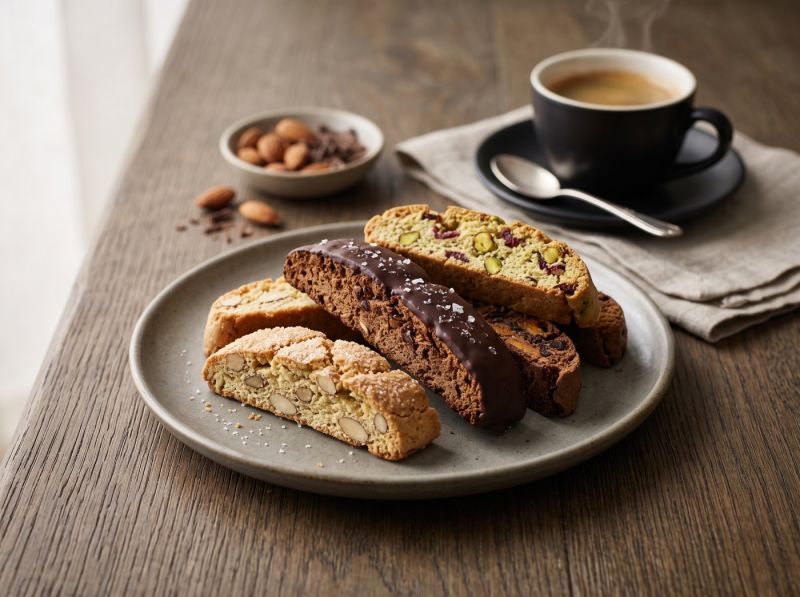
Biscotti takes its name from being baked twice. That method removes the biggest problem gluten-free dough has.
What does double baking solve in gluten-free dough?
The common problem with gluten-free doughs is moisture. Without gluten the water cannot be held and the product ends up either wet or dry.
In biscotti the second bake removes whatever moisture remains.
The target is a dry product anyway, so the risk of a wet result disappears.
That is why gluten-free biscotti comes so close to the wheat-flour version, a closeness most gluten-free products never reach.
| Product | Target moisture | Gluten-free difficulty |
|---|---|---|
| Biscotti | Very low | Low |
| Biscuit | Low | Low |
| Cake | Medium | Medium |
| Muffin | High | High |
| Bread | High | Very high |
How does the biscotti flour blend get built?
Rice flour forms the base at forty percent of the blend.
Almond flour takes thirty. It brings both aroma and fat, and keeps the product from drying out too far.
Maize starch takes twenty, supplying lightness.
Potato starch takes ten, holding the structure together through the first bake.
One gram of xanthan gum goes in; that quantity stops the dough breaking up during slicing.
What problem do raisins bring?
Raisins are hygroscopic and draw moisture from their surroundings.
Set inside a baked biscotti, they pull moisture from the dough around them over time.
The result is a product with soft spots around every raisin.
That shortens the shelf life and spoils the crispness.
The solution is drying the raisins first: fifteen minutes in a hundred-degree oven.
How do the raisins get prepared?
They soak five minutes in warm water and get washed; dust and surface sugar come away.
They drain and get patted dry with kitchen paper.
Fifteen minutes at a hundred degrees dries them.
Before going into the dough they get tossed in a tablespoon of the flour blend, which stops them sinking.
Seedless sultanas get chosen; large raisins end up under the blade during slicing.
How do biscotti logs get shaped?
The dough divides into two equal pieces.
Each becomes a log on the tray, about twenty-five centimetres long and six wide.
Height stays under two centimetres; a thicker log never cooks through.
Hands get lightly wetted; gluten-free dough sticks to them.
At least five centimetres separate the two logs; they spread as they bake.
How does the first bake work?
The oven runs at a hundred and eighty degrees for twenty-five to thirty minutes.
The logs come out at a pale gold.
They rest fifteen minutes on the tray. Sliced hot, a log falls apart.
They do not cool completely, though; a cold log shatters under the knife.
Fifteen minutes is the right interval between those two risks.
How do biscotti get sliced?
A serrated knife gets used; a straight blade crushes the log.
Slices run one and a half centimetres.
The cut goes on the diagonal, which increases the surface area and gives the classic biscotti shape.
The knife saws rather than presses. Pressing splits the slice in two.
Broken slices do not get discarded; the pieces dry in the second bake and remain usable.
How does the second bake work?
The slices go onto the tray cut side up.
The oven drops to a hundred and forty degrees.
They bake ten minutes, get turned, and bake ten more.
Twenty minutes in total. Extend that and the slices turn to stone.
Out of the oven they cool completely on a wire rack; put warm into a sealed container they take up moisture.
How does biscotti pair with coffee?
Biscotti is a product designed to be dipped.
Its dry structure takes up liquid fast and softens in two or three seconds.
Espresso and filter coffee suit it best; both run hot and concentrated enough.
In milky coffees biscotti softens faster and falls apart.
Raisin biscotti works better with light and medium roasts; a dark roast buries the sweetness of the fruit.
What nutritional picture does biscotti give?
A hundred grams carries 400 to 450 kilocalories.
Carbohydrate runs 58 to 65 grams, from both the flour and the raisins.
Fat sits at 14 to 18 grams, raised by the almond flour.
Protein comes to 7 to 9 grams.
One slice weighs about twenty-five grams, so 100 to 115 kilocalories.
Where does biscotti cross-contamination happen?
In a home kitchen flour dust is the biggest risk.
Gluten-free work moves to another day, or finishes before any wheat flour is opened.
Trays and the serrated knife stay separate; crumbs caught between the teeth of a blade cannot be cleaned out.
On packaged products a certificate matters; those tested below the twenty-parts-per-million threshold carry the declaration.
How does raisin biscotti get stored?
In a sealed container at room temperature it keeps three or four weeks.
With very low moisture the shelf life runs long, which is why biscotti historically counted as travelling food.
A desiccant sachet in the container extends it further.
It does not go into a fridge; in the cold it takes up moisture.
It freezes well, keeping three months at minus eighteen degrees, and five minutes in the oven from frozen restores the crispness.
Why does biscotti keep so long?
Its moisture falls below two percent.
At that level neither mould nor bacteria can grow; the water activity is too low to support life.
That is why biscotti historically counted as food for sailors and soldiers.
The only factor limiting its shelf life is the rancidity of the oil in the almond flour.
In a cool, dark cupboard that process slows and the product can hold for a month.
What can replace the raisins?
Dried cranberry can take their place; its acidity works well in recipes without cocoa or hazelnut.
Dried apricot goes in coarsely chopped; carrying more moisture than raisins, it makes the drying step more important still.
Grated orange zest can join the raisins and adds a citrus note.
Where hazelnuts or almonds go in, the raisins come down; two large components together make slicing difficult.
Chocolate drops do not get used; they melt in the second bake and burn on the tray.