


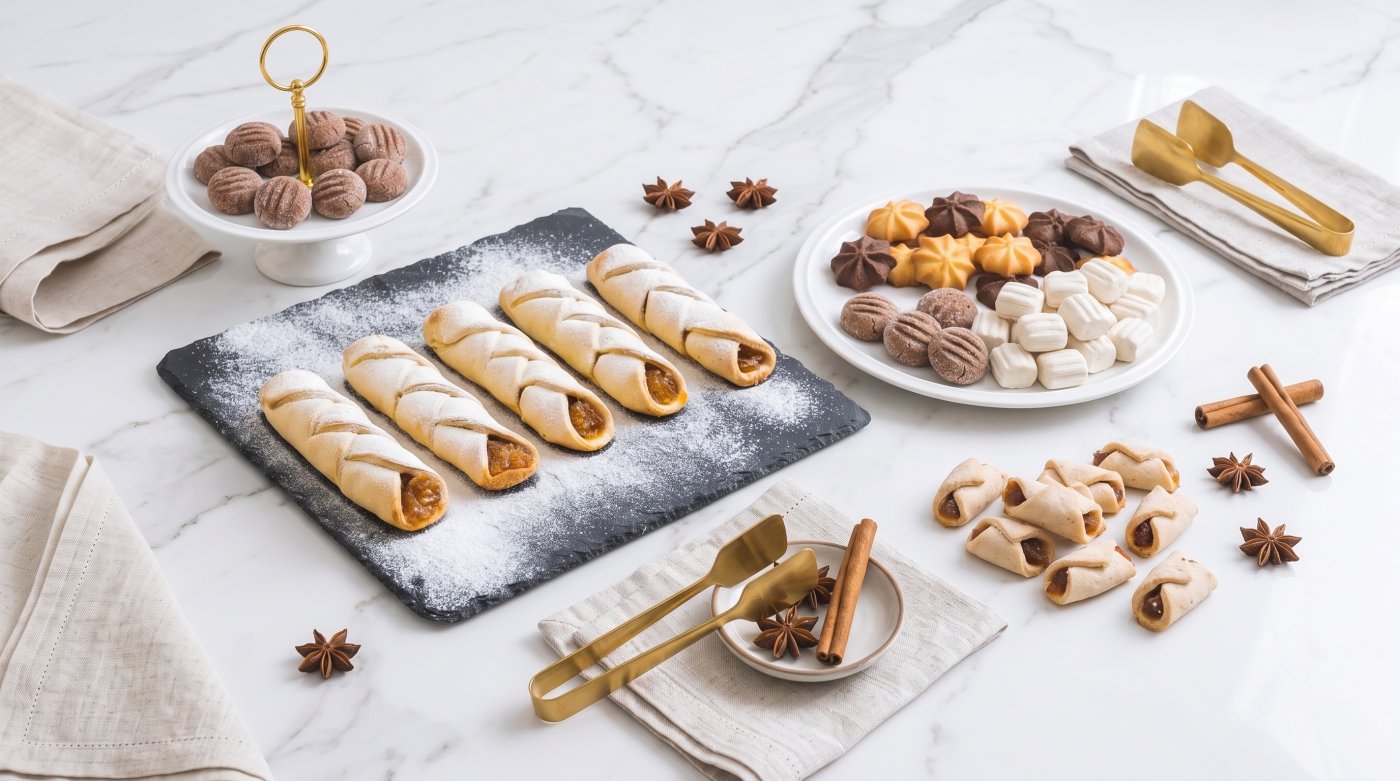
Savoury and sweet items appearing together on a platter is common. But how that combination gets built determines whether the platter works.
What should the savoury to sweet ratio be?
That is the platter's most decisive decision.
The hour of the day changes the ratio.
A platter weighted toward savoury gets eaten more in the morning and before lunch.
Sixty to seventy percent savoury and thirty to forty percent sweet is a suitable distribution.
The ratio reverses for an afternoon serving.
Forty percent savoury and sixty percent sweet suits better.
Sweet gains weight after a meal: twenty-five percent savoury and seventy-five percent sweet.
Those proportions are not fixed rules; but a one-sided platter — only sweet or only savoury — gets eaten less in every case.
The reason is sensory adaptation; the palate tires quickly of a single profile.
What is a mini simit?
A mini simit is not simply a shrunken standard simit.
Its dough proportions are set differently.
Small products have a high surface-to-volume ratio, which leads to faster drying.
The fat in mini simit dough is therefore raised slightly and the water kept high.
The molasses bath is the same as for a standard simit, but the time gets shortened.
The sesame coating is proportionally greater; sesame registers more strongly on a small product.
Baking takes eight to twelve minutes, half the time of a standard simit.
The weight is 20 to 30 grams, a size of two or three bites suited to standing service.
| Product | Weight | Temperature | Serving window |
|---|---|---|---|
| Mini simit | 20-30 g | Warm | 30-40 minutes |
| Mini poğaça | 25-35 g | Warm | 30-40 minutes |
| Dry biscuit | 10-15 g | Room | Unlimited |
| Soft biscuit | 15-25 g | Room | A few hours |
| Mini cake slice | 25-35 g | Room | A few hours |
| Chocolate item | 15-25 g | Cool room | 1-2 hours |
Which biscuits are chosen?
Three criteria apply for a platter.
The first is durability. The product has to stand on the table for an hour or two.
Dry biscuits suit best: shortbread-style biscuits, tahini biscuits and dry pastries.
Cream-filled and chocolate-coated products keep less well.
The second is crumbling. Biscuits that crumble heavily soil the platter and the table.
That is a problem in standing service.
The third is size. Products under fifteen grams finish in one bite.
Larger products fall apart when bitten.
Three varieties suffice; one plain, one with cocoa and one with nuts gives both visual and flavour variety.
How is the platter laid out?
Savoury and sweet items should be grouped in separate areas.
Guests hesitate over their choice on a platter arranged at random.
The aromas also transfer; sesame from the simit falls onto the biscuits.
The platter gets divided into two or three areas.
A small divider can sit between them: a paper case, greenery or a small bowl.
Where a tiered stand is used, savoury goes on the lower tier and sweet on the upper.
That creates a natural order of eating.
The items should sit in a single layer; stacked mini simit soften one another and biscuits break.
How are the temperatures separated?
That is the most neglected point.
Mini simit is best served warm, at 30 to 35 degrees.
Biscuits are served at room temperature.
With both on one platter, the warm simit gives moisture to the biscuits.
The biscuits soften and lose their crispness.
The solution is a separate platter or sufficient distance.
Or serving the simit at room temperature rather than warm; that costs quality but is a practical choice.
The best approach serves the simit separately and warm and the biscuits separately at room temperature; two platters sit side by side and guests choose for themselves.
When is the preparation done?
Timing varies by product type.
Biscuits can be made the day before.
They wait in a closed container and go onto the platter at the moment of service.
Mini simit and poğaça bake at most thirty minutes before the service.
That planning becomes easier where frozen products are used.
The platter gets assembled fifteen minutes before service.
Items on a platter assembled earlier dry out and the appearance suffers.
Covering with film is one solution, but moisture gathers; that has the opposite effect with warm items.
Assembling on a tray, holding it in the kitchen and carrying it out at the moment of service is the cleanest method.
How much per head on a platter?
Three or four pieces per head during a short meeting break.
That is 70 to 100 grams.
Five or six pieces at a longer serving: 120 to 160 grams.
Consumption is higher where tea or coffee accompanies the platter.
A hot drink increases the consumption of pastry.
As the number of varieties rises, the quantity taken from each falls.
On a platter of four varieties the calculation is one of each per head.
A serving for twenty people needs four varieties and twenty-five pieces of each.
A margin of fifteen percent gets added; that removes the risk of running short and creates no problem with mini products, since they keep for the next day.
How are vegetarian and allergen options planned?
That is now an expectation.
At least one vegetarian option should be on the platter.
Cheese and olive poğaça, plain simit and vegetable mini börek belong to that group.
Products containing meat should sit in a separate area and be labelled.
One gluten-free item belongs on the table too, kept on its own platter away from the rest.
A gluten-free product on the same platter carries a risk of cross-contamination.
Biscuits containing nuts need labelling as well; hazelnuts and peanuts are the most widespread allergens.
Small cards suffice for labelling, carrying the product name and the allergen information.
That arrangement, together with a simple question asked of guests before the event, removes most problems.
It also lets guests choose quickly, which matters more than it sounds during a short break.
