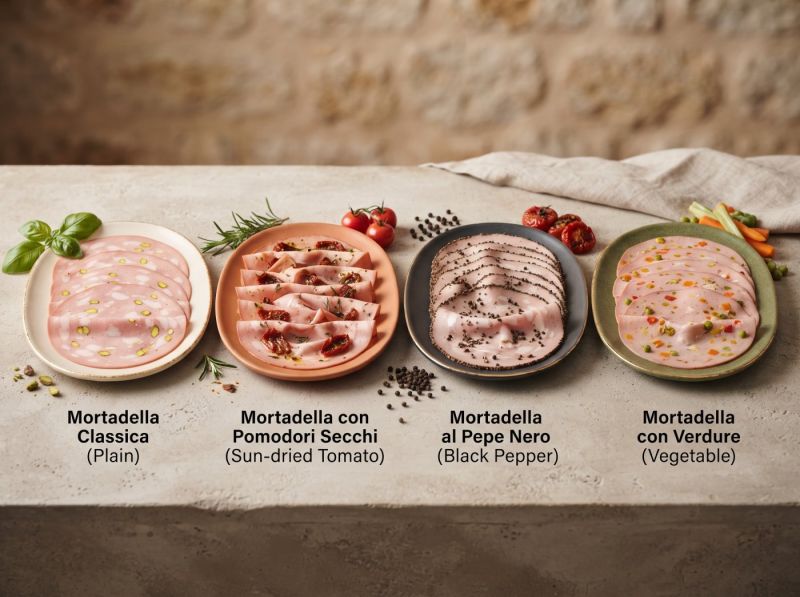
Cut a mortadella and the face looks smooth; meat and fat cannot be told apart. That structure results from one of the most delicate balances in food production.
What is a meat emulsion?
An emulsion is a stable mixture of two liquids that do not normally combine.
Fat and water separate on their own; but with a binder between them they can stay together.
In a meat emulsion that binder is muscle protein.
Protein molecules have regions that favour water and regions that favour fat.
They therefore wrap around fat droplets and hold them suspended in the water phase.
The result is a structure in which microscopic fat droplets are dispersed inside protein films.
Technically it is hard to call it a true emulsion; it is closer to a gel-matrix system.
But in practice it goes by the name emulsion and works on the same principles.
Why is salt critical to this system?
Most muscle proteins do not dissolve in water.
But they dissolve in salt water; myosin and actin belong to that group.
At a salt level of 2 to 2.5 percent those proteins dissolve and become available.
Free protein can then perform the work of wrapping the fat droplets.
In a mixture without salt the protein does not dissolve and no emulsion forms.
Salt is therefore among the first components added in mortadella production.
Phosphate performs a similar function; it raises the water-holding capacity of the proteins and eases their dissolution.
Salt and phosphate go in at the first stage in the cutter, together with the meat.
No fat goes in at that point; the protein solution is built first.
Why is there a temperature limit?
This is the most delicate point of the emulsion.
The cutter blades turn at high speed and generate heat through friction.
As the temperature rises the protein structure begins to break down.
Above sixteen degrees the proteins denature and lose their capacity to hold fat.
Eighteen degrees is the critical threshold; past that point the emulsion breaks.
In a broken emulsion the fat is released and escapes during cooking.
Ice is therefore added to the mixture.
Ice both lowers the temperature and supplies the water required.
Adding water directly loses the temperature control; ice absorbs heat as it melts.
The ice proportion runs 15 to 25 percent of the mixture.
| Stage | Temperature | Duration | Added |
|---|---|---|---|
| Breaking down meat | 0-2 °C | 1-2 minutes | Lean meat |
| Dissolving protein | 2-6 °C | 2-3 minutes | Salt, phosphate, ice |
| Adding fat | 6-10 °C | 3-4 minutes | Fat, ice |
| Homogenising | 10-14 °C | 2-3 minutes | Spices |
| Final mixing | 14-16 °C | 1 minute | Fat cubes |
| Critical threshold | 18 °C | — | The emulsion breaks |
How do the cutter stages work?
The order determines the result and cannot be changed.
Stage one: lean meat goes into the cutter and is broken down.
The muscle fibres open and the surface area increases.
Stage two: salt, phosphate and some of the ice are added.
The mixture turns tacky; that indicates the protein has dissolved.
Skipping or shortening this stage leaves a weak emulsion.
Stage three: fat and the remaining ice are added.
The fat is enveloped by the dissolved protein.
Stage four: spices and other components go in and the mixture is homogenised.
Stage five: the fat cubes are mixed in at low speed.
High speed is not used at this stage; the cubes must not be broken up.
Why are the fat cubes added separately?
The white cubes on the cut face of a mortadella are not part of the emulsion.
They are back fat prepared separately, blanched and cut into cubes.
They go into the emulsion last and at low speed.
The purpose is a visual contrast on the cut face and a difference in texture in the bite.
The cubes are blanched beforehand; that slows their melting during cooking.
An unblanched cube melts during cooking and leaves a void.
The cube size is five to eight millimetres; smaller cubes do not show on the face, larger ones fall out during slicing.
The cube proportion varies between 10 and 20 percent of the product.
Pistachios are added in the same final stage.
How should the mortadella cooking curve be built?
The emulsion has to survive the cooking as well.
Rapid, high heat tears the protein film and releases the fat.
Cooking is therefore done in steps.
The starting temperature is 55 to 60 degrees; the product heats slowly and the protein network tightens.
It then rises to 70 to 75 degrees.
Cooking completes when the core reaches 72 degrees.
In a large-diameter mortadella that can take six to ten hours.
A water bath or steam oven is preferred; dry heat hardens the surface.
Rapid chilling afterwards is essential; the product should fall below 10 degrees within six hours.
Why does a mortadella emulsion break?
There are five causes and all are preventable.
The first is exceeding the temperature; the commonest cause.
The second is insufficient salt. The protein does not dissolve and cannot hold the fat.
The third is too much fat. The available protein cannot cover it; the fat proportion should not exceed 30 percent.
The fourth is the wrong order. Fat added before the protein dissolves is left unwrapped.
The fifth is over-processing. A mixture left too long in the cutter both heats up and suffers damage to its protein structure.
A broken emulsion cannot be recovered.
The symptom appears during cooking: fat and gel accumulate inside the casing.
It shows on the cut face too, as fat voids and a rough surface.
Such a product stops being saleable; monitoring temperature is therefore the most critical control in production.## How is quality controlled?
Four measurements after production confirm the emulsion held.
The first is examining the cut face: the surface should be smooth and free of voids.
The second is yield: a cooking loss of 8 to 12 percent is normal; a higher loss indicates a weak emulsion.
The third is checking the casing: no gel or fat should have accumulated between casing and product.
The fourth is a texture test: a slice should flex rather than break when bent.
Those four should be recorded for every batch; when readings start to drift, the cutter temperature records are where to look.