


Mortadella takes its name from the Italian city of Bologna, where it is protected by geographical indication. The versions produced in Türkiye use different meats, but the underlying technique is the same: bringing meat, fat and water together into a single homogeneous mass.
What does emulsion mean?
Fat and water do not naturally mix. For them to stay together, a third component is needed that comes between them and binds them.
In a meat emulsion, muscle proteins take on that role. When meat is ground very finely and mixed with salt, a protein called myosin dissolves and is released. That protein attaches to water at one end and to fat at the other.
The result is a stable structure in which microscopic droplets of fat remain suspended in the water phase. When heated, the protein coagulates and the emulsion becomes permanent.
Mortadella's uniform appearance in cross-section is the result of that emulsion. The visible white islands are large pieces of fat added afterwards; they are not part of the emulsion.
How does production proceed?
The process has four stages, and temperature control is decisive at every one.
Grinding. The meat is ground very finely with a high-speed blade called a cutter. This generates heat through friction; if the temperature rises the emulsion breaks before it forms. Ice is therefore added to the mixture.
Emulsification. Salt and curing salts are added and mixing continues. Myosin dissolves and the structure begins to build. The temperature of the mixture is generally held below 12 °C.
Adding fat. Coarsely cut pieces of fat go in last and are mixed only until dispersed. Over-mixing draws these pieces into the emulsion too and the characteristic cross-section is lost.
Cooking. Filled into moulds, the product is cooked slowly until its core reaches the specified temperature. Rapid heating breaks the emulsion; the fat separates and cavities form in the product.
Why do emulsions break?
Breaking is the most common problem in production, and it has three causes.
The first is temperature. If the mixture warms during grinding, the proteins coagulate prematurely and cannot bind the fat.
The second is the fat ratio. Beyond a certain point the available protein is insufficient to bind all the fat, and the excess separates.
The third is the speed of cooking. Sudden heat coagulates the outer layer rapidly while the fat inside is still liquid, and pressure forces it out.
A broken emulsion cannot be recovered. Cut open, the product shows pockets of fat and cavities, and its texture is loose.
How does it differ from salami?
Both are emulsion-based products, but they diverge at several points.
| Criterion | Mortadella | Salami |
|---|---|---|
| Cross-section | Uniform with large fat islands | Uniform or particulate |
| Fat pieces | Pronounced, large | Usually absent or small |
| Spicing | Restrained, pepper-led | More intense and varied |
| Diameter | Wide, usually large moulds | Narrower |
| Texture | Soft, elastic | Firmer |
| Slice thickness | Very thin | Thin to medium |
The most decisive difference is the fat islands. Those pieces are mortadella's defining visual feature and determine the richness it delivers in the mouth.
Fermented salamis belong to an entirely different category; in those, curing and drying rather than emulsion are the essential processes.
Which meats are used in Türkiye?
Mortadella in Türkiye is generally produced from chicken, turkey or beef.
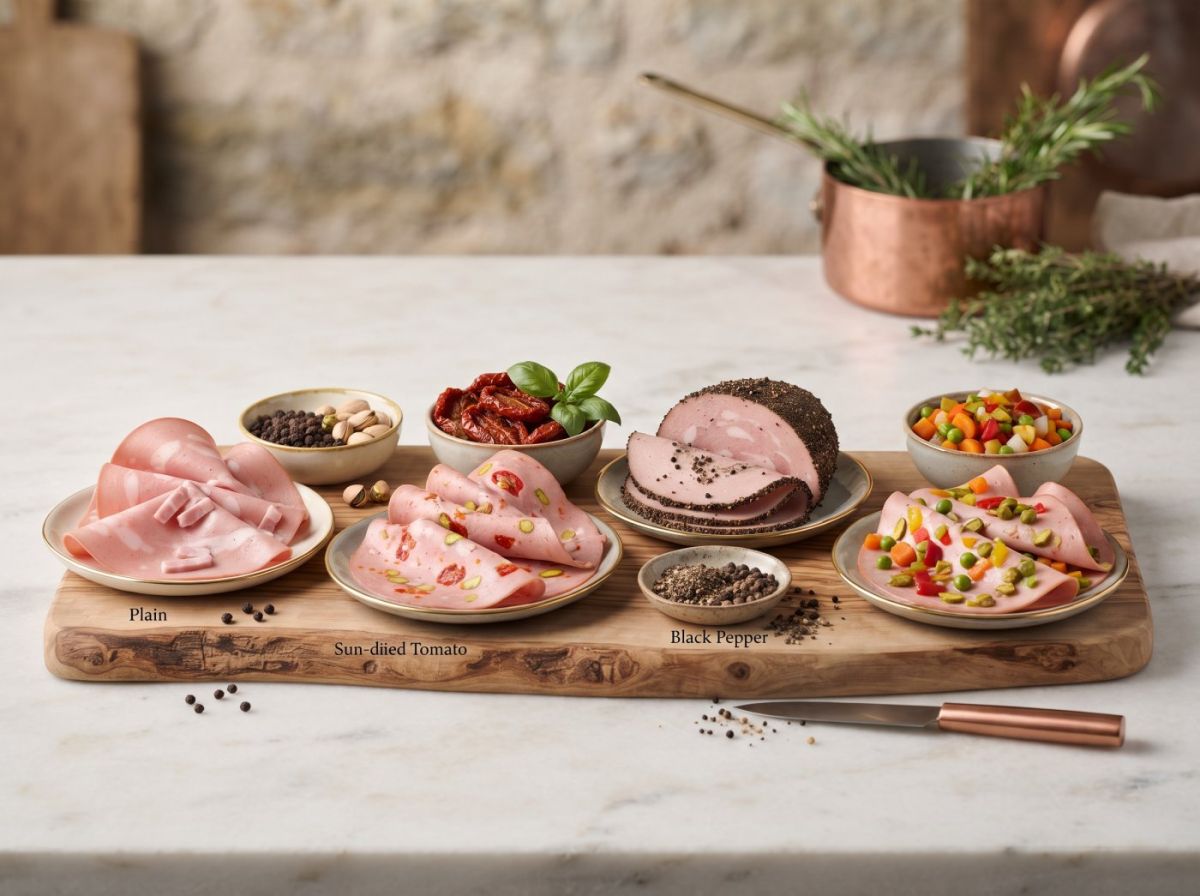
Chicken mortadella is the most widespread. The neutral taste of white meat allows spices and additional components to come forward; versions with vegetables, sun-dried tomato and whole muscle pieces are possible thanks to that flexibility.
Turkey mortadella is lower in fat and suits a lighter positioning. Its texture is slightly firmer than chicken.
Beef mortadella is darker in colour and more intense in taste; it is the version closest to the Italian original.
Vegetable versions use carrot, pea and pepper. These components are not merely visual; while providing colour in cross-section they also lower the fat content somewhat.
Why is it sliced so thinly?
Mortadella is the charcuterie product that most requires thin slicing, and there is a technical reason.
Its emulsion structure is dense; a thick slice creates weight in the mouth and feels rubbery. A thin slice softens rapidly at mouth temperature and the fat islands begin to melt.
The correct thickness is below a millimetre; held to the light the slice should look translucent. Cutting at that thinness requires a sharp, well-adjusted slicing machine.
The second reason is visual. A thin slice shows the fat islands in its cross-section more clearly and brings out the product's characteristic appearance.
The product should be sliced straight from the refrigerator. Mortadella that has come to room temperature softens, sticks to the blade and tears.
What uses does it suit in the kitchen?
Mortadella is served cold and its most common use is in sandwiches. Folding the thin slices rather than laying them flat gives a better texture.
On aperitif plates it is served with olives, pickles and hard cheese. Because its own taste is mild, sharp components are chosen alongside.
Hot use calls for care. Mortadella heated for a long period loses moisture and the emulsion loosens; it should be added last on toasted sandwiches and pizza.
In Italian cooking it is diced into pasta sauces or meatball mixtures; in that use its salt content has to be accounted for and no additional salt added to the recipe.
How should mortadella be stored?
Vacuum-packed whole product keeps in the refrigerator for the period on the label while sealed.
Once opened, the cut surface meets the air and oxidation begins. Wrapping that surface tightly in cling film extends shelf life by several days.
Sliced product should be eaten within three or four days; with its large surface area it both dries and darkens.
Mortadella is not a product suited to freezing. Ice crystals tear the emulsion structure; on thawing the product weeps and its texture loosens noticeably. This is why frozen mortadella falls apart when sliced.
