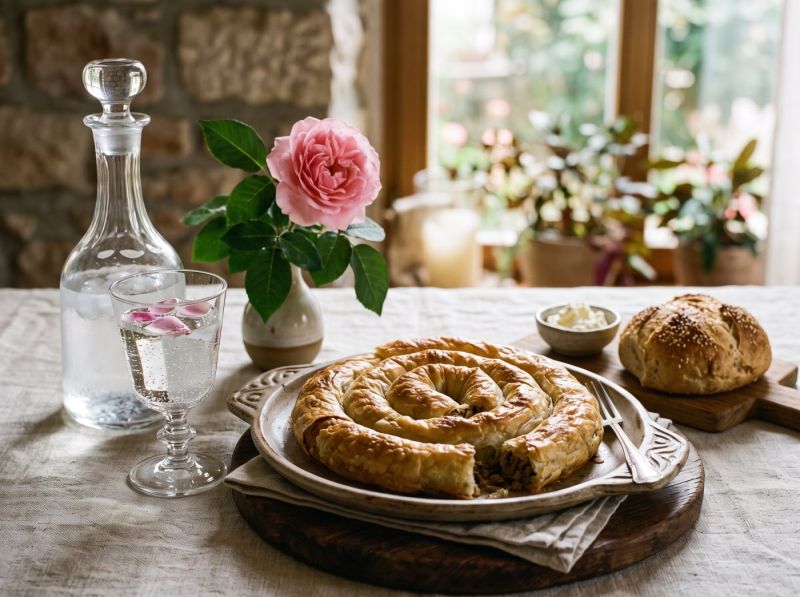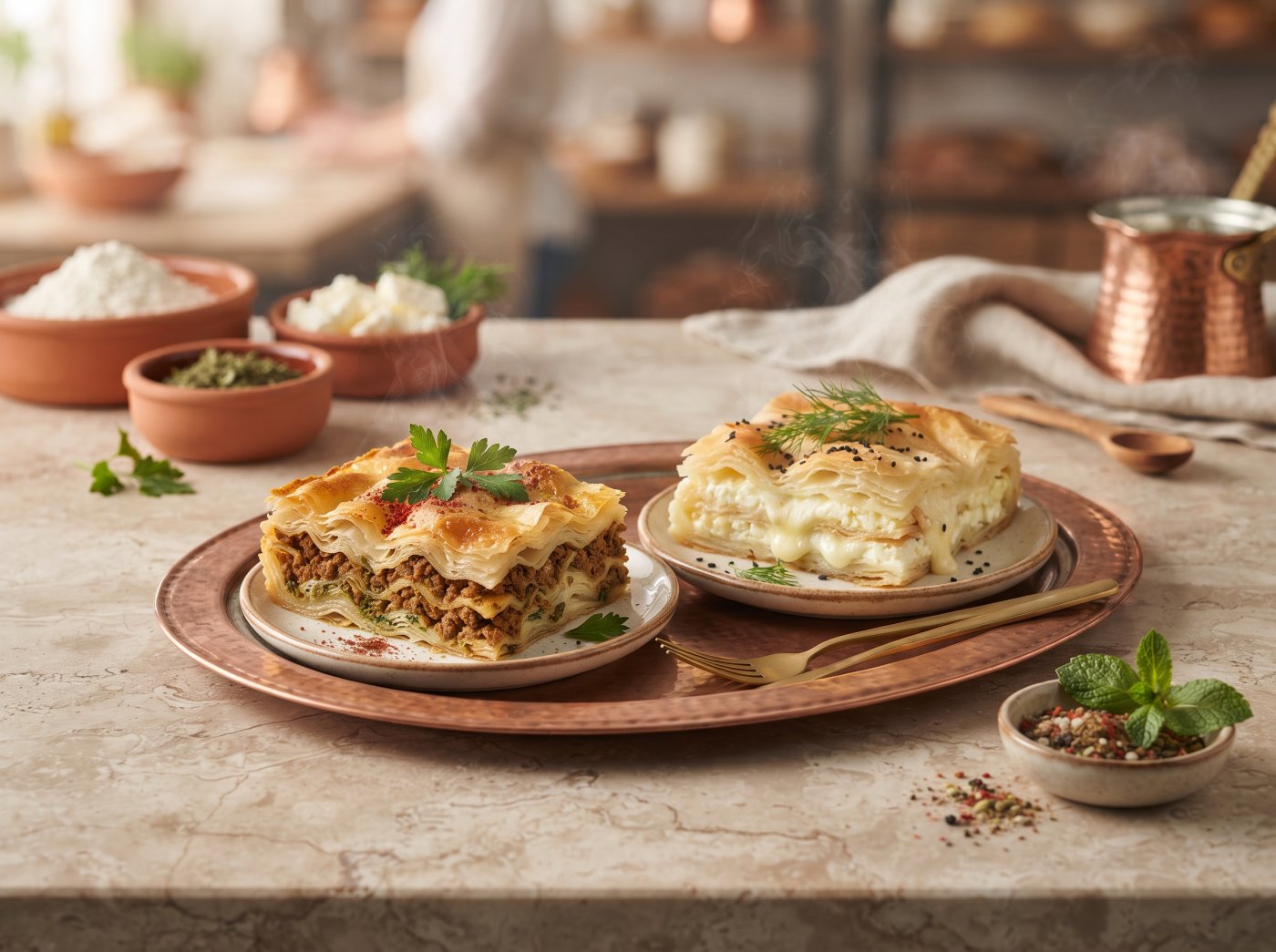
Su böreği is one of the few products in Turkish cooking named directly after its method of preparation. "Su" means water, and it refers to passing the sheets through boiling water — a step that defines both the character and the difficulty of this börek.
Why are the sheets boiled?
In every other börek the filo is laid into the tray raw and cooks in the oven. In su böreği the sheets are held briefly in boiling water before they reach the tray.
That operation gelatinises the starch in the filo. The starch granules absorb water, swell and change structure; the result is a soft, faintly tacky surface.
Gelatinised starch achieves two things. First, the layers adhere slightly to one another so the börek does not fall apart when sliced. Second, the texture changes entirely: su böreği is not crisp but soft and elastic. That is the property separating it from every other börek.
In the oven only the topmost layer dries and colours. Every layer beneath stays soft; this is not a shortcoming but the definition of the product.
Where exactly does the difficulty lie?
Three separate points make su böreği laborious.
The first is the filo itself. Su böreği filo has to be rolled thin but is not as dry as in other böreks; it is made from a dough high in starch and rolling it by hand requires experience.
The second is the boiling stage. The sheets are dipped one by one into boiling water for a few seconds. Too short and the starch does not gelatinise; too long and the sheet disintegrates. That window is measured in seconds.
The third is handling. A boiled sheet is extremely fragile. It is lifted from the water into cold water, then spread on a cloth to shed excess moisture and carried to the tray. Every step risks a tear.
These three steps repeat dozens of times for a single tray. Su böreği is rarely made at home not because the recipe is complex but because that repetition is exhausting.
How does the dough differ from other filo?
Su böreği filo takes egg and usually starch alongside flour and water.
Egg strengthens the structure; it is the component that keeps the sheet intact during boiling. Dough without egg tends to disintegrate in boiling water.
Starch prevents the layers sticking together during rolling. As with baklava, starch rather than flour is scattered between them; flour blends into the dough and thickens the sheet.
After mixing, the dough rests for at least an hour. That period relaxes the gluten network; unrested dough resists the pin and perforates.
What is the layering order in su böreği?
One or two oiled sheets are laid into the base of the tray first. These bottom layers may be left unboiled; keeping them dry stops the base turning doughy.
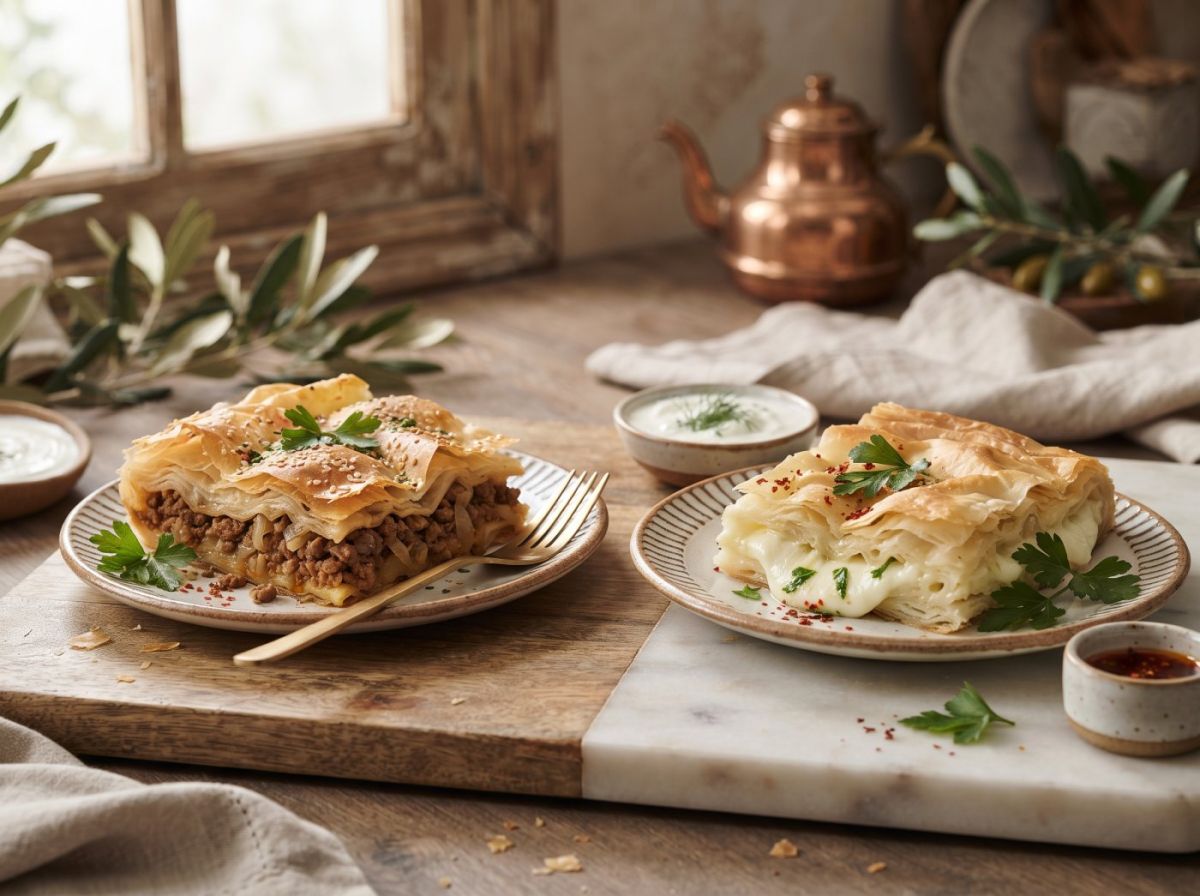
The boiled sheets are then laid in sequence. Melted butter or oil is brushed between each layer. The fat prevents the layers fusing completely and preserves their visible separation when sliced.
The filling is scattered in the middle. The most common is white cheese with parsley. The filling goes into a single layer, not distributed across several.
The remaining boiled sheets go on top and the topmost layer is generously oiled. That is the layer that will brown in the oven.
Some recipes pour a mixture of egg, milk and oil over the top; this binds the crust during baking and gives a pronounced colour.
How is su böreği baked?
| Stage | Temperature | Time | Purpose |
|---|---|---|---|
| Preheat | 200 °C | 20 minutes | Heating the oven floor |
| Lower shelf | 190 °C | 20-25 minutes | Cooking the base |
| Middle shelf | 180 °C | 20-25 minutes | Colouring the surface |
| Rest | Out of the oven | 15 minutes | Letting steam disperse |
Su böreği is baked longer and at a lower temperature than other böreks. High heat dries the top layer rapidly and the crust hardens while the lower layers are still cold.
Starting on the lower shelf matters particularly. The tray is thick and heavy; the base takes time to cook, and a börek baked directly on the middle shelf stays doughy underneath.
When is it cut?
Unlike baklava, su böreği is not cut before baking. Because the layers are boiled and soft, cutting raw simply presses them together.
Cutting happens after the börek has left the oven and rested. During the fifteen-minute wait the steam inside disperses and the filling sets; cut hot, the filling runs and the layers separate.
A long, sharp knife should be used. Repeated cuts with a short blade drag the layers and blur the cut face.
What does par-baked frozen su böreği offer?
Su böreği is one of the böreks where a frozen product makes the most sense, because the preparation effort is far higher than for the others.
Product prepared as par-baked frozen has already passed through boiling, layering and baking at the factory. The only job left to the business is reheating.
For an operation that wants su böreği on its menu but lacks the labour, this is the only workable route. The product usually arrives in large rectangular trays and the number of slices is set to the operation's requirement.
The one thing to watch during reheating is moisture. Su böreği dries quickly under dry heat; the tray should be covered with foil at first, with the foil removed for the last five minutes so the surface can colour.
Which cheese should be used?
The filling for su böreği is plain, and the choice of cheese determines the result directly.
The classic choice is white cheese with its salt drawn out. If a salty cheese is used it should be soaked first; otherwise it releases water during baking and the lower layers turn doughy.
The fat content of the cheese matters too. Fat-free cheese dries in the oven and leaves a granular texture; a medium-fat cheese softens slightly during baking and clings to the layers.
Kaşar is not used on its own. It melts and turns fluid, seeping between the layers and collecting at the base. If used at all it is mixed with white cheese and kept below a third of the total.
Parsley is the second component of the filling and must be thoroughly dried. Wet parsley adds to the water from the cheese and produces the same sogginess.
Common mistakes
- Over-boiling the sheets: they disintegrate and cannot be carried to the tray.
- Not transferring boiled sheets to cold water: cooking continues and the sheet softens and tears.
- Layering without draining: water collects in the tray and the lower layers turn doughy.
- Spreading the filling across several layers: the layers cannot adhere and the börek separates when sliced.
- Cutting while hot: the filling runs and the layers fall apart.
- Reheating in a microwave: steam is trapped inside the pastry and the product turns rubbery.