


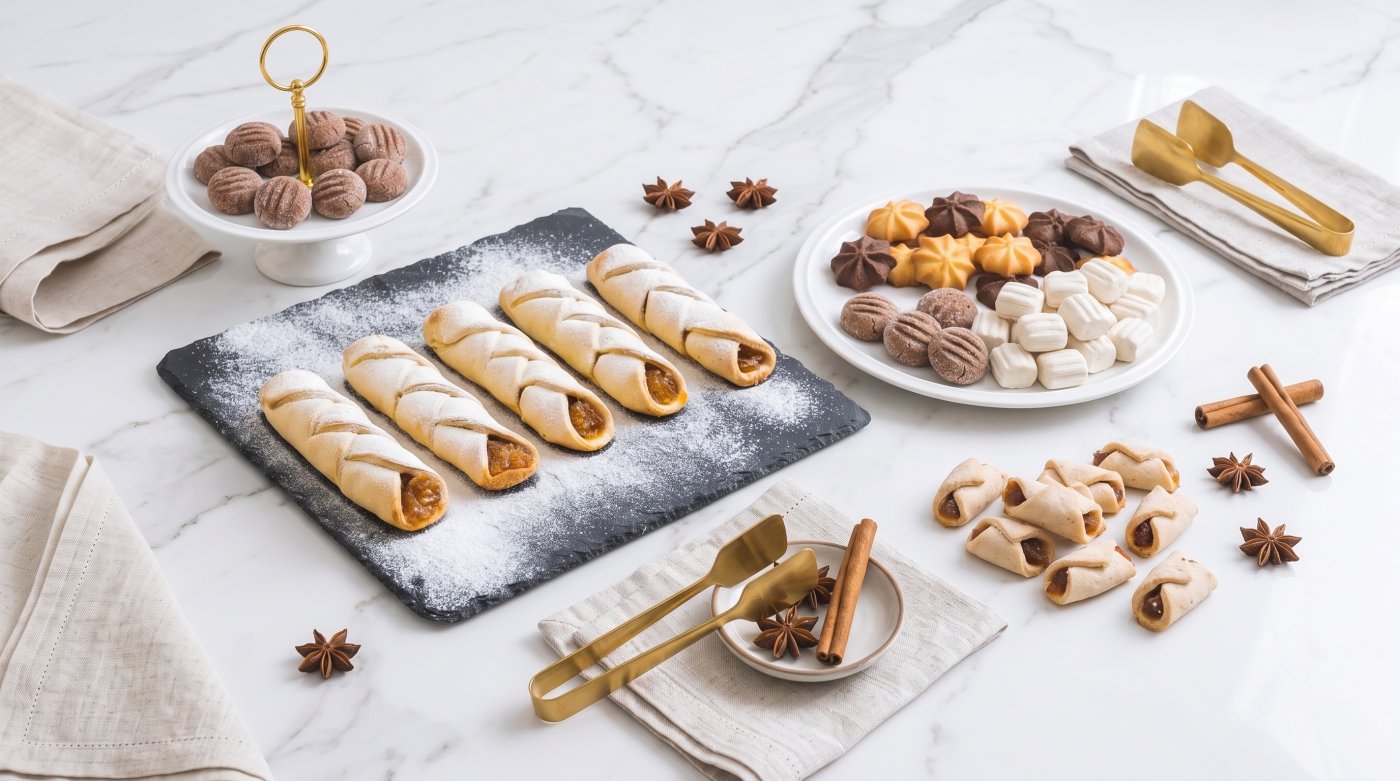
The hardest part of serving guests is variety. Three different savoury cookies deliver that variety from a single round in the oven.
What does the plate need?
Eight hand-shaped savoury cookies.
Eight dill and cheese cookies.
Eight potato cookies.
A hundred grams of white cheese and a hundred grams of olives.
Cherry tomatoes and fresh herbs.
| Component | Amount | Role |
|---|---|---|
| Three cookie types | 24 pieces | Main component |
| Cheese | 100 g | Accompaniment |
| Olives | 100 g | Salty balance |
| Tomatoes | 150 g | Freshness |
| Herbs | 1 bunch | Colour |
How do raw frozen cookies bake?
The oven setting goes to a hundred and eighty degrees.
The cookies go onto a tray without thawing.
Two centimetres stay between them.
They bake eighteen to twenty-two minutes.
All three types bake on one tray, since their times are close enough that no separate round is needed.
How long do the cookies rest?
Five minutes on the tray after leaving the oven.
Then they move to a wire rack.
Left on the tray the undersides soften.
They do not go onto the plate before cooling.
Moving them to a rack releases the steam collecting underneath and preserves their crispness.
How does the cookie plate get built?
The three types go into separate areas.
Bowls of cheese and olives sit in the middle.
The tomatoes line the edges.
Herbs fill the gaps.
Grouping the types rather than mixing them lets guests see what they are taking and makes the plate look tidier.
How do the cookie plate accompaniments get chosen?
Savoury cookies need something acidic beside them.
Olives and pickles do that work.
Cheese provides variety in texture.
Fresh vegetables add lightness.
Bringing three salty components together makes the plate heavy; an acidic, fresh accompaniment restores the balance.
How do hot and cold balance?
The cookies get served warm.
The cheese and olives stay cold.
Tomatoes sit at room temperature.
A hot drink goes alongside.
That contrast between warm cookies and cold accompaniments is the plate's most distinctive quality and requires timing the service.
How many does it serve?
Four to six cookies per person.
Twenty-four cookies serve four to six.
The accompaniments scale to that number.
Cookies get held back for a second round.
Baking only what is needed from a two-kilogram pack leaves the rest in the freezer and produces no waste.
Can the cookies be baked ahead?
Baking on the day gets advised.
Baked a day ahead they go into a lidded container.
They warm five minutes before serving.
Keeping them raw and frozen always gives a better result.
Baking what is needed from frozen stock is the biggest practical advantage of this recipe and makes planning easy.
Which additional types join?
Kavala cookies.
Apple roll cookies, for sweet balance.
Tahini cookies.
A mix of nuts.
Adding one sweet cookie provides the balance expected on a savoury-led plate and removes the need for a separate dessert plate.
How do leftover cookies get stored?
They go into a lidded container once fully cool.
They stay crisp for two days.
They soften quickly in a humid room.
Reheating restores part of their freshness.
Steam in a container closed while they are warm softens them within an hour; that is the one critical rule of storage.
What are the common mistakes with a cookie plate?
Thawing the cookies.
Cooling them on the tray.
Mixing the types on the plate.
Putting them away warm.
Among those four, cooling them on the tray is the most common and softens the undersides irreversibly.
When does this plate get made?
When guests arrive unexpectedly.
For an afternoon tea.
At gatherings at home.
As an addition to a breakfast table.
Raw cookies waiting in the freezer make it possible to produce a serving in twenty minutes in all four cases.
How do the cookie types get chosen?
One plain type.
One with cheese or herbs.
One with vegetables or spices.
Three types suffice; a fourth complicates the plate.
Types that differ in texture and flavour provide variety more effectively than raising the count.
Which drink goes alongside?
Strong black tea is the classic accompaniment.
Herbal tea is a lighter alternative.
Ayran suits a savoury plate.
Coffee gets chosen less often.
The pairing of savoury cookies with black tea balances the richness of the plate and is the most common choice.
How does the plate get refreshed?
New cookies join once the plate is half empty.
A second round waits in the oven.
The accompaniments get refreshed too.
Emptied bowls get refilled.
Keeping the second round warm in the oven removes any wait for rebaking while the plate gets refreshed.
Does a cookie plate suit breakfast?
It does, and it can replace bread.
Cheese and olives are already breakfast components.
Adding eggs makes it a full breakfast.
A sweet item can join too.
Savoury cookies are among the few alternatives able to replace bread at a breakfast table without any preparation.
Why do the cookies sometimes spread?
When the tray goes in before the oven is hot.
When the cookies have been thawed.
When new cookies go onto a hot tray.
When too little space stays between them.
The fat in thawed dough starts melting and the cookie spreads; baking from frozen removes that entirely.
How does the plate get ready for a photograph?
Natural light gets preferred.
The plate gets shot from the side.
Herbs go on at the last moment.
An overcrowded arrangement gets avoided.
Leaving a third of the plate empty lets the components be told apart and strengthens the presentation noticeably.
