


Whole Muscle Roast Beef 1700 g
In charcuterie, meat is handled in one of two ways: minced, seasoned and reformed, or cooked as a whole piece. The phrase whole muscle marks the second route; in this product the meat's own structure is preserved intact.
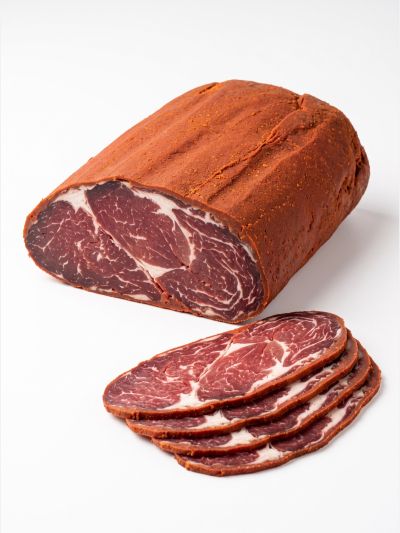
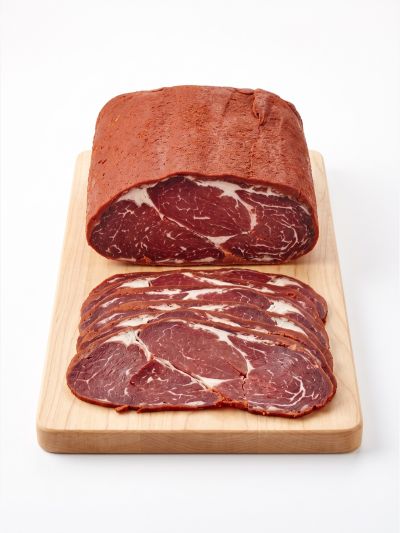
Looking at the cut is enough to see the difference. In a minced and reformed product the cross-section is homogeneous and uniform; in a whole-muscle product bundles of fibre and the fine lines of connective tissue between them can be picked out. That creates the impression of meat rather than processing and lifts the product into a higher segment on a deli counter.
Shelf life and storage conditions
- Shelf Life
- Production and best-before dates are printed on the packaging.
- Storage Conditions
- Store between 0 °C and +4 °C with the cold chain maintained. After opening, keep refrigerated in a sealed container.
Please contact us for pricing. (professional kitchen / wholesale)
Why Choose This Product?
- The meat is not minced or reformed; muscle structure and fibre bundles run unbroken through the cut.
- It parts from the homogeneous cut of minced products, creating an impression of meat rather than processing.
- The whole-muscle structure means the direction of the grain is felt as the slice is chewed.
- A whole 1700 g piece leaves slice thickness to the kitchen.
Where To Use It
- Charcuterie boards and wine service
- Restaurant à la carte presentation
- Sandwich and baguette fillings
- Breakfast plates
- On salads
- Butcher and deli counters
Wholesale Ordering & Storage
Whole-muscle products sit in a higher segment than minced ones; the order plan should follow the sales volume of premium menu items. Store between 0 °C and +4 °C with the cold chain maintained. After opening, keep refrigerated in a sealed container.
Frequently Asked Questions
What does whole muscle mean?
It means the meat has not been minced and reformed. It is processed as a whole piece and the muscle structure runs unbroken through the cut.
How can you tell from the cut?
In a minced product the cross-section is homogeneous and uniform. In a whole-muscle product, fibre bundles and the fine lines of connective tissue between them can be picked out.
What is roast beef?
It is the charcuterie type produced by cooking meat as a whole piece and slicing it. This product is additionally smoked.
Similar Products
You May Also Like

For premium pricing to be sustainable, the difference has to be perceptible to the guest. A quality difference that cannot be perceived turns into price resistance on the second order; the guest does…
Because of curing, ham is a moister product than roast, and that moisture creates a technical problem in sliced packaging: moist slices tend to bond together. The function of the tray here is not onl…
In family restaurants a child's order is a risk line of its own. When a child does not like it the plate comes back, something else is made, the cost doubles — and the whole table's experience suffer…
The cut used in pastirma directly determines the grade of the product, and ribeye sits at the top of that classification. The reason is marbling: the fat distributed through the muscle of a ribeye st…